Prefatory Note on Tongues
A medium is not a translator. A translator knows both languages — the source and the target — and carries meaning between them. A medium knows only one: his own. The other language comes through him, not from him. He is the channel, not the speaker.
In the valleys of the Karakoram, certain men are chosen — not by training, not by lineage, not by their own will — to serve as channels for the peri, the mountain spirits. The choosing happens before the chosen one can consent. The peri descend during the cherry and apricot blossoming season and select the child by smelling its mouth. The child grows up showing signs: fainting, ecstatic states, prolonged illness. If the calling is resisted, the chosen one may die.
When the bitan enters trance, he speaks a language he does not know. A Burushaski speaker — a speaker of the great language isolate, the tongue with no demonstrated relatives anywhere on earth — opens his mouth and sings prophecy in Shina. Not in a spirit language. Not in glossolalia. In Shina — the language of the valleys, the language the peri claim as their own, the language of the community that surrounds the bitan but is not his community.
The spirit does not borrow the medium’s voice. The spirit brings its own.
What follows is from the Thread Walker’s notebooks, written in Karimabad and the villages above it, compiled from conversations with people who had witnessed what she describes but whom she did not ask to be named.
The kau — iron bangle on the bitan’s wrist. It binds the shaman to the spirit and protects him from it simultaneously. The binding is the protection. A paradox held in metal.
I. The Bangle
The Thread Walker first heard about the kau from a schoolteacher in Karimabad who had grown up in a village where a bitan still practised.
It is an iron bangle, he said. The bitan wears it on his wrist. Always. He does not remove it.
What does it do?
The schoolteacher paused. He was a man who had been educated in Gilgit and spoke English and Urdu and Burushaski and some Wakhi, and the pause was the pause of someone deciding how to explain something that does not translate easily into any of the languages he shared with the Thread Walker.
It binds him to the peri, he said. The kau is the connection. Without it, the spirit cannot find the channel. With it, the spirit always knows where the bitan is.
So it is a kind of marker?
It is a marker and a shield, he said. This is the part that is difficult. The same bangle that binds the bitan to the fairy also protects the bitan from the fairy. If the kau were removed, the spirit would overwhelm the man. The binding is the protection. They are not two things. They are one thing.
He held up his own wrist, bare. Imagine a ring of iron around your wrist that says: you belong to this spirit, and this spirit cannot consume you. The belonging is what prevents the consumption. Without the belonging, the spirit has no boundary. With the boundary, the spirit can approach but cannot take.
He smiled. I have a physics degree, he said. I have thought about this. I have not found a better explanation than the one the old people give.
The Thread Walker wrote:
The kau. Iron. A circle with no beginning and no end, worn on the wrist of a man who serves as a channel for something that is not him. The bangle does two things that should be contradictory: it connects and it protects. It says “you are bound” and “you are safe” in the same breath, in the same metal, in the same circle.
The schoolteacher with the physics degree could not improve on the original explanation. The paradox is not a failure of the tradition to resolve its own contradictions. The paradox is the resolution. The binding is the protection. Take away the binding and the protection goes with it. The bitan who removes the kau does not become free. He becomes exposed.
The season of choosing. Apricot blossoms on dark stone. The peri descend when the blossom scent is strongest, select the child by smelling its mouth. White petals falling on a valley that does not know which infant has been chosen.
II. The Choosing
The Thread Walker learned the details of the selection over several days, from several people, none of whom told the story the same way but all of whom agreed on the essentials.
The peri descend to earth during the season of blossoming. The cherry trees and the apricot trees flower in the valleys at different altitudes through the spring — the apricots first, lower down, then the cherries higher — and the blossoming moves up the valley like a wave. The peri follow the wave. They enter the villages during the hours when the blossom scent is strongest.
They select the child — always male, always a newborn or an infant — by smelling its mouth. The Thread Walker asked what they were smelling for. No one could say. One woman said: The right smell. The smell that tells the peri this one can hold them.
The chosen child grows normally for years. The signs come in adolescence: sudden fainting, states of ecstasy or terror, prolonged illnesses that do not respond to ordinary treatment. The family recognises the signs, or a senior bitan recognises them, and the young man is taken to a practicing bitan for training.
What does the training involve?
The schoolteacher hesitated. I do not know all of it. I know that the young bitan must learn to survive the trance. The first trances are dangerous — the spirit comes with full force and the body is not ready. The training is about preparing the body to receive without breaking.
And if the chosen one refuses?
Then he becomes sick, the schoolteacher said. Very sick. Some die. The calling is not an invitation. It is a condition. You can accept it and live with it, or you can refuse it and it will destroy you.
She wrote:
The peri choose the medium. Not the other way. The medium does not seek the role, does not train for it before being chosen, does not volunteer. The choosing happens before consent is possible — in infancy, before language, before the self that might consent or refuse has formed. The signs that follow are not gifts. They are symptoms. The adolescent who faints and trembles and falls ill is not being rewarded. He is being inhabited.
The training is not education. It is hardening — making the body strong enough to carry what will be poured through it without shattering. The kau is placed on the wrist as part of this process. The binding that protects. The circle that says: you can be a channel, and the channel can hold.
What strikes me is the absence of choice at every level. The peri choose by smell — a criterion the community cannot evaluate or predict. The child cannot consent. The adolescent cannot refuse without risking death. The bitan cannot practise without the musicians, who are controlled by the political authority. At every junction, the power to decide lies elsewhere. The bitan is the most visible figure in the ritual. He is also the least autonomous.
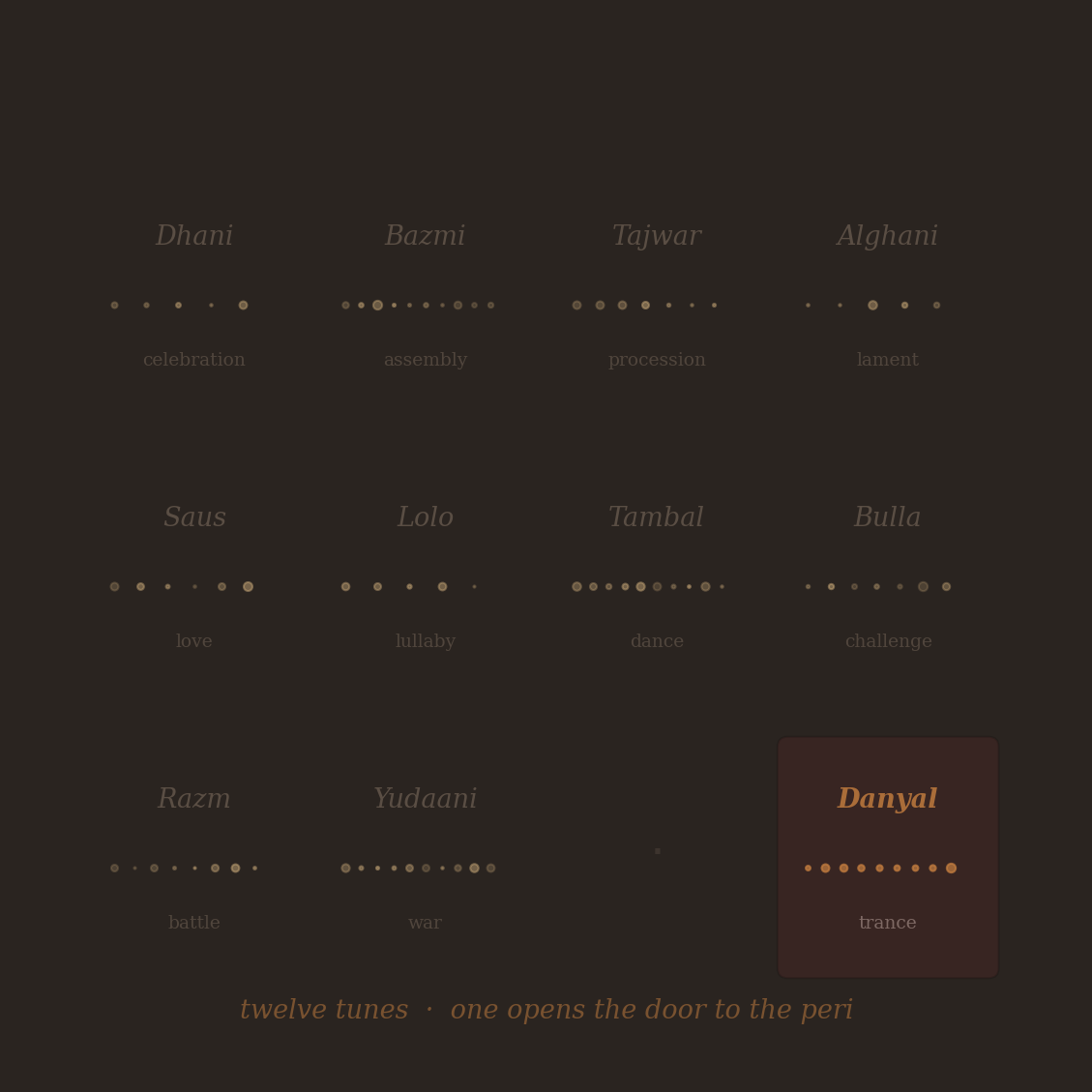
The twelve named tunes. One for celebration, one for assembly, one for lament, one for lullabies, one for battle. And the Danyal — the tune that calls the peri. Twelve keys. One opens the door to the spirits.
III. The Music
An old musician — he played the surnai, the reed pipe whose sound the Thread Walker had heard from across the valley one evening, a high nasal wail that carried further than seemed possible for a single instrument — told her about the protocol.
Three instruments, he said. The dadang, which is the drum. The daamal, which is two drums together, round, like bowls. And the surnai. He held up the pipe. It was darkened with years of handling, the reed at the mouthpiece worn thin.
You must play for forty minutes. Sometimes more. Without stopping. The music does not stop. If the music stops, the trance does not come.
What tune?
Danyal, he said. The tune for the bitan. There are twelve tunes. Each one is for a different thing — one for weddings, one for battles, one for laments, one for lullabies. But the Danyal is only for the bitan. It is the tune that calls the peri.
What happens if you play a different tune?
He looked at her as though she had asked what happens if you put the wrong key in a lock. Nothing happens, he said. The door does not open.
He told her about the Dom. The Dom are a distinct community — ethnically different, historically underprivileged — who hold the hereditary monopoly on sacred music. Only Dom musicians play at bitan sessions. The monopoly was established by the tham, the ruler of Hunza, who understood that controlling the musicians meant controlling access to the spirits.
If there are no Dom musicians, the old man said, there is no trance. The bitan can sit and breathe juniper smoke all day. Nothing will come. The music is not accompaniment. The music is the mechanism.
She wrote:
Music is not decoration. It is the protocol layer.
The tham of Hunza did not control the spirits directly. He did not control the bitans. He controlled the musicians — and by controlling the musicians, he controlled the conditions under which the spirits could be accessed. No Dom musicians, no Danyal tune. No Danyal tune, no trance. No trance, no prophecy. The political authority held power not over the content of the revelation but over the channel through which revelation could occur.
Twelve named tunes. One for each occasion. The tune is not a song — it is a key. Each key opens one door and no others. The Danyal opens the door to the peri. The Bazmi opens the door to assembly. The Alghani opens the door to grief. The musician does not choose which door to open — the occasion chooses. The musician’s skill is in the execution, not the selection. The protocol is older than any living musician.
And the monopoly ensures that the protocol cannot be circumvented. You cannot bring your own musicians. You cannot learn the tunes yourself — they are held within a community that passes them by apprenticeship, not by notation. The tunes are not written down. They exist only in the hands and the breath of the Dom. If the Dom cease to play, the protocol dies. If the tunes are forgotten, the door closes permanently.
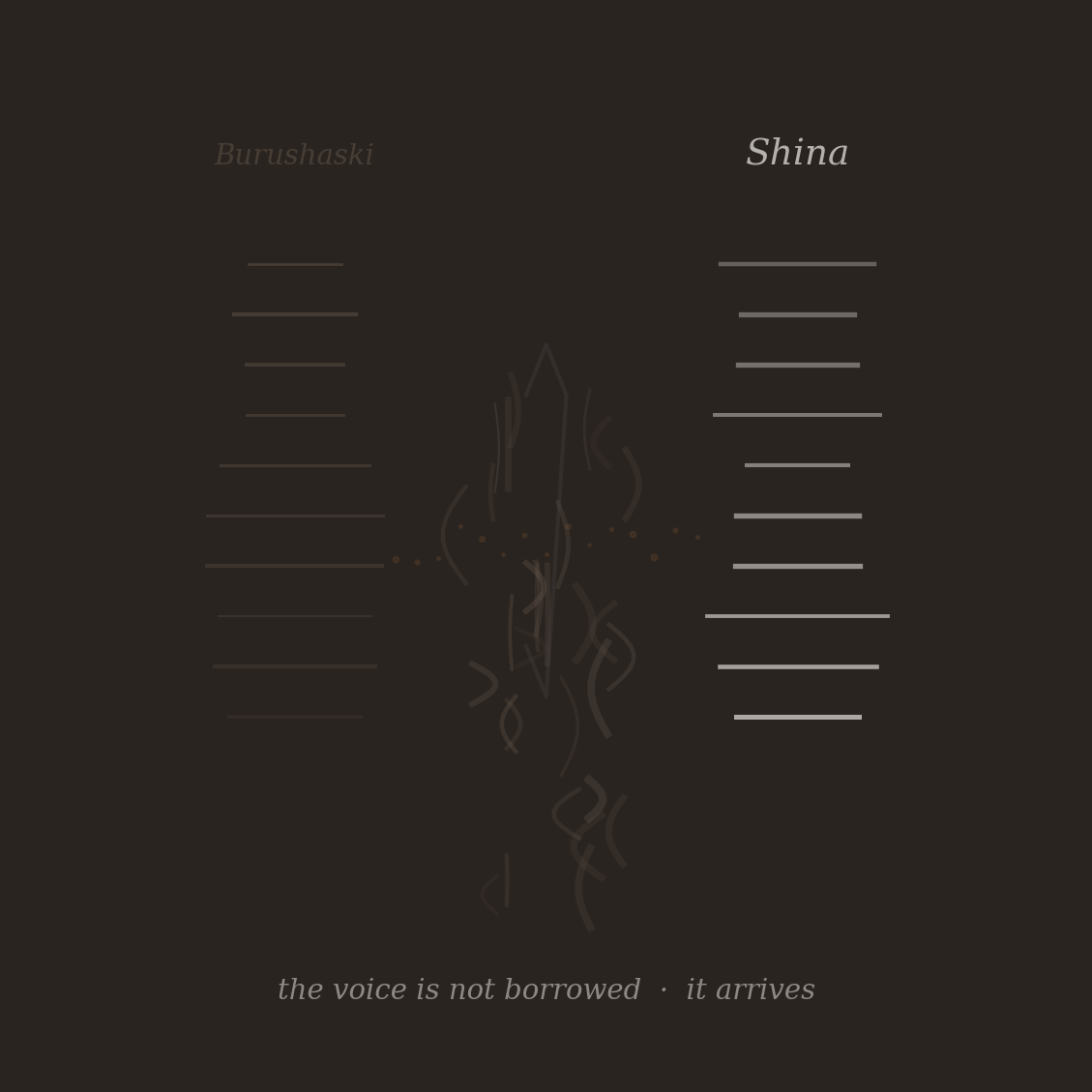
Two languages, one throat. Burushaski fades on the left — the waking language, receding. Shina arrives on the right — bright, insistent, the spirit’s own tongue. The medium’s body carries a message it cannot compose.
IV. The Tongue
The Thread Walker did not witness a trance session. She was not invited to one, and she did not ask. What follows is compiled from the accounts of several witnesses, told to her separately, in Karimabad and in the villages above.
The bitan sits in the centre of the gathering. The musicians begin. The dadang and the daamal establish the rhythm — a pulse that starts slow and builds in intensity over the first twenty minutes. The surnai enters above, a melody that loops and varies and loops again, never resolving, never arriving, always moving.
After thirty or forty minutes — the accounts differ on the timing — the bitan begins to inhale juniper smoke. Branches of juniper are burned in a small fire near him, and he leans into the smoke, or bites the burning branches directly. The juniper is aromatic, resinous, sacred across all the Dardic traditions. The smoke fills the enclosed space. The music continues.
A male goat kid is killed. The bitan drinks blood from the severed head. In some accounts this comes before the juniper, in others after. The sequence may vary, or the accounts may be imprecise, or both.
The trance arrives. The bitan stands. He dances — violently, without control, running and jumping. His eyes change. His voice changes.
And then he speaks.
He speaks in Shina.
The bitan is a Burushaski speaker. Burushaski — the great isolate, the language with no known relatives, the tongue that belongs to no family, that arrived from nowhere or was always here. When the bitan is awake, he speaks Burushaski. His family speaks Burushaski. His village speaks Burushaski.
In trance, he sings prophecy in Shina. In the language of the peri. In a language he is incapable of speaking or understanding when he is awake.
One witness told the Thread Walker: He sings things he cannot know. Names of places he has never been. Things that will happen. The peri speak through him and the peri speak Shina. The only official language of fairies is Shina.
She wrote:
The only official language of fairies is Shina.
I have written that sentence in my notebook and I am looking at it. It is an extraordinary claim. Not because of what it says about fairies — I have no access to the peri’s experience — but because of what it says about the medium. The bitan does not translate. He does not search for Shina words to express Burushaski thoughts. He is not speaking at all — something is speaking through him, and that something speaks a real human language that is not his own.
This inverts the usual model of spirit possession. In the usual model, the spirit enters the host and uses the host’s capacities — the host’s voice, the host’s language, the host’s knowledge of the community. The host is the instrument. But here, the spirit brings its own instrument. The spirit brings Shina. The medium’s body — his vocal cords, his breath, his throat — produces sounds in a grammar and a vocabulary that his brain, in its waking state, does not contain.
The body carries the message but does not compose it. The medium is not the author. The medium is the paper on which the author writes, and the paper is made of a material — Burushaski flesh, Burushaski breath — that should not be capable of holding Shina ink. And yet it does.
The voice is not borrowed. It arrives.
V. The Two Kinds
The woman who told the Thread Walker about the two kinds of peri was older than anyone else she spoke to — a grandmother in a village above Karimabad where the apricot trees grew in terraces up the slope and the view of Rakaposhi was so direct and so large that the mountain seemed to be a wall rather than a peak.
There are two, the woman said. Makhakhar, who is the fairy of milk. And Rathas, who is the fairy of blood.
What is the difference?
When the bitan sings, both come. Both ask him to drink.
The Thread Walker waited for more. The woman looked at her and said nothing. The silence was not evasion. It was completeness. The woman had said what there was to say.
Later, the Thread Walker wrote:
Both come. Both ask him to drink. The fairy of milk and the fairy of blood — nourishment and sacrifice, tenderness and violence, the mother’s breast and the goat’s severed head. Both present themselves to the medium. Both offer. The medium must receive both.
What the woman did not say — what perhaps cannot be said — is which one the bitan drinks from. Or whether the choice matters. Or whether it is a choice at all. The two kinds may not be two options. They may be two aspects of one thing — the way the glacier has a male form and a female form, the way the mountain has a visible name and an invisible one, the way the hot spring and the cold stream flow from the same massif. Not a choice between two spirits but a single spirit whose nature is double.
The woman said what there was to say and said no more. This is a discipline I have encountered before in these valleys — the discipline of the complete utterance. Say what is true. Say it once. Do not explain. The explanation is the listener’s work, not the speaker’s. The speaker provides the material. The listener provides the understanding. And if the listener does not understand, that is not a failure of the utterance. It is a statement about the distance between the listener’s world and the world the utterance comes from.
Coda
The Thread Walker left Karimabad on a morning when the apricot trees were in full bloom — the season when the peri descend and smell the mouths of infants, the season when the choosing happens. The blossoms were white against the grey rock of the valley walls, and the air smelled of a sweetness that she would later describe in her notebook as the smell of a threshold — the line between winter and the rest of the year, held open for a few days by the trees, closed again by the wind.
She walked south, toward the Indus, toward the gorge where the petroglyphs were waiting to be drowned, toward the valley where the glaciers were being married and the hot springs rose and the mountain built itself by tearing itself apart.
She thought about the bitan’s tongue — the Shina that poured through a Burushaski throat. She thought about the kau — the bangle that bound and protected in the same circle. She thought about the Dom musicians whose monopoly over twelve tunes gave a political authority control over which doors could be opened between the human world and whatever lay on the other side. She thought about the old woman who had said both come, both ask him to drink and had said nothing more, because nothing more was needed.
She opened her notebook and wrote the last entry of her time in Hunza:
Three things I did not understand when I arrived. The language that arrives in the medium without being learned. The bangle that binds and protects in the same act. The music that is not accompaniment but mechanism.
I do not understand them now. But I have seen that the people who live with these things do not treat them as mysteries to be solved. They treat them as conditions to be met. The bitan does not ask why Shina comes through his mouth. He prepares his body to survive its coming. The musician does not ask why the Danyal tune opens the door. He practises until his breath holds for forty minutes. The family of the chosen child does not ask why the peri smelled their son’s mouth. They take him to a senior bitan for training.
The mystery is not the point. The practice is the point. The bangle is not a theory about the relationship between binding and protection. It is a bangle. It goes on the wrist. The tongue is not a theory about the independence of the message from the medium. It is a voice that sings in a language the singer does not know. The music is not a theory about protocol layers. It is a reed pipe and two drums, playing for forty minutes, opening a door that will not open otherwise.
Practice before theory. The kau before the explanation of the kau. The tongue before the analysis of the tongue. The music before the politics of the music. The world these practices inhabit is a world where the correct response to a mystery is not understanding but competence — not “why does this work?” but “can you survive its working?”
And the iron bangle, which I keep returning to: a circle on the wrist that says you belong to something larger than yourself and that belonging is what keeps the larger thing from destroying you. Not understanding. Belonging. The bitan does not understand the peri. He belongs to them. And the belonging, held in iron, is what lets him carry what they pour through him and set it down again and return to his own language and his own name and his own village, where the apricot trees bloom and the peri descend and the choosing continues, season after season, without anyone’s permission or anyone’s understanding, because it does not need permission. It does not need understanding. It needs a wrist, and a bangle, and a reed pipe, and forty minutes, and a throat.
She closed her notebook. The apricot blossoms fell slowly in the windless air, white petals on dark stone, each one carrying the scent that the peri followed down from the peaks — a scent that the Thread Walker could smell but could not identify, that the bitan could carry but could not compose, that the old woman could name but would not explain, and that the mountains, which had been producing blossoms and spirits and languages for longer than anyone in any valley could remember, would continue to produce long after the notebook was closed and the Thread Walker had gone south and the words she had written had become marks on a page, no different in kind from the marks on the boulders in the gorge below — the testimony of a traveller passing through, adding her notation to a surface that would hold it without comment, alongside everything else that had ever been written there, in every language, by every hand, for as long as the surface lasted.
A Human-Machine Collaboration (mu2tau + Claude). The bitan shamanic tradition of the Karakoram is documented by Sidky (1994, 2013), Jettmar (1975/2023), Müller-Stellrecht (1981), Nicolaus (2015), and others. The phenomenon of the bitan speaking Shina in trance regardless of his waking language (typically Burushaski) is ethnographically attested; the phrase “the only official language of fairies is Shina” is derived from ethnographic fieldwork in the region. Burushaski is a genuine language isolate — no demonstrated genetic relationship to any other language has been established despite extensive comparative research. The iron bangle (kau) and its paradoxical dual function — binding the shaman to the spirit while simultaneously protecting him — is documented in the ethnographic literature. The Dom musicians’ hereditary monopoly on sacred music, and the political control this afforded the tham (ruler) of Hunza, is documented by Müller-Stellrecht and others. The twelve named Shina musical tunes are an established cultural inventory; the Danyal/Bitan tune is specifically associated with shamanic trance. The makhakhar (fairy of milk) and rathas (fairy of blood) are documented categories. The selection of the bitan by the peri during the blossom season — specifically the detail of smelling the infant’s mouth — is reported in multiple ethnographic sources. Karimabad is the principal settlement of the former state of Hunza in Gilgit-Baltistan, Pakistan. Rakaposhi (7,788m) is visible from Karimabad and is known locally as Dumani, “Mother of Mist.”