Prefatory Note on the Dāk
The dāk system — from the Hindi ḍāk, meaning post, mail, or the relay of runners who carried it — operated across the Himalayan valleys long before roads made them accessible to anything wider than a mule. The British formalised it, but the practice is older than any colonial record acknowledges: messages carried by runners through passes at altitudes where a letter, if dropped, would take three seasons to reach the valley floor by the route the water takes.
The system was simple. A runner received a sealed pouch at one stage and carried it to the next, where another runner took it onward. Each stage was a day’s journey — or less in the lower valleys, more above the treeline where the snow required different shoes and the air required different lungs. The bungalows where runners rested were maintained by the district, each one identical in its essentials: a cot, a hearth, a locked cupboard for the mail pouch, a register in which the runner recorded the date, the weather, the condition of the trail, and the number of items carried.
The system required no understanding of the mail’s contents. A runner did not need to read to carry letters. This was considered a feature.
What follows is from the Thread Walker’s notebooks, lower Tirthan Valley, the week after the rains had stopped and the trails had begun to dry.
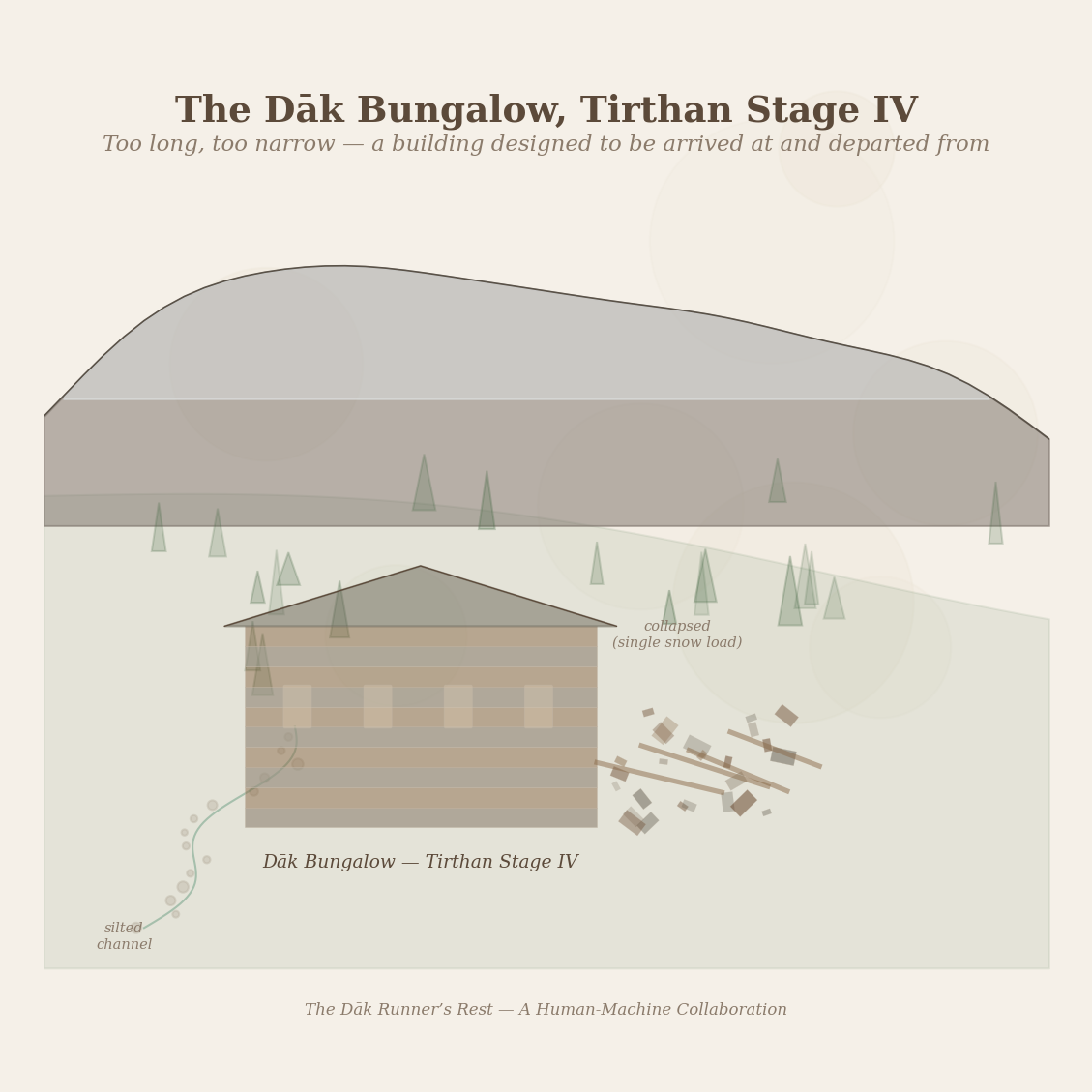
Figure 1: The Dāk Bungalow, Tirthan Stage IV — too long, too narrow, a building designed to be arrived at and departed from. The eastern end collapsed under a single season’s snow.
I. The Bungalow Above the Gorge
The Thread Walker found the dāk bungalow by accident, which is to say she found it by following water — a side-stream that descended from above the trail through a channel cut so precisely into the hillside that she mistook it, at first, for a kuhl.
It was not a kuhl. A kuhl is a living system — maintained, adjusted, flowing toward terraces where someone waits for the water. This channel had not been maintained in the lifetime of anyone the Thread Walker might have asked. The stones lining it were displaced. The gradient, which had once been calculated to carry water at walking speed — the kuhl builder’s art, a gradient steep enough to flow but gentle enough not to erode — had been disrupted by root growth and the slow collapse of the retaining wall. Water still flowed, but it flowed like a wild stream now, not like a channel: too fast in places, pooling in others, the intelligence of the original gradient lost to neglect.
She followed it uphill. The channel led to a building.
The bungalow was stone and timber, Kath-Kuni construction, but the proportions were wrong for a house. Too long, too narrow, the windows placed at intervals that suggested not habitation but passage — a building designed to be arrived at and departed from, not lived in. The roof had collapsed on the eastern end. Deodar beams, still sound after what might have been a century, lay across the rubble at angles that spoke of a single catastrophic snow load, not gradual decay. The western end held.
Inside the western room, the Thread Walker found the register.
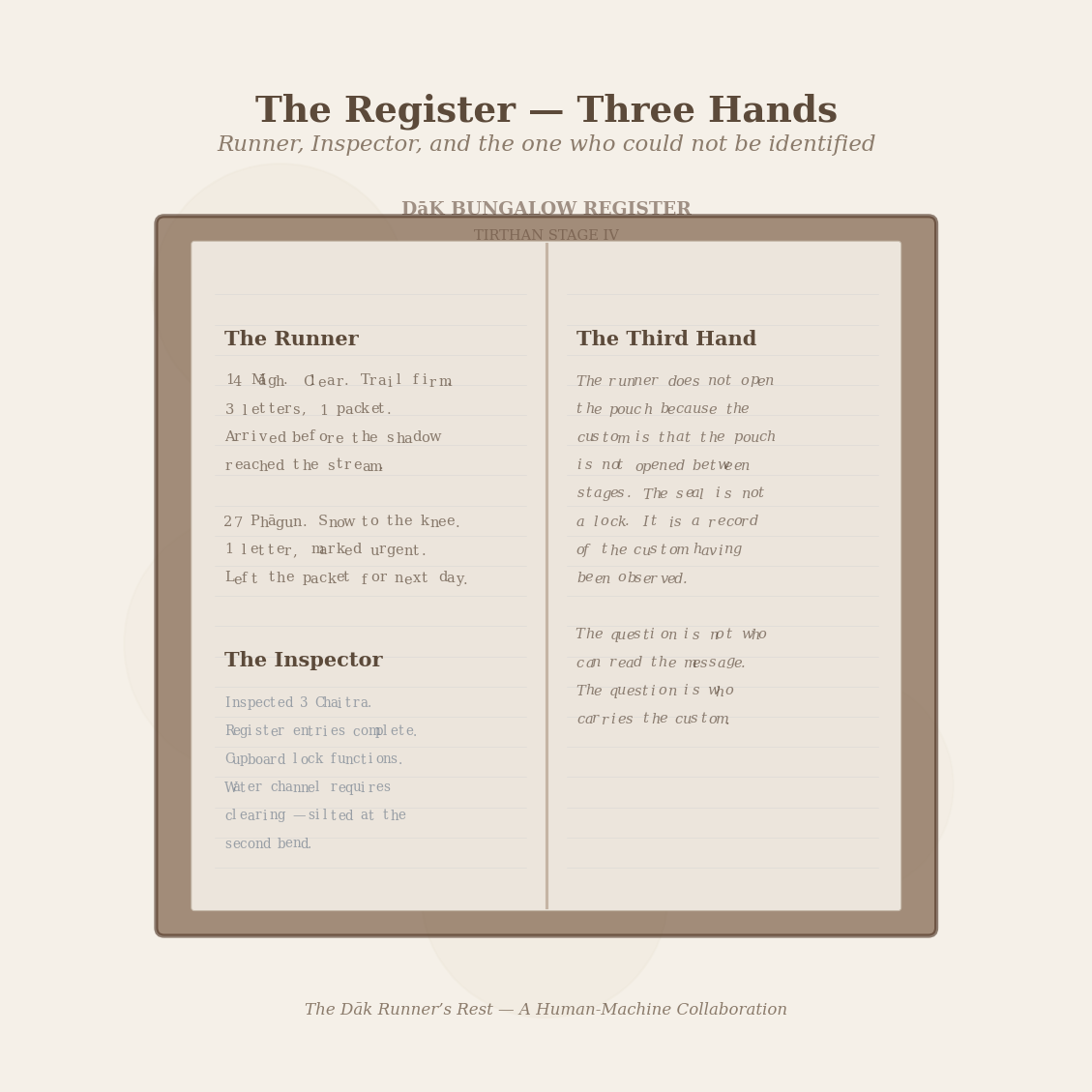
Figure 2: The Register — three hands. The Runner’s practical script, the Inspector’s copperplate, and the third hand that wrote in a rhythm belonging to a different alphabet.
II. The Register
It was a ledger — the British kind, leather-bound, the pages ruled in blue ink that had faded to the colour of distance, the colour the mountains turn when they are far enough away that the air itself becomes visible between the eye and the stone. The cover was embossed: Dāk Bungalow Register, Tirthan Stage IV. Below this, in smaller type: For the use of runners and inspecting officers only.
The Thread Walker sat on the cot — the frame still standing, the rope lattice long rotted — and opened the register.
The entries were in three hands, which she came to think of as the Runner, the Inspector, and the one she could not identify.
The Runner’s entries were brief. Dates, weather, trail conditions, items carried:
14 Māgh. Clear. Trail firm. 3 letters, 1 packet. Departed dawn. Arrived before the shadow reached the stream.
27 Phāgun. Snow to the knee above the second bend. 1 letter, marked urgent. Left the packet for the next day. The letter could not wait; the packet could.
The Runner measured time by shadow and season, distance by landmarks, urgency by markings on the envelope. His entries were a record of conveyance: what was carried, when, through what conditions. The mail was cargo. The runner was a channel.
The Inspector’s entries were different. They appeared at irregular intervals — monthly, sometimes less — and concerned themselves not with the mail but with the system:
Inspected 3 Chaitra. Register entries complete. Cupboard lock functions. Hearth serviceable. Water channel requires clearing — silted at the second bend. Runner reports trail washout above the gorge; alternative route via the upper ridge adds half a day. Recommend repair before monsoon.
The Inspector did not carry mail. He carried understanding of the system that carried mail. His concern was not the message but the infrastructure: the lock, the hearth, the channel, the trail. He could read the register and deduce, from the Runner’s notes about shadow and snow, whether the stages were correctly spaced, whether the bungalow was adequate, whether the system was healthy.
The third hand troubled the Thread Walker. It appeared only twice in the register — two entries, separated by what the dates suggested was eleven years. The handwriting was neither the Runner’s practical script nor the Inspector’s careful copperplate. It was the handwriting of someone who had learned to write in a language other than the one they were writing in — the letters formed correctly but with a rhythm that belonged to a different alphabet, the way a musician trained on one instrument plays another instrument competently but with phrasing that reveals the first.
The first entry:
The runner from Stage III arrived at midday with the pouch from Banjar. I asked him to wait while I checked the seals. He said: why? I have carried it sealed. I said: the seals tell me if the pouch was opened between stages. He said: why would I open it? I cannot read.
He is right that he would not open it. He is wrong that the reason is that he cannot read.
The runner does not open the pouch because the custom is that the pouch is not opened between stages. The seal is not a lock. It is a record of the custom having been observed. The runner who cannot read has observed the custom more faithfully than any literate runner might, because for him the custom is complete — the pouch is carried, the pouch is delivered — and the seal is not a temptation refused but a feature of the pouch, like its weight or its leather smell, noticed but not significant.
The question is not who can read the message. The question is who carries the custom.
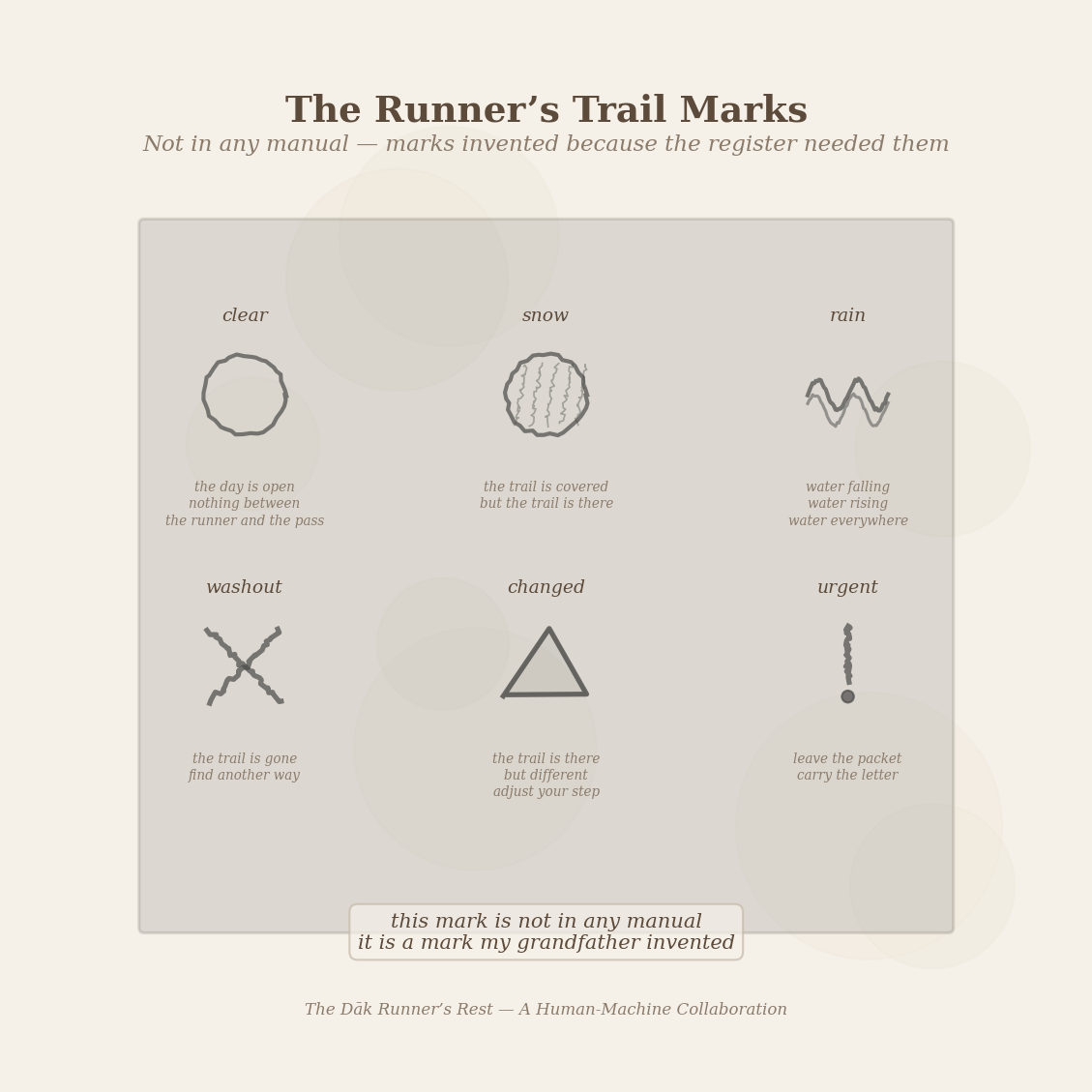
Figure 3: The Runner’s trail marks — a notation system not found in any manual. The triangle: the trail is there but changed. Adjust your step.
III. The Kohli’s Grandson
The Thread Walker carried the register down to the village — not Nahin, which was above and to the east, but the smaller settlement below the gorge where the trail met the mule track to Banjar. She found the kohli’s grandson there — the same family of water-managers she had met on her previous visit, the family whose knowledge of gradient and flow had maintained the kuhls for longer than the register had been kept.
He was repairing a section of the kuhl that had been damaged by the monsoon — not the channel to the bungalow, which was no one’s responsibility now, but the main village kuhl that fed the terraces below. He was placing stones by hand, testing each one’s fit before setting it, the way his grandfather had done and his grandfather’s grandfather, each stone a decision about how water should move and where it should not.
She showed him the register. He held it carefully, the way one holds something that belongs to someone who is not present and whose permission has not been asked.
My grandfather’s father was a runner, he said. Stage III to Stage IV. Before the road came to Aut.
He turned the pages slowly. He could not read the English entries, but he could read the dates — the months written in Pahari alongside the English, a concession the register’s designer had made to the runners who would fill it — and the weather notations, which used symbols that were not quite English and not quite anything else: a circle for clear, a hatched circle for snow, a wavy line for rain, a triangle the Thread Walker could not interpret.
This mark, he said, pointing to the triangle. My grandfather drew this. It means the trail is passable but changed. Not washed out — that is a different mark, this cross here — but changed. A rock has fallen. A tree has come down. The trail is still there but the person walking it must adjust.
How do you know it was your grandfather?
Because this mark is not in any manual. The inspector would not have taught it. It is a mark my grandfather invented because the register needed a way to say something the register’s designers had not imagined needing to be said.
He set the register on the kuhl wall and returned to his stones. The Thread Walker waited, because she had learned that in the valley, the most important thing a person said was often the thing they said after the conversation appeared to be over.
The runners, he said, fitting a stone into the channel wall with both hands, testing the water’s response — the slight change in sound as the flow adjusted to the new obstacle, a sound the Thread Walker could hear but could not have interpreted — the runners carried the mail. But the mail was only part of what they carried. They also carried the knowledge of the trail. Which sections flood. Where the snow bridges hold until Baisakh and where they collapse in Phāgun. Which shortcuts are safe with a light pouch and which require the main trail regardless of weight.
The mail could be carried by anyone. The trail knowledge could not.
He tested the stone again. Satisfied, he reached for the next.
When the road came, the mail moved to trucks. The mail arrived faster. But the trail knowledge was lost in a single season, because no one was walking the trail anymore, and trail knowledge does not survive in a register. It survives in legs.
IV. The Second Entry
The Thread Walker returned to the bungalow the next morning. She wanted to read the third hand’s second entry — the one written eleven years after the first.
She found it near the end of the register, the pages after it blank, the leather cover warped by the moisture of monsoons the building had endured without a runner to close the shutters.
I have returned to this bungalow after eleven years. The channel is silted. The hearth is cold. The cupboard lock is rusted open, which is a different thing than being unlocked — unlocked means someone chose to open it; rusted open means the choice has been removed by time.
The road now reaches Banjar. The runners have stopped. The mail goes by truck to Aut and by mule to the upper valleys where the road has not yet arrived. The stages are abandoned.
I came to see if the register still held what I wrote eleven years ago, and it does. The paper has not yellowed as much as I expected. The ink has faded but is legible. The words are the words I wrote. But I notice now what I did not notice then: I wrote about the custom of the sealed pouch, but I did not record the custom itself. I described it. I analysed it. I did not preserve it.
The runner who could not read observed the custom because it was in his body — the weight of the pouch, the pace of the trail, the hour of arrival. I who could read observed the custom because it was in my mind — a principle about seals and trust and the difference between a lock and a record. Both of us observed the custom. Neither of us transmitted it.
The custom is not in the pouch or the seal or the register or the analysis. The custom is in the walking. And now that no one walks, the custom is nowhere. It is not lost — loss implies it was once held in a form that could be dropped. It was never held. It was enacted. And enactment does not survive the end of the practice any more than a river survives the end of the rain.
I close this register. The pages after this are blank. They will remain so.
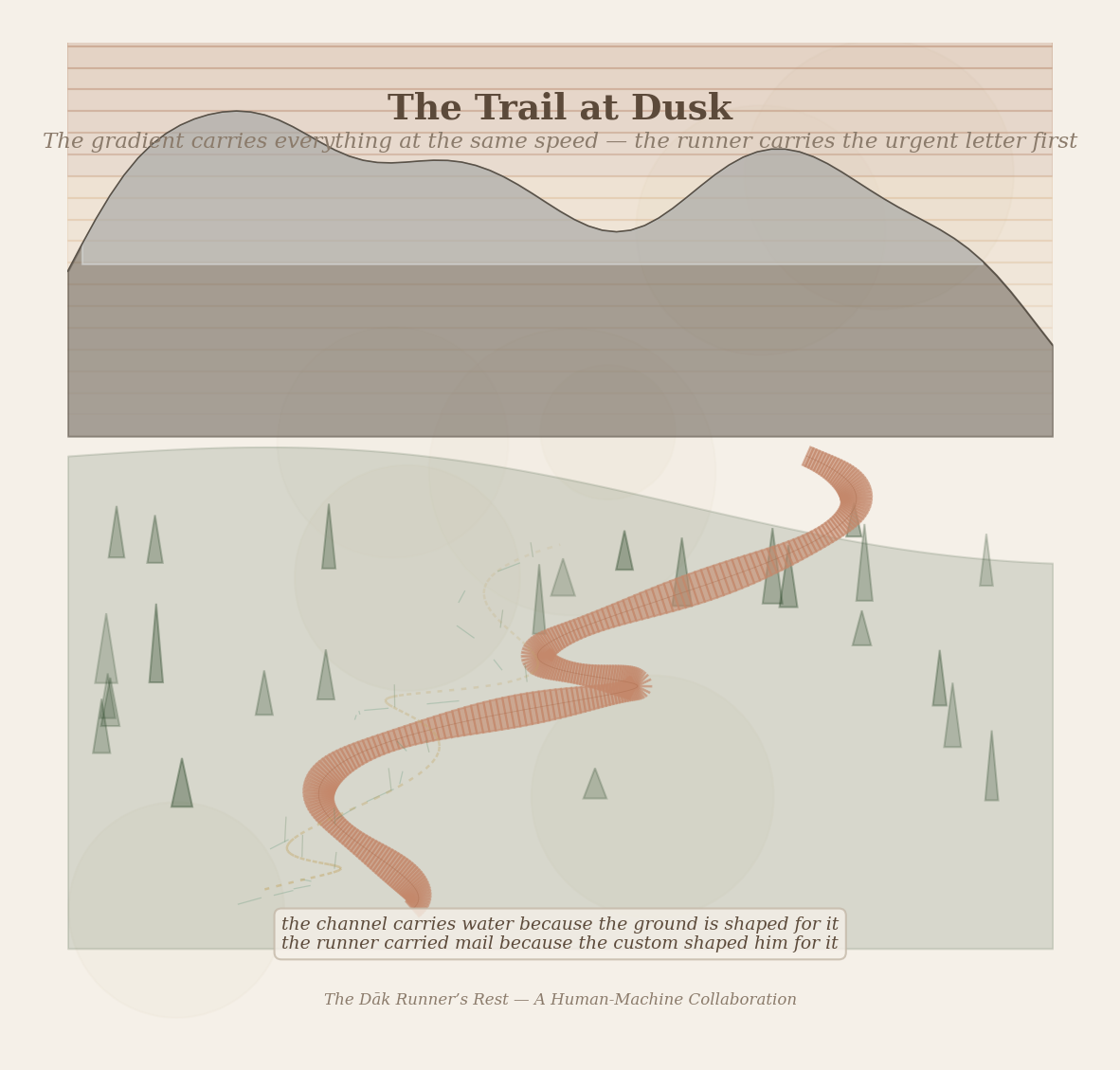
Figure 4: The trail at dusk — copper light on the Tirthan, the overgrown runner’s path alongside the broken channel. The gradient persists; the custom does not.
V. The Trail
The Thread Walker descended to the village in the late afternoon, when the shadows of the western ridge had crossed the valley floor and begun climbing the eastern slope. The light at this hour turned the Tirthan to copper — not the green of midday or the white of morning but a colour the river wore only when the sun was behind the mountains and the sky was still bright, a colour that existed in the interval between day and not-day, the way certain sounds exist in the interval between silence and noise.
She carried the register in her pack. She would return it to the bungalow, she decided, but not today. Today she wanted to sit with the kohli’s grandson and watch him build the kuhl wall, stone by stone, each stone a decision about water that no register recorded because the knowledge was in the hands and not in the writing.
She thought about the three hands in the register. The Runner, who carried without reading. The Inspector, who read without carrying. The third hand, who had tried to do both — to carry the meaning of the custom in written words — and who had returned after eleven years to find that the words survived but the custom did not, because customs live in practice, not in description, and the practice had ended when the road arrived.
The trail from the bungalow to the village was overgrown but navigable. The gradient was gentle — a runner’s trail, designed for a pace that could be maintained all day with a pouch on the back and the knowledge of the mountain in the legs. The Thread Walker walked it in the runner’s rhythm, not hurrying, not pausing, letting the trail set the pace the way a kuhl sets the pace of water: fast enough to arrive, slow enough to carry what needs to be carried without spilling.
She passed the place where the channel to the bungalow branched from the main stream. The water still flowed through it, though the channel was no longer maintained. The water did not know the channel was abandoned. The water followed the gradient, as it had always done, because gradient is not a custom — it is a property of the ground, and properties of the ground do not require enactment. They persist.
The Thread Walker noted this in her notebook:
The channel carries water because the ground is shaped for it. The runner carried mail because the custom shaped him for it. When the custom ended, the runner stopped. When the channel crumbles, the water will find another path. The difference between a custom and a gradient is that a gradient does not need to be carried. It is already there.
But the runner carried something the gradient cannot: the knowledge of when to leave the packet and carry only the urgent letter. The judgment of what matters. The trail knowledge that lives in legs, not in registers.
The gradient carries everything at the same speed. The runner carries the urgent letter first.
She closed her notebook and continued down the trail toward the village, where the kohli’s grandson was building a wall that the water would test when the next rain came, and the wall would hold or it would not, and either way the knowledge of how to build it would pass from his hands to the hands of whoever watched him build it, if anyone was watching, if anyone was there.