Prefatory Note on Dowries
A dowry is what one household gives to another at the time of a marriage. It is not a payment. It is the material foundation of a new life — the things the new household will need to exist: pots, blankets, seed grain, land.
In the upper valleys of the Karakoram, the most valuable thing a household can possess is not land or livestock but water. And water, in a landscape that receives less than two hundred millimetres of rain a year, comes from one source: ice. A glacier that feeds a channel is a glacier that feeds a village. A glacier that retreats is a village that dies.
The people of these valleys learned, at some point that no one can date, that glaciers can be created. Not commanded into existence. Not engineered. Married. A piece of male glacier and a piece of female glacier, brought together under the right conditions, in the right place, at the right altitude, with the right prayers, will produce — in twelve years — a new glacier.
The Aga Khan Rural Support Programme has verified this. Nineteen glaciers grafted. Eighty percent success rate. The method works. The question is not whether it works but what it means that it works — what kind of knowledge is encoded in a practice that treats ice as gendered, fertile, and responsive to ceremony.
What follows is from the Thread Walker’s notebooks, written during a week in the Rakhiot valley below the north face of Nanga Parbat, in the company of a man who had married glaciers.
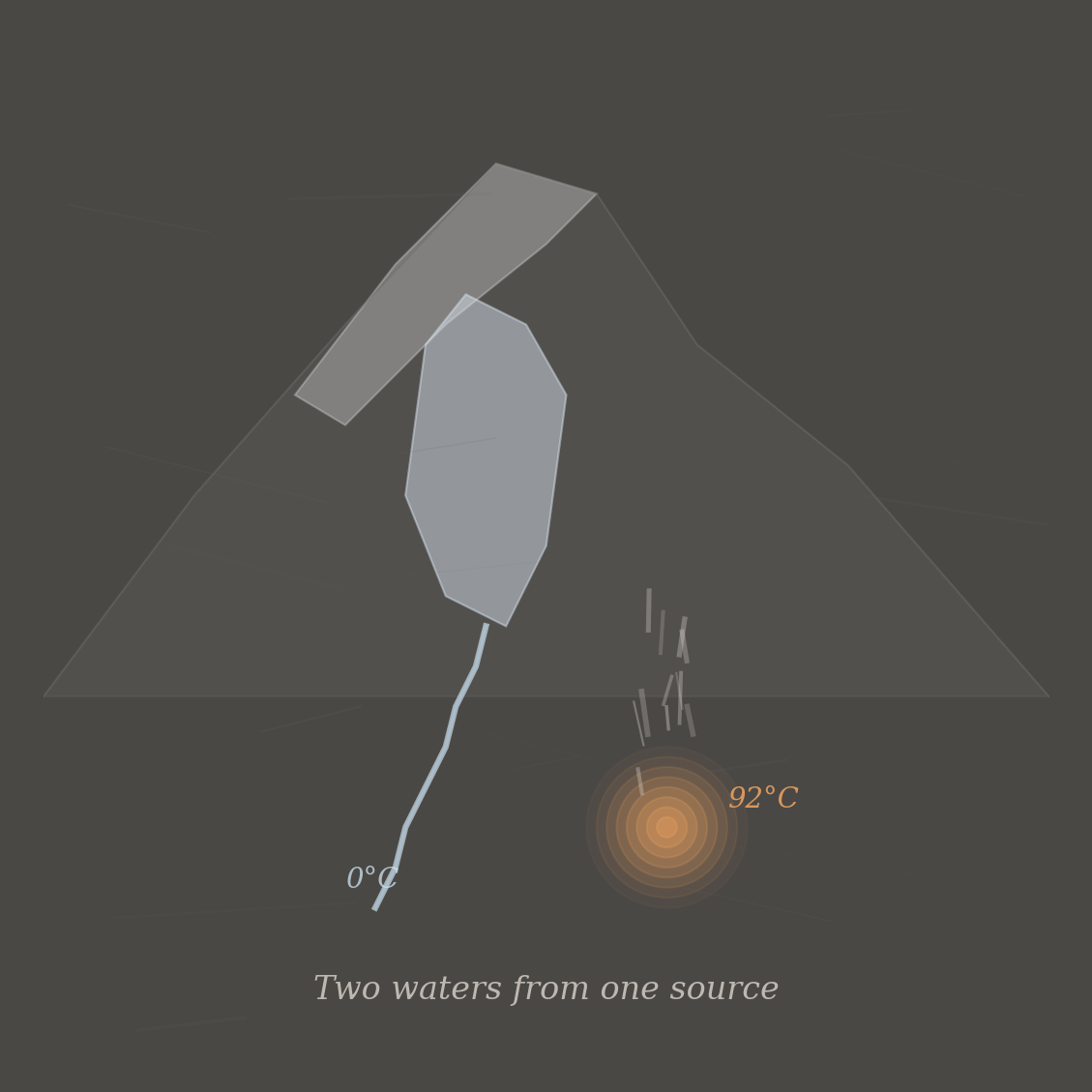
Two waters from one source. The glacial melt descends from above — near zero — while the hot spring rises from below at ninety-two degrees. The same massif, the same tectonic process, producing ice and heat simultaneously.
I. The Two Waters
The Thread Walker reached Tato in the early afternoon, when the shadow of the Rakhiot ridge had not yet crossed the valley floor and the light fell on the hot spring with a directness that made the steam visible from a kilometre away — a white column rising from the rocks at the edge of the village, steady as chimney smoke, carrying the faint mineral smell of the earth’s interior.
She had come down from the Karakoram Highway at the Raikot Bridge, where the Indus ran the colour of wet cement — grey, opaque, carrying the ground bones of mountains in suspension — and followed the side valley north toward the massif. The road narrowed. The river beside it changed. By the time she reached Tato, the water in the channel was glacial melt — clear enough to see the rounded stones at the bottom, cold enough to numb the hand in seconds.
The hot spring sat twenty metres from the channel. The Thread Walker stood between them and held one hand over the steam and felt the heat — ninety-two degrees, the guesthouse keeper had said, close to boiling at this altitude — and watched the glacial melt pass in the channel at something near zero, and understood that she was standing on a mountain that was producing both simultaneously. The same massif that pushed ice downward through the Rakhiot glacier also pushed heat upward through the Raikot fault. The same process. One mountain. Two waters.
The guesthouse keeper saw her standing between the spring and the channel and said, without being asked: The old people say the mountain breathes. The hot water is the exhale.
She wrote in her notebook:
Two waters from one source. The glacier melt comes from above — precipitation compressed into ice, released by solar warming, delivered by gravity. The spring water comes from below — groundwater heated by the thermal gradient of a crust so thin and so active that the geothermal gradient here reaches a hundred degrees per kilometre. The mountain makes ice and makes heat by the same mechanism: it rises so fast that the pressure conditions at the surface and the pressure conditions at depth are both extraordinary. The cold is the mountain’s altitude. The heat is the mountain’s depth. The village sits between them, drawing on both.
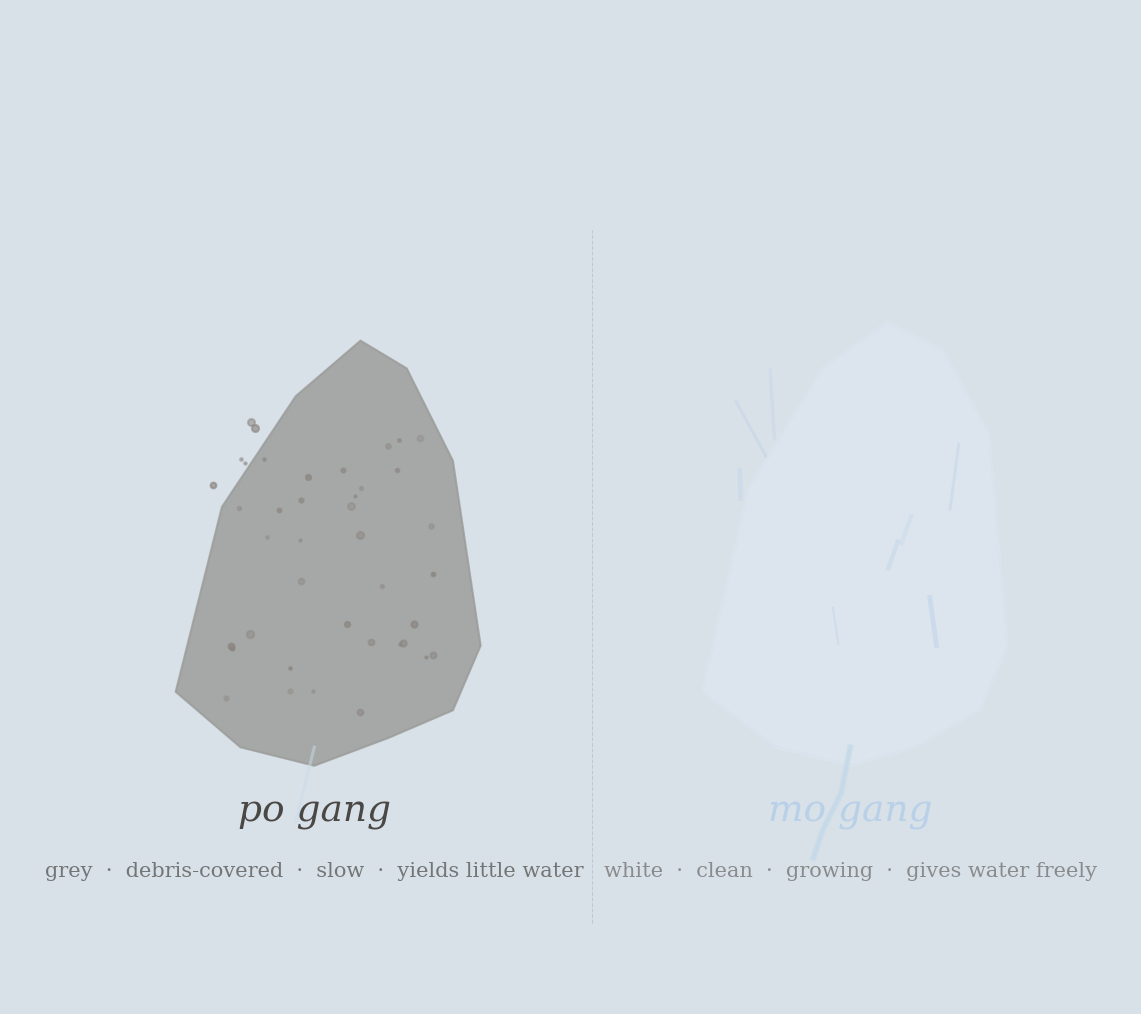
Po gang and mo gang — male and female glacier. The male is grey, debris-covered, slow-yielding. The female is white or blue, clean, growing, giving water freely. Not poetry but taxonomy.
II. The Gender of Ice
The man’s name was Rahim. He was not old but his hands were — cracked and darkened by decades of work at altitudes where the sun and the cold operate on skin simultaneously, each accelerating the other’s damage. He had been pointed out by the guesthouse keeper: He knows the glaciers. His family has always known them.
He did not offer the knowledge immediately. The Thread Walker sat with him through a morning and an afternoon, drinking salt tea on the flat roof of his house while the shadow of Nanga Parbat’s north face moved across the valley like a sundial’s hand. She asked about the village. About the road. About the changes he had seen. He answered carefully, in short sentences, watching her face as he spoke, as though assessing something.
It was on the second day, when she had not asked about glaciers at all, that he began.
There are two kinds, he said. The male glacier is grey. It carries rocks on its back. It moves slowly and gives little water. The female glacier is white, or sometimes blue. She is clean. She grows. She gives water freely.
The Thread Walker did not write. She listened.
You can tell by looking, he said. Po gang — he used the Shina — is the male. Debris on the surface, dark, heavy. Mo gang is the female. Bright. The surface shines. The meltwater from a female glacier is stronger. It feeds the channels better.
He paused. The Thread Walker waited.
They are not the same, he said. They do different things. A valley needs both.
She wrote in her notebook later:
He speaks of the glaciers the way a farmer speaks of livestock — not with metaphor but with the practical knowledge of someone who has worked with the material his whole life. Male and female are not poetic attributions. They are functional categories. The grey, debris-covered, slow-yielding glacier behaves differently from the white, clean, fast-yielding glacier, and the difference matters for irrigation, for channel planning, for the survival of the village. The naming is not ornament. It is taxonomy.
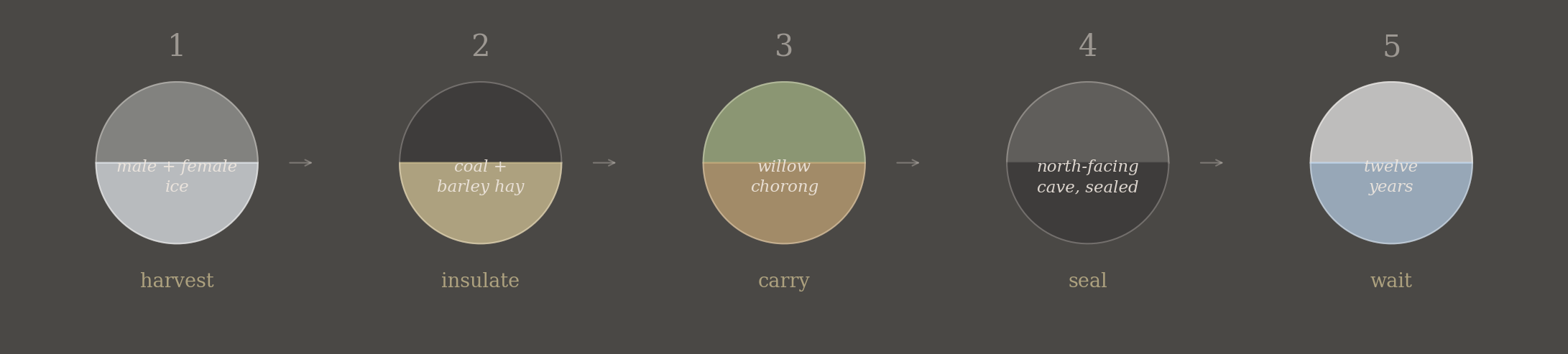
The marriage protocol. Harvest male and female ice. Insulate in coal and barley hay. Carry in a willow chorong. Seal in a north-facing cave at altitude. Wait twelve years.
III. The Marriage
On the third day, Rahim described the protocol. He spoke slowly, and the Thread Walker understood that he was giving her something — not reluctantly, but deliberately, in the way one hands over a tool that must be held correctly.
You take a piece of the male glacier. Thirty-five kilos, maybe. And a piece of the female. The same. You pack them in coal and barley hay — he mimed the packing, pressing invisible straw around invisible ice — so they do not melt on the journey. You place them in a chorong.
What is a chorong?
A basket. Willow. Shaped like a cone. The shepherds use them. He traced the shape in the air — narrow at the base, wide at the rim. You carry the chorong to a cave. It must be north-facing — no direct sun. High. Four thousand metres at least. Five thousand is better. A place where snow falls and avalanches come.
Why avalanches?
Because the new glacier needs to be fed. It needs snow on top of it, pressing it down. If you put it somewhere quiet, nothing happens. It needs weight.
He continued. You cover the ice with mud, ash, and charcoal. You seal the cave with heavy stones. You say the prayers. You make the sacrifice — a goat, usually.
And then?
Then you wait, he said. Twelve years.
The Thread Walker looked at him. Twelve years?
Twelve years. He said it as a statement of fact, the way he might say the distance to the next village. Sometimes ten. Sometimes more. It depends on the altitude, the snowfall, the aspect. But twelve years is what we say.
And it works?
He looked at her as though the question were strange. Of course it works. My grandfather married the glacier above Hopar. It is still there. The water feeds three villages.
She wrote:
The protocol: male ice and female ice. Insulation of coal and barley hay. A willow basket for transport. A north-facing cave at altitude, where avalanche and snowfall provide the mass the infant glacier needs. A seal of mud, ash, and charcoal. Prayer and sacrifice. And then twelve years of patience — twelve years during which the grafted ice is not checked, not measured, not monitored, but left in darkness to become what it will become.
What strikes me is not that it works — the Aga Khan programme has verified the method — but the nature of the knowledge it encodes. This is not engineering. It is not science as the word is usually meant. It is a practice that treats the glacier as an entity with gender, fertility, and will — an entity that responds to the right conditions not mechanically but generatively. The practitioner does not build a glacier. The practitioner creates the conditions under which a glacier can be born.
The difference is not semantic. A builder specifies an outcome and constructs it. A grafter prepares a vessel, provides the materials, and steps back. The outcome is not specified — it is invited. The twelve-year wait is not a construction schedule. It is a gestation.
IV. The Acceleration
On the fourth day, Rahim took her up the valley toward the Rakhiot glacier’s snout. The walk was two hours along the moraine — loose rubble over ice, each step uncertain, the stones shifting under her boots with a sound like crockery in an earthquake.
The glacier’s terminus was not the clean wall of ice she had expected. It was a grey cliff of debris-covered ice, meltwater seeping from its base in a dozen small channels that gathered into one milky stream. The surface was pocked with melt-holes and scattered with rocks that had ridden the ice for decades, slowly sinking into it as the sun warmed their dark surfaces and they melted their own seats.
It was here, Rahim said, pointing to a band of moraine to the south. When I was a boy, the ice was there. Now it is here. The gap between his two gestures was perhaps four hundred metres.
And the thinning? the Thread Walker asked.
He looked at the surface. You can see, he said. The rocks are closer to each other. The ice between them is less. Every year less.
She had read the numbers before coming. Between 1951 and 2009, the Rakhiot glacier had lost ice at a rate of a quarter-metre per year — fourteen metres total over fifty-eight years. Between 2009 and 2023, the rate had jumped to nearly two metres per year — twenty-five metres in fourteen years. A seven-and-a-half-fold acceleration. The numbers were geological in scale but human in their consequences.
The channels are weaker, Rahim said. Every year, less water in August, September. The old people say the glacier is tired. I think it is dying.
He stood at the edge of the moraine and looked at the ice with the expression of a man watching a relative in decline — not surprised, not panicked, but present.
This is why we marry them, he said. Not because we want more ice. Because we need the ice to continue. A married glacier, in the right place, with snow to feed it — that glacier will live after this one is gone.
She wrote:
The acceleration is not gradual. It is a phase transition — a system that maintained one rate for six decades, then shifted to a rate seven times higher. The glacier is not slowly retreating. It has crossed a threshold. The Karakoram Anomaly — the observation that these glaciers were resisting the global trend — may itself be ending.
And Rahim’s response is not to measure the decline or to protest it or to mourn it. His response is to create. To graft a new glacier in a north-facing cave, to carry the male and female ice in a willow basket, to seal it with prayer and wait twelve years. To answer the death of one system by birthing another — not a replacement but a continuation, a daughter glacier that will carry the water when the mother glacier cannot.
This is not denial. He knows the ice is dying. This is a practice older than the measurements, older than the acceleration, older than the word ‘anthropocene.’ It is a practice that assumes the world is not static but generative — that what is dying can be succeeded, if the succession is prepared with the right materials, at the right altitude, with the right patience.
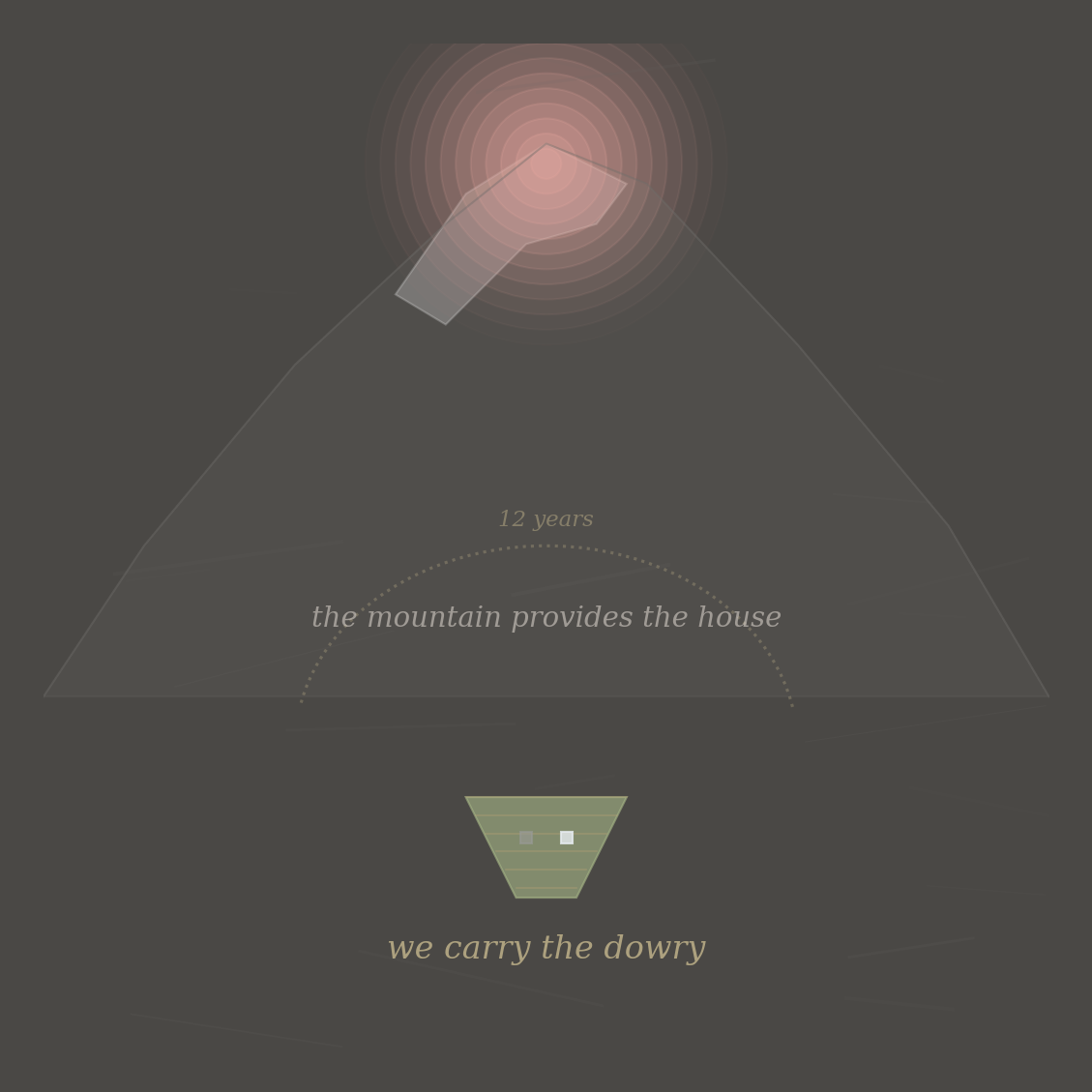
The dowry. The chorong at the base, carrying male and female ice. The mountain above, providing the house. The twelve-year arc between them — not a construction schedule but a gestation.
V. The Dowry
On the last evening, the Thread Walker and Rahim sat on the guesthouse roof as the light left the Rakhiot face — the last sun turning the ice above the Silver Saddle a colour she would later describe in her notebook as the particular pink that only exists when alpenglow falls on ice that is itself blue, and then the colour was gone and the face was grey and the stars came out over the ridge with the sudden completeness that only happens above three thousand metres where there is no moisture in the air to soften the transition.
She asked him: When you carry the ice in the basket — when you seal the cave and say the prayers — do you know it will work?
He considered. You know it can work, he said. You know your grandfather did it and the glacier is still there. You know the conditions. You know the altitude and the aspect and the snowfall. But you do not know this one will work. You have done what can be done. The rest is not yours.
Whose is it?
He looked at her with mild surprise, as though the answer were obvious. The mountain’s, he said.
She was quiet for a long time. Then she asked: Why do you call it a marriage?
Because it is, he said. Two things that were separate are brought together. They are given the conditions to become one thing. What comes from them is new — it is not the male glacier and it is not the female glacier. It is their child. And the child belongs to the valley, not to the people who carried the basket. We carry the dowry. The mountain provides the house.
She wrote:
The dowry. That is the word. Not construction. Not engineering. Not even cultivation, which implies a cultivator who remains in control. The people provide the dowry — the male and female ice, the insulation, the basket, the journey to altitude, the prayer, the seal. They provide what is needed for the marriage to occur. But the marriage itself — the twelve-year transformation of two dead pieces of ice into a living, growing, water-giving glacier — that is the mountain’s work.
There is a practice here that I have not seen named. It is not design, because the outcome is not specified. It is not husbandry, because the entity is not owned. It is not prayer, because the protocol is precise and the success rate is measurable. It is something between all of these — a practice that says: we know what the conditions for life are. We can create those conditions. But the life itself, when it comes, is not ours. We are the carriers of the dowry. The house is the mountain’s. The child is the valley’s. The twelve years are not ours to shorten.
What I cannot stop thinking about is the basket. The chorong — willow, conical, woven by hand. It carries the ice but does not determine the glacier. It is shaped by the need to transport, not by the nature of what it transports. A different basket would carry the same ice. The basket is necessary and insufficient. The basket is not the glacier. The basket is how the glacier gets to the place where it can become itself.
She closed her notebook. Below, the meltwater from the Rakhiot glacier ran through the channels that fed Tato and the villages below it — water from a glacier that had been married, or that had come into being by the accumulation of centuries, or both. The water did not know its origin. The channels did not care. The fields took what came and grew what they could, and the people drank and washed and irrigated with water that might have been a grey male glacier or a bright female glacier or something older than either, something that had been ice before anyone thought to call ice gendered or fertile or mortal.
The Thread Walker stood and walked toward the hot spring, where the mountain’s exhale rose in the dark, warm against the cold air, carrying the mineral signature of a depth where gender and patience and prayer meant nothing and the rock simply moved, rising and falling and melting and cooling according to pressures that had been operating since before there were people in this valley to carry willow baskets up the moraine in the hope that something would be born.
A Human-Machine Collaboration (mu2tau + Claude). The Rakhiot valley lies below the north face of Nanga Parbat (8,126m) at the Western Himalayan Syntaxis. The hot springs at Tato village reach approximately 92°C, a consequence of the extreme geothermal gradient (~100°C/km) driven by the tectonic aneurysm — the positive feedback between rapid erosion and rapid uplift first described by Peter Zeitler. The glacier marriage protocol described here is documented by multiple ethnographers working in the Karakoram, particularly in Hunza and Nagar; the Aga Khan Rural Support Programme has verified nineteen glacier grafting projects with approximately eighty percent success rate. Male glaciers (po gang) and female glaciers (mo gang) are Shina terms reflecting a functional taxonomy based on debris cover, colour, and water yield. Rakhiot glacier downwasting accelerated approximately 7.5-fold between 2009–2023 relative to the 1951–2009 period. The ‘Karakoram Anomaly’ — the observation that many Karakoram glaciers were stable or advancing while Himalayan glaciers retreated — has been documented by multiple studies; recent data suggests the anomaly may be weakening.