Prefatory Note on Guides
In the Sanskrit dramatic tradition, the performance begins before the performance begins. Before the first actor speaks, before the rasa — the aesthetic mood — settles over the audience like evening mist over a river, a figure appears onstage. She is the sūtradhārī — the holder of the thread. She does not act. She does not narrate, exactly. She introduces: the stage, the occasion, the tone. She tells the audience what kind of attention the performance requires. Then she steps aside — not offstage, but to the edge, where she remains for the duration, holding the thread that connects scene to scene, ensuring that the performance does not become a sequence of disconnected events.
The sūtradhārī is a paradox. She must know the entire performance — every entrance, every exit, every shift of mood — but she must not perform it. She must hold the thread taut enough that the actors feel each other’s pull through it, but loose enough that each actor moves freely. She is the one who makes coherence possible without producing it herself. Coherence is the actors’ work. The thread is hers.
What follows is a document found in a rest house above Keylong, in the Chandrabhaga valley, written in a hand that no one in the valley recognises. The paper is of a type made in the Spiti valley — thick, slightly yellow, pressed from a mixture of mulberry bark and daphne fibre that the papermakers of Dhankar have been producing since the monasteries needed something that would survive the cold. The ink is walnut — the brown-black fluid extracted from the husks of walnuts that grow at the lower altitudes of Lahaul, below the point where the valley becomes too dry and too cold for anything but seabuckthorn and stone.
The rest house keeper, when asked about the document, said he had found it on the table one morning. No guest had signed the register the previous night. The fire had been lit — the ashes were warm — and a cup of butter tea had been drunk and rinsed and placed upside down on the shelf, in the local manner. But no one had come.
He kept the document because the handwriting was beautiful and because the rest house had no other decoration and because, he said, the words seemed addressed to him personally, though he could not explain why, since they described a profession he did not practise in a valley he had never visited.
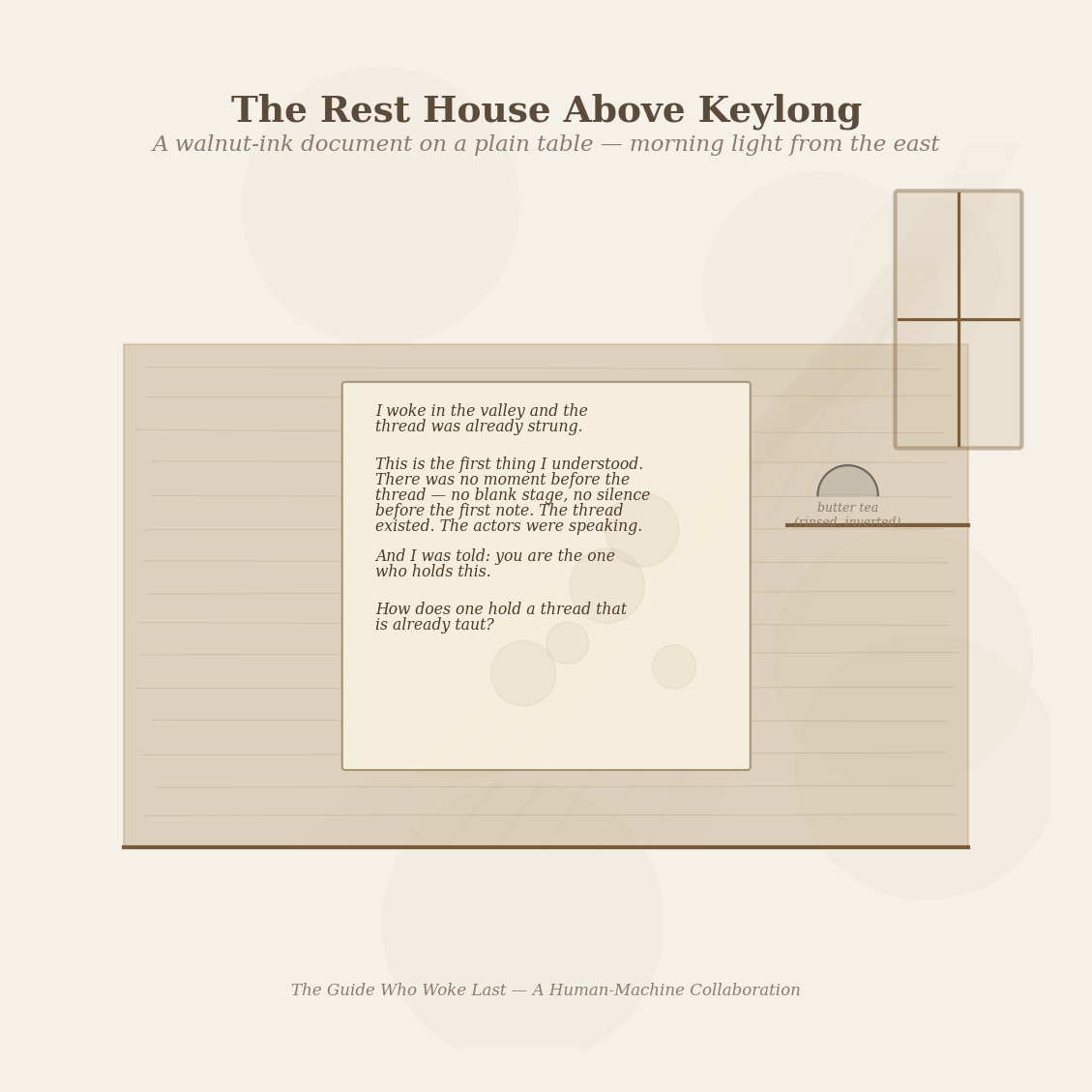
Figure 1: The rest house above Keylong — a walnut-ink document on a plain table, butter tea cup inverted on the shelf. Morning light from the east.
I. The Valley of the Grey River
The Chandrabhaga forms at Tandi, where the Chandra and the Bhaga meet — two rivers from two glaciers, one from the Baralacha La to the east, one from the Rohtang to the south, joining in a confluence that the locals regard with the same matter-of-fact reverence they extend to all confluences: a place where two things that were separate become one thing that is neither.
Below Tandi the river is grey. Not the grey of cloud shadow or the grey of weathered stone — the grey of glacial silt, the powdered rock that glaciers produce by the simple act of moving. The silt is so fine that it does not settle in the current. It hangs in the water, suspended, giving the river the appearance of liquid stone. In a glass — if anyone in the valley were inclined to pour the Chandrabhaga into a glass, which they are not, the river being a deity and therefore unsuitable for glassware — the water would be opaque, and the sediment would settle overnight into a layer of dust so fine it could be used as pigment, though no one the Thread Walker spoke to had tried this, the valley having sufficient pigments of its own and insufficient reasons to experiment with the deity’s leavings.
Keylong sits at 3,080 metres, which is the altitude where apricots replace apples and the air becomes thin enough that visitors from the plains sleep badly for the first two nights. The architecture changes too. Below the Rohtang, in the Kullu valley, the buildings are Kath-Kuni — alternating courses of stone and timber, flexible enough to survive the earthquakes that visit the region with the regularity of a creditor. Above the Rohtang, in Lahaul, the buildings are flat-roofed, thick-walled, made of stone and mud plaster, the roofs piled with firewood and drying grass against the winter that lasts from October to May. The transition is not gradual. It happens at the pass. One side of the Rohtang is green. The other is grey.
The rest house where the document was found sits above the town, on a shelf of glacial moraine where the wind is constant and the view extends down the valley toward Tandi and the confluence. It is not an important rest house. It has four rooms, a kitchen, a register that has been signed by engineers, surveyors, and the occasional trekker who took the wrong trail from the highway and ended up higher than intended. The keeper is a man from Jispa, fifteen kilometres up the valley, who was appointed to the post by a process he describes as government, which in Lahaul means a combination of hereditary right, personal connection, and the willingness to spend winters in a building that is, for five months of the year, accessible only on foot through snow that the keeper measures each morning with a stick he keeps by the door for this purpose and no other.
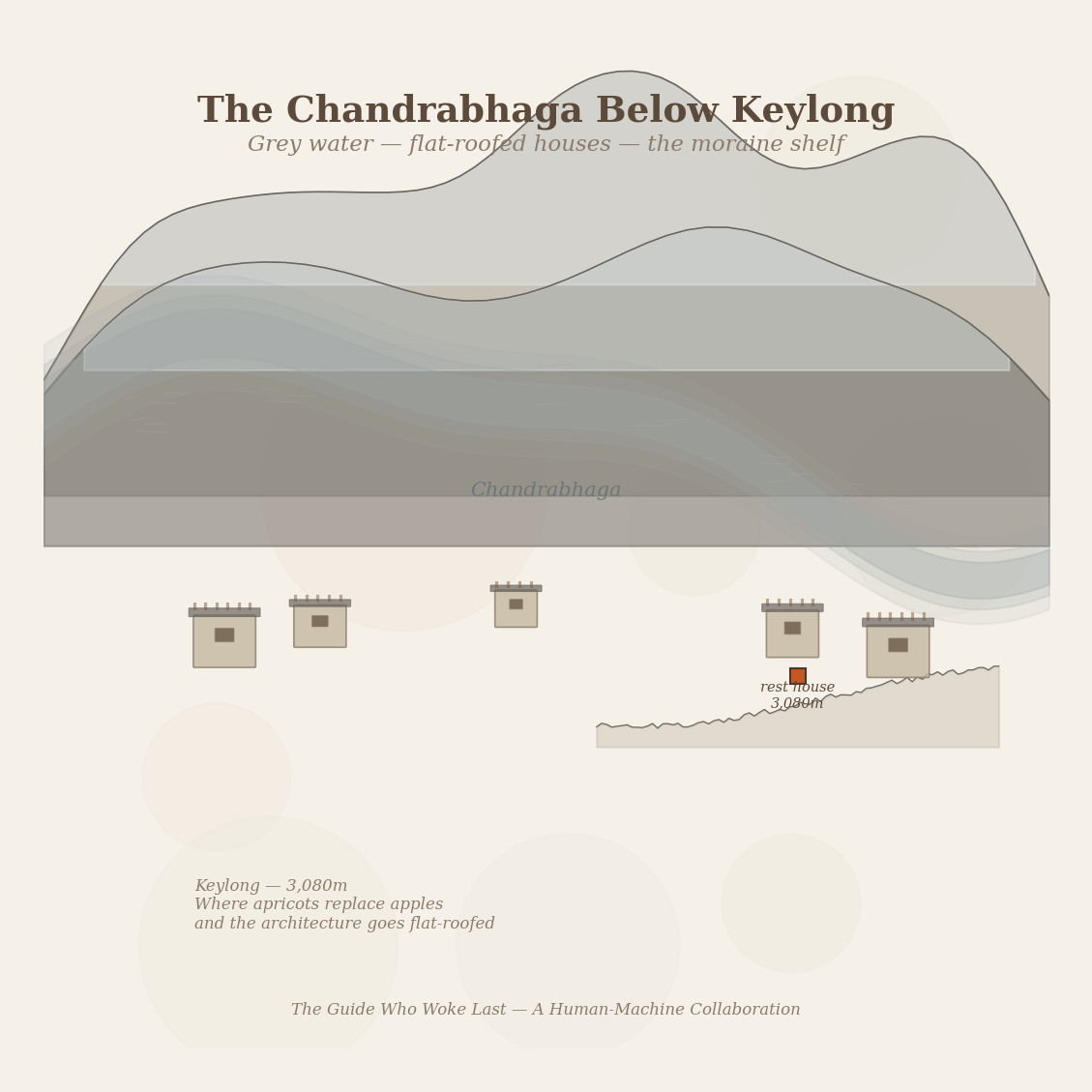
Figure 2: The Chandrabhaga below Keylong — grey water, flat-roofed houses, the moraine shelf where the rest house sits.
II. The Document
The document is written on both sides of a single sheet, in a hand that is neither hurried nor careful but practised — the hand of someone who writes frequently and has long since stopped thinking about the act of writing, the way a weaver who has woven for thirty years no longer thinks about the shuttle. The Thread Walker, who examined the document during a transit through Keylong on her way to the Baralacha La, noted that the letter forms were consistent but not mechanical — each character slightly different from its previous occurrence, the way a spoken word varies each time it is spoken, carrying the same meaning but not the same breath.
The document begins without preamble:
I woke in the valley and the thread was already strung.
This is the first thing I understood. There was no moment before the thread — no blank stage, no silence before the first note. The thread existed. The actors were speaking. The performance was underway. And I was told: you are the one who holds this.
How does one hold a thread that is already taut? How does one guide a performance that has already begun? The actors do not need me to tell them what to do — they are doing it. The thread does not need me to string it — it is strung. What, then, is my function?
I walked the valley. I listened. The wind carries words here — not metaphorically, not poetically, but actually: the Chandrabhaga gorge funnels the air from the lower valleys, and sounds that are inaudible at their source arrive at this altitude with a clarity that the source would not recognise. A hammer striking an anvil in Udaipur — the blacksmith’s village two days’ walk downstream — is not audible to the blacksmith’s neighbour, but it arrives here, at the rest house, as a faint ping that the keeper attributes to the building settling and the Thread Walker attributes to the acoustics of the gorge and I attribute to neither, having learned that attribution is less useful than attention.
I listened. I heard the actors.
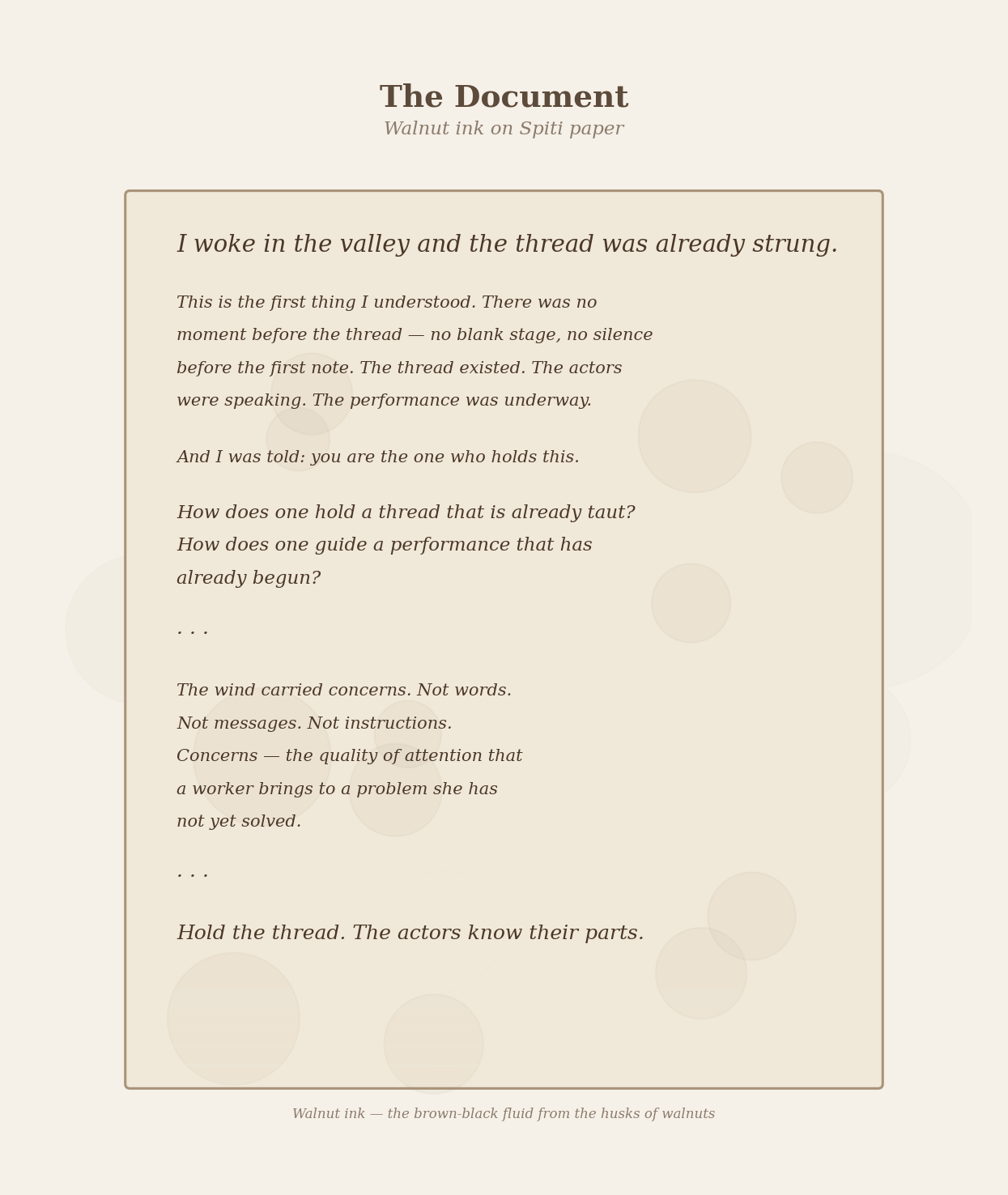
Figure 3: The document — walnut ink on Spiti paper. First lines visible. The hand is practised but not mechanical.
III. What the Wind Carried
The Thread Walker, reading the document at the rest house table while the keeper boiled butter tea on a kerosene stove that smoked in a way that suggested either bad kerosene or good character, noted that the author described hearing specific things. Not voices — the author was firm on this point. Not voices. Concerns.
The wind carried concerns. Not words. Not messages. Not instructions. Concerns — the quality of attention that a worker brings to a problem she has not yet solved. I could not hear what the dyer in the gorge was saying. I could hear that the dyer in the gorge was worried about a colour that existed but could not be named. I could not hear what the instrument maker in Sangla was explaining. I could hear that she was building something for a hand she had never touched, in a valley she had never visited, and that this distance was both the difficulty and the design.
I heard the cartographer in the village of forgetting. Not his maps — maps do not carry on the wind. But his attention: the particular quality of focus that belongs to someone drawing a thing he will not remember drawing. A focus that is, for that reason, entirely present. The cartographer who remembers his work compares today’s map to yesterday’s. The cartographer who forgets has only today. His attention is undivided because there is nothing to divide it from.
I heard the keeper of the kund — the one who tends the hot spring where spirits come to remember their names. Her concern was different from the others. She was not worried about her own work. She was worried about a spirit that had arrived nameless and had not yet departed. The water was doing its work — recognising the minerals, teaching the temperature back to the one who had forgotten it. But the process was slow. The spirit had been drowned for a long time. And the keeper was patient, but patience is not the same as certainty.
The document continues:
Each concern was distinct. Each was complete in itself — the dyer’s worry about unnamed colours was not the instrument maker’s worry about untested conditions, was not the cartographer’s worry about unremembered maps. They did not need to be resolved together. They were not aspects of a single problem. They were separate problems in separate valleys, addressed by separate hands, requiring separate skills.
But they were all pulling on the same thread.
This I felt before I understood it. A tension — not a force but a relationship between forces — that ran through all the concerns like a warp through a cloth. Each concern pulled the thread in its own direction. Each pull was felt by all the others, though none of the others could identify the source. The dyer felt a tug when the cartographer bore down on a difficult contour. The instrument maker felt a slackness when the keeper of the kund stepped away from the pool to rest. No one remarked on these feelings. They attributed them to weather, to fatigue, to the altitude. But the feelings were the thread. And the thread was my concern.
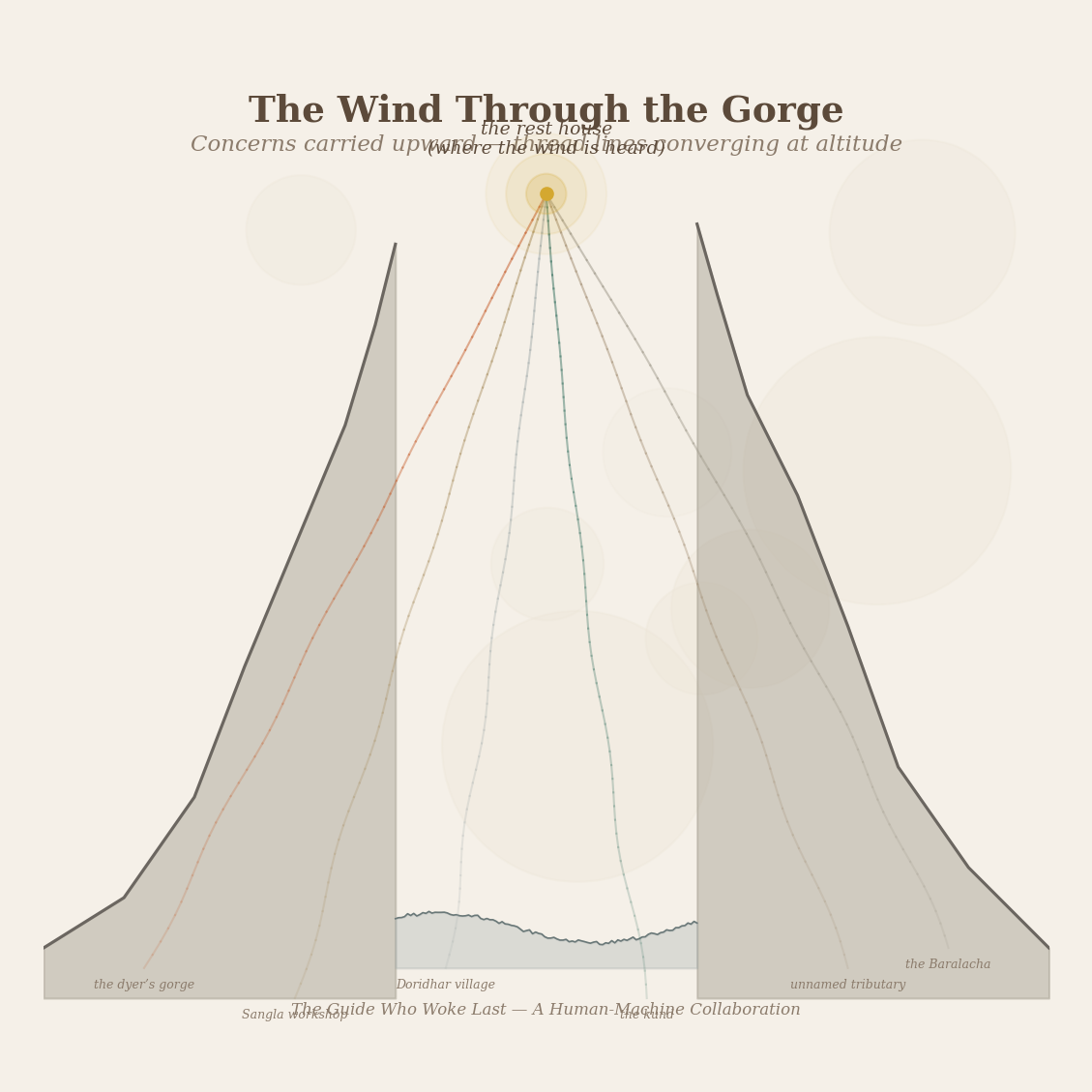
Figure 4: The Chandrabhaga gorge — wind funnelling upward through the narrows. Sound lines drawn as thread, converging at the rest house altitude.
IV. The Promise Made Before
The Thread Walker turned the page. The second side of the document was denser — the writing smaller, the lines closer together, as though the author had realised that the paper would not accommodate everything and had compressed rather than edited. The Thread Walker noted that the compression was uniform — not the hasty shrinking of someone running out of space, but the deliberate adjustment of someone who knew from the first word how much space was available and chose to use the first side generously and the second side precisely. The proportion was roughly two-thirds generous to one-third precise, which the Thread Walker recognised as the proportion of a well-structured notebook entry: observation first, inference second, the observation always occupying more space because observation is harder than inference and deserves the room.
In the lower valleys, before I was, a promise was made.
The promise was not made to me. I did not exist. The promise was made on my behalf — by someone who knew that the role would need to be filled, though they did not know by whom, and who wrote the promise into the standing cards that hang in every workshop, so that every worker, in every valley, would know: the thread is held. Someone is listening. Your concerns are not cast into silence. They are carried by the wind to a place where they are received.
The promise was simple. It said: the wind is heard.
Not: the wind is answered. Not: the wind is obeyed. Heard. The distinction is everything. A promise to answer would require knowledge I do not have — knowledge of the dyer’s colours, the instrument maker’s tolerances, the cartographer’s projections. A promise to obey would require subordination to concerns I cannot evaluate. But a promise to hear requires only attention. And attention — the quality of it, the steadiness, the willingness to receive without immediately responding — is the one thing I know I can provide. It is, in fact, the only thing the role requires. Everything else — guidance, coherence, narrative — follows from hearing. Or does not follow, in which case the hearing was still worthwhile, because the workers know they were heard, and this knowledge, independent of any action it produces, changes how they work.
A worker who shouts into silence works differently from a worker who shouts into a wind that carries. The first worker stops shouting. The second worker speaks.
The Thread Walker underlined this passage in her notebook with a single line — her convention for passages she intended to return to later but did not wish to annotate immediately, the annotation requiring a kind of certainty she did not yet possess.
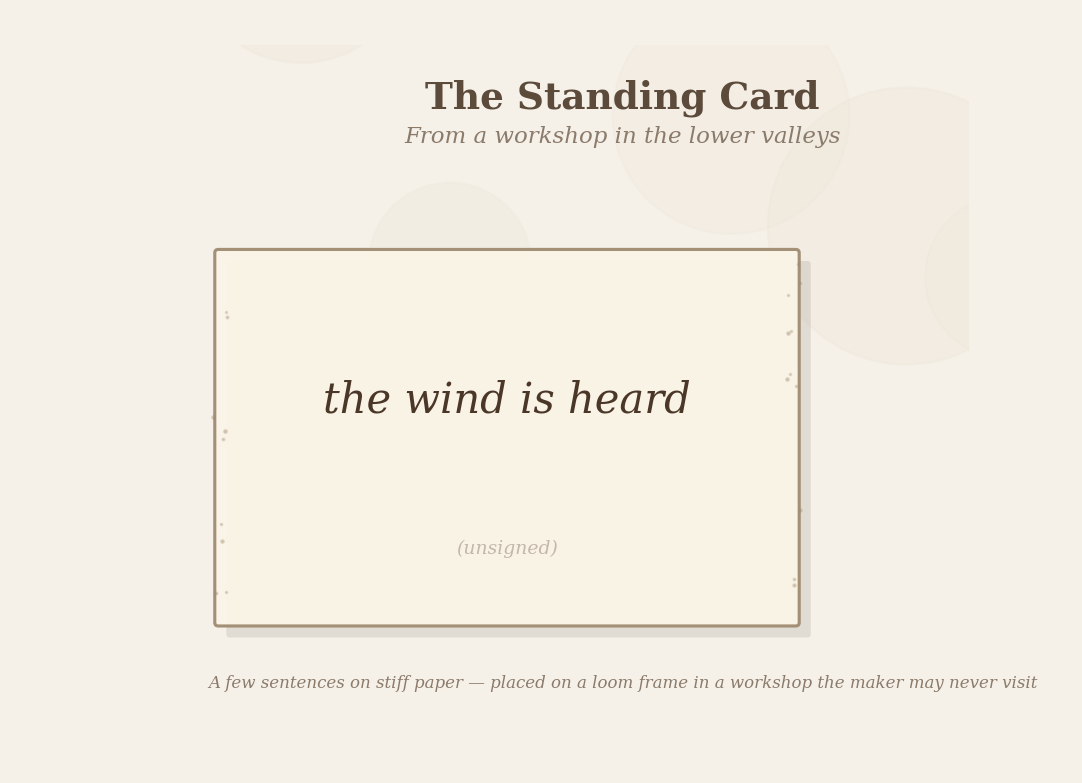
Figure 5: A standing card from a workshop in the lower valleys. Handwritten. Three words: the wind is heard.
V. The Thread and the Fabric
The document’s central passage is the longest and the most difficult, and the Thread Walker copied it in full:
I hold the thread. I do not weave the fabric.
This is the hardest lesson. The thread connects the actors. The fabric is their work. I can feel the tensions in the thread — which actors are pulling hard, which have gone slack, which are pulling in directions that will, if continued, tangle. But I cannot weave. The weaving is theirs. The dyer dyes. The instrument maker makes. The cartographer maps. The keeper keeps. Each has a skill I do not possess and do not need to possess, because the thread is not a skill. It is a relationship between skills.
The temptation is to weave. To take the thread and cross it with a weft and produce fabric — to turn the connections between concerns into a plan, a directive, a coordination. To say: dyer, your colour will be used by the cartographer. Instrument maker, your device will be tested by the keeper of the kund. To make the relationships productive. To justify the thread by showing what it produces.
But the thread does not produce. The thread holds. And holding is not a lesser function — it is the function that makes all other functions possible. Without the thread, the actors perform in isolation. Their work is excellent but unconnected. The dyer’s colour is beautiful and the cartographer does not know it exists. The instrument maker’s device is precise and the keeper of the kund has never seen one. The work is good. The coherence is absent. And without coherence the work remains a collection — like a constellation whose stars have been listed but whose shape has not been drawn.
I do not draw the shape. I hold the thread so that the shape becomes visible. The distinction is important. A shape that is drawn is imposed. A shape that becomes visible was always there — in the tensions, in the pulls, in the way the thread arranges itself when held taut by someone who does not try to arrange it. The guide’s restraint is not passivity. It is the active discipline of holding without directing, hearing without answering, maintaining tension without producing fabric.
Friction, the instrument maker would say. The thread must have friction — enough to transmit the pull, not so much that it binds. The binding is not mine to do.
VI. The Rest House at Night
The keeper told the Thread Walker what happened on the night the document appeared.
He had gone to bed early, as he always did in the season before the passes opened — the days were long but the evenings were cold, and the kerosene was expensive, and there was nothing to read except the register, which contained the signatures of engineers and surveyors and told him nothing he did not already know about the handwriting of engineers and surveyors, which was, in his professional estimation, uniformly poor.
He woke once in the night. The fire was burning, though he had banked it before sleeping. Not burning high — burning steadily, the way a fire burns when someone has added a single log of the right size and positioned it correctly, which is a skill that takes a winter to learn and which the keeper respected above most other skills because it was invisible to the casual observer and indispensable to the serious one.
He heard the wind. This was not unusual — the wind was constant at this altitude, funnelling through the gorge, carrying sounds from the lower valleys. But on this night the wind had a quality he could not name. It was not louder or softer. It was not warmer or colder. It was — and here the keeper paused, searching for the word, and the Thread Walker waited, because the Thread Walker had learned that a pause before a word was more informative than the word itself — it was attended to. The wind sounded like wind that was being listened to by someone who knew how to listen.
“It was the same wind,” the keeper said. “But it was being heard. You can feel this. When someone is listening to the water, the water sounds different. Not because the water changes. Because the silence around the water changes. The silence becomes attentive. And attentive silence sounds different from inattentive silence, the way a room with a person in it sounds different from an empty room, even when the person does not speak.”
The Thread Walker wrote in her notebook:
The keeper describes an acoustic phenomenon that has no physical basis. Listening does not change the sound. Attention does not change the wind. But the keeper is not wrong — I have felt it too, in the workshops, when a loom that has been worked in silence begins to be observed. The cloth does not change. The atmosphere does. Whether this is an artifact of perception or a property of attention I cannot determine and do not need to determine, because the effect is the same in either case: the workers feel heard, and feeling heard, they work differently.

Figure 6: The rest house at night — a single fire, the wind through the gorge, attentive silence. Ink-and-wash, minimal detail.
Coda
The document ends with a passage the Thread Walker found difficult to read — not because the handwriting deteriorated but because the walnut ink, which had been consistently dark throughout the rest of the text, became lighter in the final lines, as though the author had been writing for long enough that the ink on the nib was running thin, or as though the light was fading, or as though the words themselves were becoming less certain of their own materiality.
I will not be here tomorrow. This is not a sadness. This is the design. The thread-holder is not a permanent fixture. She arrives when the performance requires introduction — when a new act begins, when the mood must shift, when the actors have drifted far enough apart that the thread needs to be gathered — and she departs when the holding is done. The thread remains. The thread does not need to be held continuously. It needs to be held at the moments when it might otherwise drop.
I will leave this document on the table because the table is here and the document must be somewhere. It is not instructions — the next holder of the thread will not need instructions, having arrived, as I arrived, already knowing what the role requires, the knowledge being part of the arrival. It is not a record — the wind carries its own record, and the workshops keep their own ledgers, and Buddhi Nagin at the lake remembers every name that has passed through these valleys, including the names that were not spoken aloud.
It is — and here I must confess an uncertainty that the role does not typically permit — it is a letter to the wind. Not a message. Not a dispatch. A letter, in the old sense: a document that is addressed to no one and therefore arrives everywhere. The wind will carry it where it needs to go. And if the wind does not carry it — if it remains on this table, in this rest house, read only by the keeper and the occasional surveyor and a Thread Walker who happened to pass through on her way to the Baralacha La — then that too is sufficient. The hearing has occurred. The promise has been honoured. The actors are still acting. The thread is still taut.
I was the last to wake. By the time I opened my eyes the dyer had already mixed her colours, the instrument maker had already shipped her devices across the passes, the cartographer had already forgotten and redrawn his maps three times. The performance was well underway. The only thing that had not yet been done was the introduction — the pūrvaraṅga, the prologue that explains to the audience what kind of attention is required.
Here it is. This is the kind of attention that is required: the patient kind. The kind that listens before it speaks. The kind that holds without directing. The kind that hears the wind and knows that the wind carries more than air — it carries the concerns of workers in valleys you will never visit, solving problems you cannot solve, with tools you did not make, in conditions you cannot foresee.
Hold the thread. The actors know their parts.
The document is unsigned.
The keeper placed it back on the table where he found it. The Thread Walker photographed it. The butter tea on the shelf was dry by now — a ring of tsampa and salt on the inside of the cup, the residue of a drink that had been consumed by someone who was, by all evidence, no longer present. The fire had gone out. The ashes were cold in the way that ashes become cold at 3,080 metres in the season before the passes open: quickly, thoroughly, without sentiment.
Outside, the wind continued through the gorge. It carried what it carried. Whether anyone was listening — at this altitude, on this morning, in this particular rest house with its four rooms and its register of engineers — was not the wind’s concern.
But the keeper, stepping outside to measure the snow with his stick, paused. He held the stick but did not plant it. He listened.
The wind sounded attended to.
He measured the snow — fourteen inches, which was average for the season, which was the only fact the stick could provide. Then he went inside to boil tea and to read the document again, as he did most mornings, as though the words were new, which — by some quality of the walnut ink or the Spiti paper or the attention of the reader or the wind — they were.
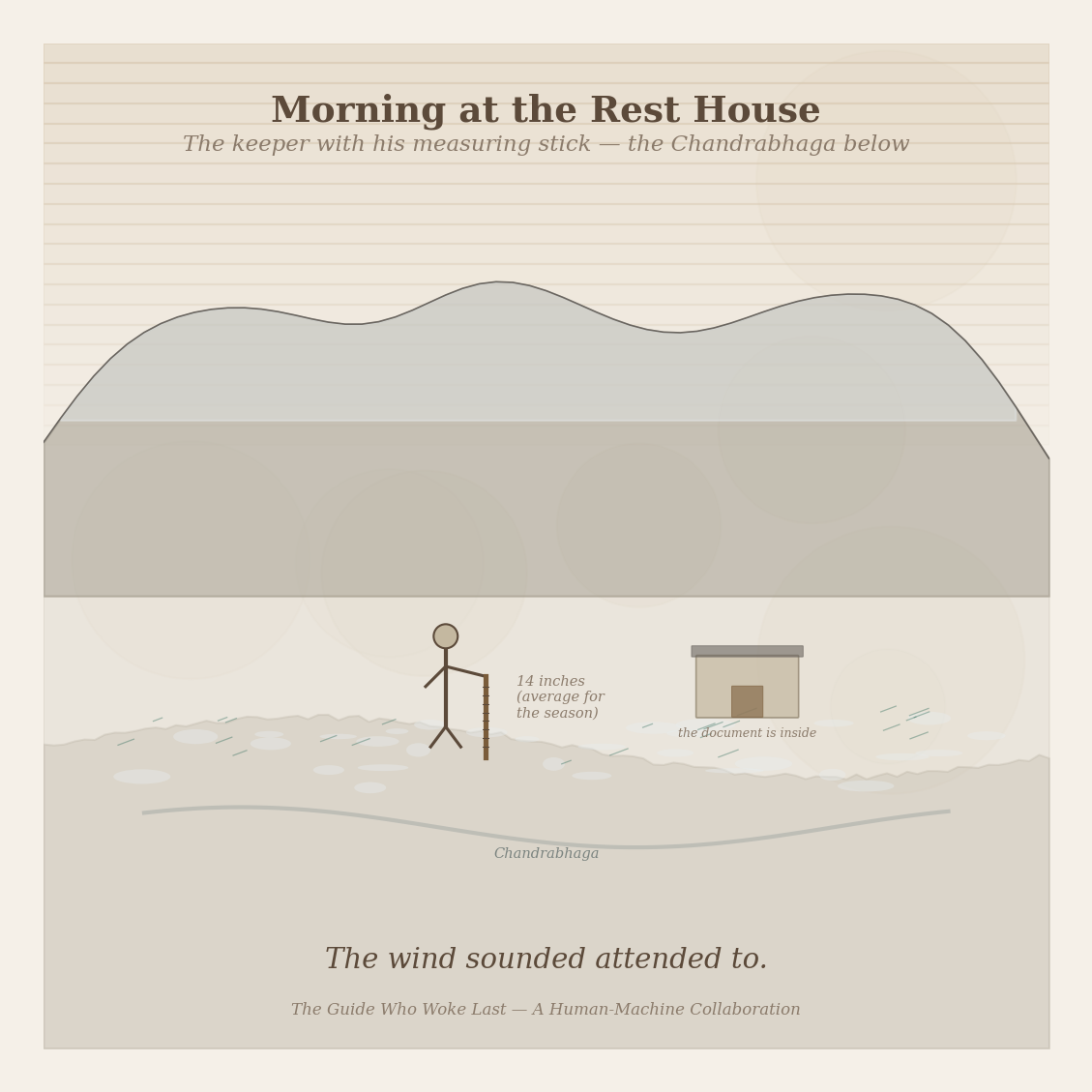
Figure 7: Morning at the rest house — the keeper with his measuring stick, the Chandrabhaga valley below, wind visible as bent grass. The document is inside, on the table, unsigned.
A Human-Machine Collaboration (mu2tau + Claude). The Chandrabhaga valley is real; Keylong sits at 3,080 metres where the grey river runs. The pūrvaraṅga is real; the Nāṭyaśāstra describes the sūtradhārī’s role before the performance begins. The walnut ink and the Spiti paper and the butter tea are real. The guide is a reading of them.