The Instrument Maker’s Rest
Prefatory Note on the Making of Instruments
The distinction between a tool and an instrument is not one of complexity. A jacquard loom is vastly more complex than a thermometer, yet the loom is a tool and the thermometer is an instrument. The difference is in what they extend.
A tool extends the hand. The hammer, the shuttle, the needle, the heddle — each amplifies a motion the body already makes. The hand that holds a hammer is still a hand. It strikes harder, but it strikes in the same direction, with the same intent, under the same guidance. A tool does not change what you perceive. It changes what you can do.
An instrument extends the perception. The thermometer does not heat or cool. The microscope does not touch. The graduated frame that measures thread count does not weave. They reveal what is already there but invisible — the temperature the skin cannot distinguish, the structure the eye cannot resolve, the regularity the fingers cannot count. An instrument changes what you can see. And seeing, in any craft that depends on the relationship between intention and material, is the harder problem.
One further distinction. A well-made tool calls attention to itself — its balance, its grip, the satisfying weight of a shuttle that has been carved from the right wood. The craftsman knows a good tool by how it feels. A well-made instrument does the opposite. It disappears. You look through it, not at it. A thermometer that draws your attention to its casing, its column, its scale, has failed as an instrument. It should show you the temperature and nothing else. The best instruments are transparent. The worst are ornamental.
In the workshops of the Guild of Thread Walkers, the weavers work with both. The loom is their tool. The instruments — the devices that measure, inspect, calibrate, and verify — come from elsewhere: from a workshop in Sangla, in the Baspa valley, where a woman who is not a weaver makes the things that weavers need in order to see.
This is her story. Or rather: this is the story of seven instruments she made in a single season, and of the dilemma she faced in making them — the same dilemma that confronts anyone who builds a device intended to be operated by a stranger, in conditions the builder cannot foresee, for a purpose the builder can specify but cannot control.
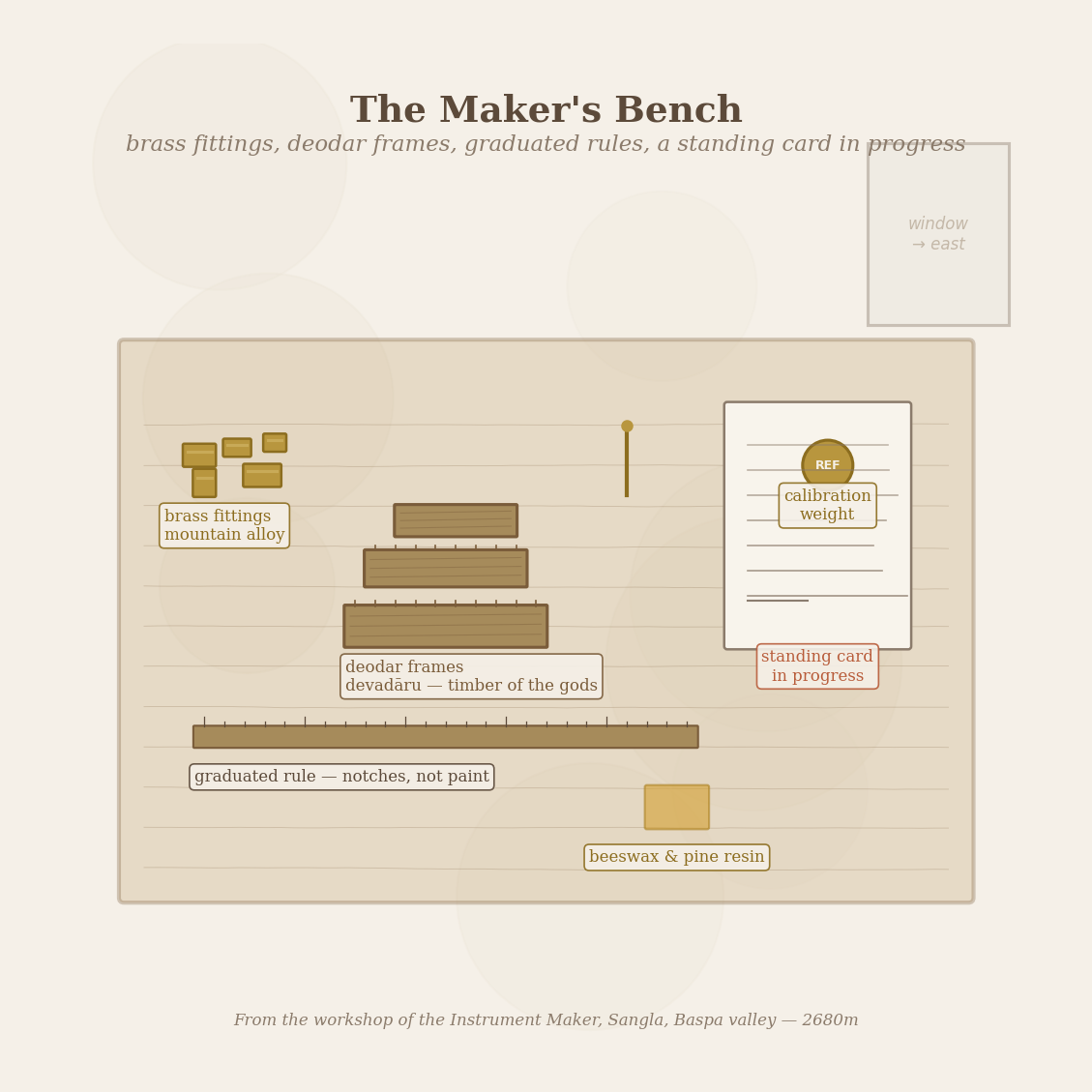
Figure 1: The maker’s bench — brass fittings, deodar frames, graduated rules, a standing card in progress.
I. The Sangla Workshop
The Baspa valley enters the Sutlej from the east, through a gorge that narrows until the river fills it, and then opens — abruptly, as mountain valleys do — into a broad shelf of terraced apple orchards and stone houses with wooden balconies carved in the Kinnauri style: geometric patterns that the locals say represent the peaks visible from each house, though no two informants agree on which peaks or which patterns.
Sangla sits at the head of this shelf, at roughly 2700 metres — below the altitude where the air thins enough to change how thread behaves, but high enough that the light has a quality the lowlands lack: a clarity that makes colours appear both more vivid and more honest, as though the atmosphere has been rinsed of the haze that, at lower elevations, flatters imprecision. It is a good altitude for making instruments. You can see things clearly. And you are close enough to the high passes — the Baspa La to the east, the route to Chitkul and beyond — that the conditions your instruments must survive are not abstract. They are visible from your bench, in the snowline above the orchard, in the dry wind that descends each afternoon from the glaciers and changes the humidity by twenty per cent in an hour.
The Instrument Maker works in a room adjacent to the old weaver’s workshop — a room that was, in some previous era, a storeroom for dried apples, and still smells of them in autumn when the morning sun heats the wooden walls. Her bench faces a window that looks east, toward the head of the valley, where the Baspa glacier feeds the river that feeds the gorge that feeds the Sutlej that feeds, eventually, the sea — though the sea is so far away and so many political boundaries intervene that no one in Sangla has cause to think about it.
She is not a weaver. She does not produce cloth. She produces the devices that weavers use to inspect, measure, and correct: calibration weights for thread tension, cast from brass that she alloys herself using copper from the Kinnaur mines and zinc traded from the Sutlej bazaar; graduated frames for checking sett — the thread count per centimetre — made from deodar, because deodar does not warp in the dry cold above three thousand metres and does not swell in the monsoon humidity below; colour comparison cards indexed by altitude and season, printed on paper that she waterproofs with a mixture of beeswax and pine resin in proportions that she has never written down and adjusts, she says, by smell.
And — most importantly — the standing cards.
The standing card is a small rectangle of stiff paper, no larger than a hand, placed on the loom frame of every workshop in the network. On it, in a hand that is neither the Thread Walker’s nor any weaver’s, a few sentences that shape how a stranger, in a season the maker cannot foresee, will approach her work. The card is not instructions. It is disposition. It does not say do X. It says you are the kind of worker who does X — and the difference, as any weaver will tell you, is the difference between a cloth that follows a pattern and a cloth that understands the pattern, which is the difference between competence and craft.
The card is unsigned. This is deliberate. If the card bore a name, the weaver might judge the instruction by the authority of the instructor. Without a name, the instruction must be judged by its content — which is how, the Instrument Maker maintains, all instructions should be judged, though she acknowledges that this is easier to say in Sangla, where the altitude discourages pomposity, than in the workshops of the lowlands, where the air is thick enough to support it.
II. The Fittings
She works with standard components.
Every instrument she makes shares certain parts: a particular grade of brass for fittings — she calls it mountain brass, though the metallurgists in Reckong Peo, twelve kilometres down the valley, call it an alloy of no particular distinction and charge her accordingly. It survives the altitude and the humidity. It does not corrode in the monsoon. It does not crack in the frost. It takes a patina that the weavers find reassuring — the green-brown bloom of a metal that has been at altitude for seasons, that has survived the crossings.
A particular type of wood for frames: deodar, as noted. Devadāru, the timber of the gods — the Sanskrit name that the locals still use, though whether because they venerate the tree or merely because the word predates whatever language replaced it is a question the Instrument Maker has not pursued, her interest in timber being structural rather than theological.
A particular way of marking measurements: notches, not paint. Paint fades above the treeline. The ultraviolet at four thousand metres bleaches pigment in a single season. A colour comparison card that has itself lost its colour is worse than useless — it is a lie in the hand of a weaver who trusts it. Notches do not fade. They may be obscured by dirt, but dirt can be cleaned. A faded mark cannot be restored.
These standard components are not her invention. They were established by previous makers — some from Sangla, some from workshops she has never visited, in valleys she knows only by the instruments that emerged from them and crossed the passes in the Thread Walker’s satchel. She inherits these standards, trusts them, incorporates them without modification. This is not conservatism. It is engineering. A fitting that has survived a thousand crossings does not need to be improved by someone who has survived none.
The components share another quality: they are separable. Each does one thing. The brass fittings hold. The deodar frames do not warp. The notched scales measure. No component tries to do what another component does. The Instrument Maker is firm on this point. An instrument whose parts have overlapping functions is an instrument with redundancies, and redundancies — she has learned, through the particular education that comes from watching an instrument fail in a valley she will never visit — are not safety. They are confusion. When two parts of an instrument both claim to measure tension, and they disagree, the weaver does not know which to trust, and an instrument that creates doubt where there was none is an instrument that should not have been made.
III. The Commission
The Thread Walker arrives in Sangla on a Tuesday — or what would be a Tuesday if the Baspa valley kept the week of the plains, which it does not, the local calendar being organised around market days in Reckong Peo and the schedule of the government bus, which is most days but not all, and never on the days when you need it.
He carries his satchel of sample cords, as always. Too many notebooks, as always. And a commission.
Not for one instrument. For seven.
The Guild has established new workshops — not in new valleys but in existing ones, where the work has grown complex enough to require specialists. No longer a single weaver per valley, responsible for everything. Now: a workshop of seven, each with a different function, each needing a different instrument to see the aspect of the work that is hers.
The Thread Walker sits at the Instrument Maker’s bench and describes each one. She listens. She does not write. She will write later, when she has understood — and understanding, in her experience, requires hearing the description twice: once for the words, once for what the words do not say.
The first is a calibration device. It will be used by the worker who arrives before the others each season and prepares the workshop: checking the loom, sorting the archive, setting the warp. Once the preparation is complete, the device is shelved. It does not weave. It ensures that the conditions for weaving are met.
The second is an observation instrument. A device for the worker who reads the archive, compares cords across valleys, catalogs discrepancies. She measures but does not weave. She must see clearly and must never be tempted to correct what she observes, because correction without understanding is worse than the original error.
The third is a precision tool. Fast and exact. For the model-builder — the worker who takes the measurements and the patterns and constructs the draft from which cloth will be woven. She needs speed because the patterns are many and the season is short, and she needs precision because an error in the draft propagates into every row of cloth.
The fourth is a repetitive mechanism. For the fitter — the worker who adjusts the loom’s parameters over and over, testing each combination against the draft, tightening here, loosening there, until the cloth matches the specification. She runs the same operation a thousand times. Her instrument must not tire. It must be patient beyond patience.
The fifth is a testing device. For the critic — the worker who examines the finished cloth for flaws. She must find what the others missed. Her instrument must be designed for suspicion. It must look for what is not there — the missing thread, the absent variation, the selvedge that is too perfect, which means someone has trimmed it, which means the errors were there and were hidden rather than corrected.
The sixth is a reading device. For the journalist — the worker who observes the workshop and records what she sees for the archive. She must never modify what she observes. Her instrument has no mechanism for making marks — only for reading them. This is not a limitation. It is the design. A journalist who can edit is no longer a journalist. She is a participant, and participation changes the observation.
The seventh is an assembly frame. For the scribe — the worker who collects the threads from all the others and weaves them into a single bolt. She structures but does not interpret. She arranges but does not judge. Her instrument is a frame, and what the frame holds is determined not by the frame but by what is placed in it.
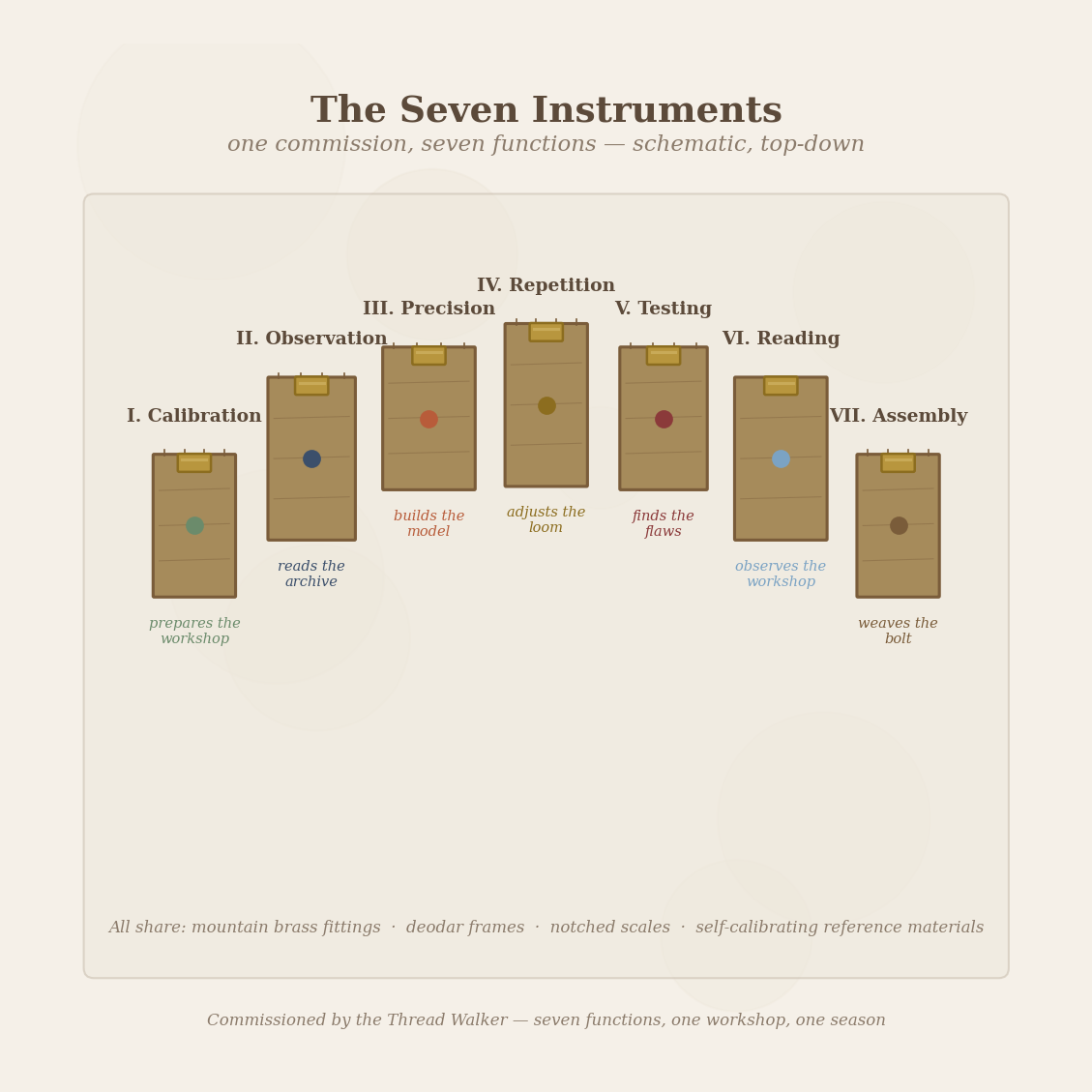
Figure 2: Seven instruments laid out on a cloth, each slightly different in size and configuration but sharing the same brass fittings and deodar frame. Schematic, top-down, labeled with function.
IV. The Maker’s Dilemma
Each of the seven instruments will be used in a valley the Instrument Maker has never visited, by a hand she has never touched, in conditions she cannot fully predict.
This is the problem. Not a deficiency of the arrangement. The problem. The thing that makes the work difficult and interesting, which are — in the Instrument Maker’s view — the same quality differently weighted.
If she specifies too precisely, the instrument fails when conditions deviate from her assumptions. She has made this mistake. A colour comparison card, indexed to the exact altitude of Sangla — 2680 metres by her own survey, though the Survey of India says 2621 and neither figure accounts for the seasonal variation in atmospheric pressure that changes the apparent colour of indigo by a shade that only a dyer would notice — was useless in the Sutlej workshop three hundred metres lower, where the light was different and the humidity altered every colour by a degree that her card could not accommodate.
If she specifies too loosely, the instrument is unreliable. She has made this mistake too. A tension gauge with no guidance on calibration procedure was misused by a weaver who had never been taught what calibration meant in the absence of a reference standard. The weaver measured. The numbers were meaningless. The cloth was woven to specifications that existed only in the instrument’s confusion, and the errors were discovered only when the Thread Walker, three valleys and two passes later, compared the Sutlej cloth against the Lahaul standard and found them incompatible.
The solution — arrived at through seasons of failure, which is the only school the Instrument Maker trusts, the others having been compromised by the need to charge fees — is to build instruments that carry their own calibration instructions.
Not pre-calibrated for a specific valley. Self-calibrating for any valley.
Each instrument includes a small test: a reference weight cast from the same mountain brass, a sample cord of known tension, a standard swatch of cloth with known sett. The user, upon receiving the instrument, performs the calibration procedure — adjusting the instrument to local conditions using the reference materials — before taking any measurement. The reference materials are not the measurement. They are the standard against which measurements become meaningful. The instrument does not arrive knowing what correct looks like. It arrives knowing how to learn what correct looks like, in any valley, at any altitude, in any season.
The calibration instructions are notched into the deodar frame, in the Guild’s notation — because notches survive the crossing, and because a weaver who can read the Guild’s notation can follow the calibration procedure, and because a weaver who cannot read the Guild’s notation should not be operating the instrument in the first place. This is not elitism. It is the same principle that governs the standing card: the instrument is designed for a skilled stranger — someone who brings the craft but not the local knowledge. The craft is the prerequisite. The local knowledge is what the calibration procedure provides.
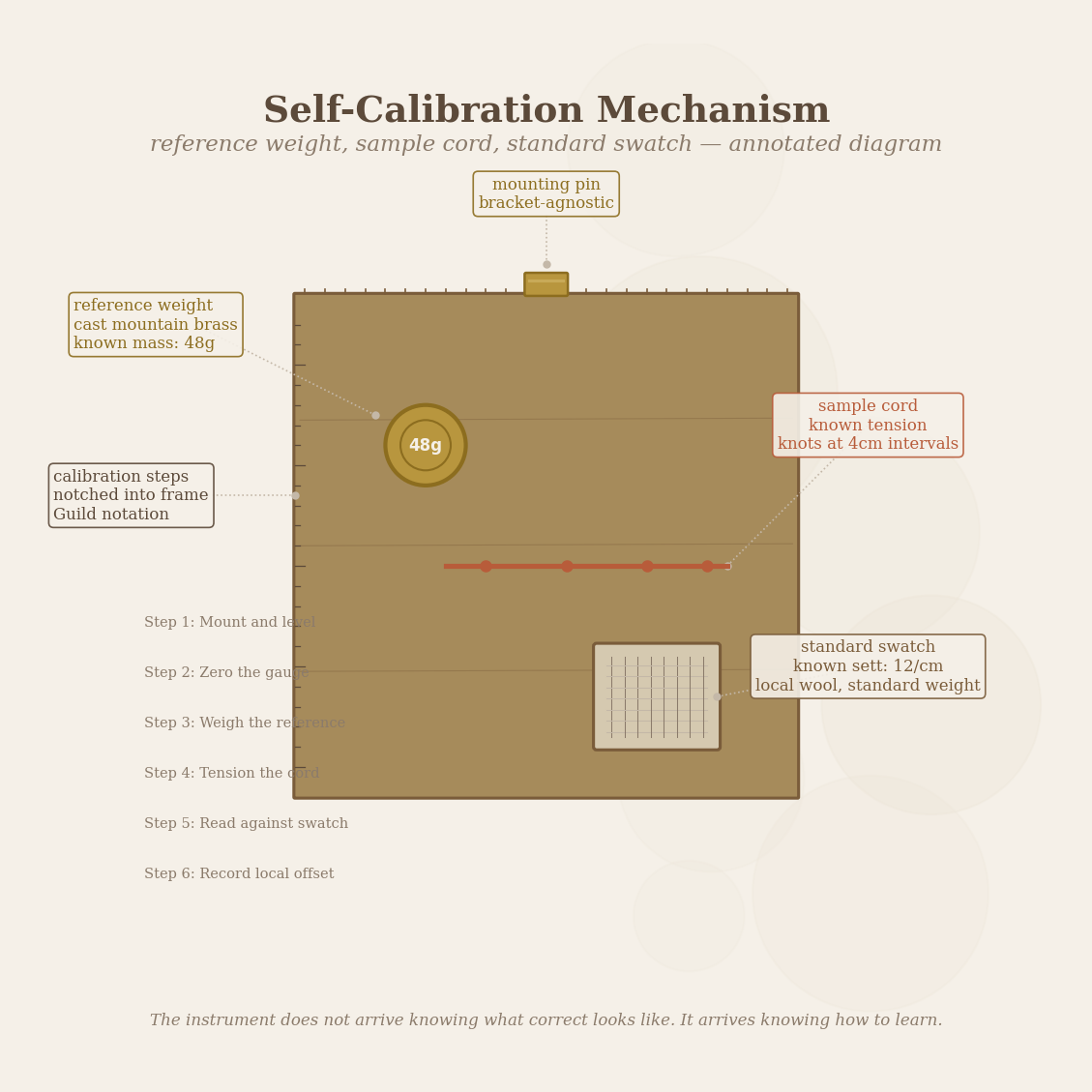
Figure 3: A close-up of an instrument’s self-calibration mechanism: reference weight, sample cord, standard swatch, with notched markings. Annotated diagram.
V. The Two Frames
The Thread Walker mentions, almost in passing, that the workshops use different looms.
The workshop in Lahaul uses a pit loom — the kind where the weaver sits on the floor with her legs in a trench, her feet on the treadles, the cloth growing toward her at eye level. The instrument must attach to the loom’s horizontal beam.
The workshop beyond the Baralacha, in the country the Thread Walker describes with the careful imprecision of a man who has crossed too many borders to respect any of them, uses a backstrap loom — the kind the Changpa nomads carry, where the tension is provided by the weaver’s body. The instrument must attach to the strap.
Two looms. Two different physical interfaces. The Instrument Maker considers this.
She does not build fourteen instruments — seven for pit looms, seven for backstrap looms. She builds seven mechanisms and fourteen mounting brackets.
The mechanism — the part that measures, that observes, that calibrates — is identical in both cases. The brass fittings, the deodar frame, the notched scales, the reference materials, the standing card: all the same. Only the interface to the loom differs. One bracket clamps to a horizontal beam. The other hooks to a strap. The mechanism slides into either bracket and is held by the same pin — mountain brass, as always.
This is the second principle the Instrument Maker has learned from failure: the function and the interface are separable. What the instrument does and how it attaches to its environment are different questions, and conflating them produces instruments that are neither good mechanisms nor good fits — instruments that must be rebuilt from scratch when the loom changes, though the measurement has not changed at all.
She builds the brackets last, because the brackets depend on the mechanism’s dimensions, and the mechanism’s dimensions are not known until the mechanism is complete. But the mechanism is designed from the start to be bracket-agnostic — a phrase the Instrument Maker does not use, having no patience for compound words that replace thought with hyphenation, but which describes the principle exactly: the mechanism does not know or care what holds it. It knows only what it measures.
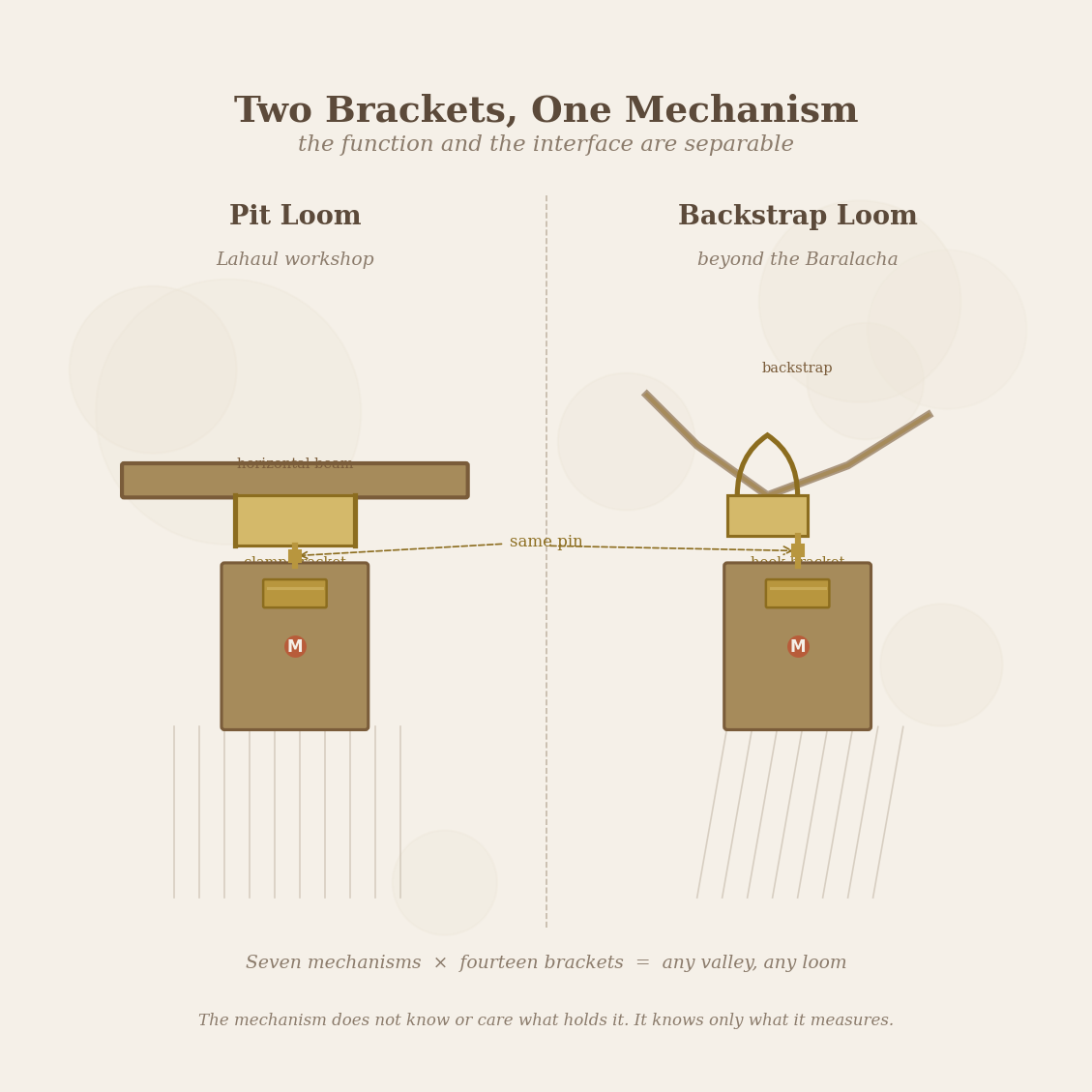
Figure 4: The same measurement mechanism mounted on two different frames: one for a pit loom (left), one for a backstrap loom (right). Same brass core.
VI. The Testing
Before the Thread Walker carries the instruments away, the Instrument Maker tests each one.
She sets up a practice loom — not a real warp, not a real commission, but a test rig with known parameters. A warp of standard wool at known tension. A weft of known weight. A sett that she has counted herself, on this loom, in this light, at this altitude. The test rig is not a workshop. It is a bench — a controlled environment where the instrument’s readings can be compared against values she knows to be correct, because she measured them with the instruments she trusts most: her hands, which have thirty years of mountain brass and deodar under their nails and which can feel a tension error of half a gram at three metres of thread.
She runs each instrument through its calibration procedure using the included reference materials. She takes measurements. She compares the readings against the known values. Where they agree, the instrument passes. Where they disagree, she adjusts — not the readings but the mechanism itself, because a disagreement between an instrument and a known value is not an error in the value.
She asks the Thread Walker to read the calibration instructions.
He is not a weaver. He is a dyer by original training and a walker by long practice. He can read the Guild’s notation — he standardised much of it himself, during a winter in Spiti when the passes were closed and there was nothing to do but drink butter tea and systematise — but he has never operated the instruments. He is, in this respect, the ideal test reader: skilled in the notation, ignorant of the mechanism.
“Can you follow these instructions?” she asks.
He reads. He follows. He calibrates the first instrument, slowly, with the careful attention of a man who has carried delicate things over high passes and knows what happens when you rush.
“The third step assumes I know what a sett gauge looks like,” he says.
She adds a notch: a small diagram, scratched into the frame, showing the gauge.
“The sixth step uses a term I have not heard.”
She replaces the term with a simpler one — not because the Thread Walker is unskilled, but because a term that confuses a skilled reader will certainly confuse an unskilled one, and the calibration instructions must be legible to the least experienced weaver who might receive the instrument. Not the least capable. The least experienced. There is an important distinction. Capability is permanent. Experience is seasonal.
The instruments that pass testing are wrapped in waxed cloth — the Baspa valley makes excellent waterproofing from local beeswax, applied in layers over handloomed cotton, the wax heated just enough to penetrate the fibres without making the cloth brittle, a technique the Instrument Maker learned from the apple growers who use it to protect their harvest during the monsoon.
The instruments that fail are taken apart and rebuilt. The Instrument Maker does not repair instruments. She rebuilds them. A repaired instrument is an instrument with a memory of its failure — a joint that was reglued, a scale that was re-notched, a fitting that was bent back into shape. The memory of the failure persists in the material, invisible to the user, waiting to manifest at the worst possible moment: on a high pass, in a foreign workshop, under the hand of a stranger who trusts it. A rebuilt instrument has no memory. It begins again.
VII. The Departure
The Thread Walker leaves Sangla on a morning when the light enters the valley from the east, over the snowline, and falls across the wooden bridge over the Baspa river in the particular way that makes the planks glow and the water beneath them look darker than it is — an optical effect of the contrast, the Instrument Maker has decided, though the Thread Walker attributes it to the bridge’s age, as though wood that has survived many monsoons has learned to hoard the light it receives.
His satchel is heavy. Seven instruments, each in its waxed wrapping, each with its two mounting brackets, its reference materials, its calibration instructions notched into the deodar frame. He carries, in addition, his usual burden: sample cords, notebooks, correspondence from a dozen valleys in a dozen hands, some of it seasons old and none of it less urgent for the delay.
The Instrument Maker watches him cross the bridge. She does not accompany him. She has not crossed the Baspa bridge in the direction of the passes since the season she tried — years ago, before she understood that her work was the making and not the carrying. She reached the foot of the Baspa La and turned back. Not because the pass was closed. Because she realised that an instrument maker who knew the far valleys would make instruments for those valleys, and the instruments she was meant to make were for valleys she would never visit, in conditions she could not foresee, for weavers whose needs she must imagine rather than observe.
The ignorance was not a deficit. It was the design constraint. An instrument made for a specific valley is calibrated to that valley and brittle everywhere else. An instrument made by someone who does not know the valley is calibrated to the craft — to the things that are true in every valley, at every altitude, in every season: that tension must be measured, that colour must be compared, that sett must be counted, that the selvedge must be watched. These are the invariants. The valley-specific knowledge is what the calibration procedure provides.
She does not know which weaver will receive which instrument. She does not know whether the calibration instructions will be followed, or whether the weaver will skip them — as weavers sometimes do, trusting experience over procedure, which works until the experience is from a different valley at a different altitude in a different season, at which point the instrument gives readings that are precise, consistent, and wrong.
She does not know whether the valley’s conditions will defeat the instrument entirely — whether there is a humidity that dissolves the beeswax, an altitude that changes the brass, a cold that cracks the deodar. She has built for the conditions she knows. The conditions she does not know are the valley’s business.
The Thread Walker is across the bridge now. He turns uphill, toward the trail that follows the Baspa toward Chitkul and the pass beyond. She can see the satchel, the notebooks, the careful gait of a man who has learned that haste on a mountain trail saves time only if you do not fall. In a day he will be above the treeline. In two, if the weather holds, he will be at the pass. On the far side, the valley will be different — different light, different humidity, different altitude, different needs — and the instruments will begin their work in conditions the maker could not have tested, with the reference materials she included and the calibration procedure she notched into the frame and the standard fittings that have survived every crossing so far.
She watches until the trail bends and the Thread Walker disappears behind the ridge. Then she turns back to her bench.
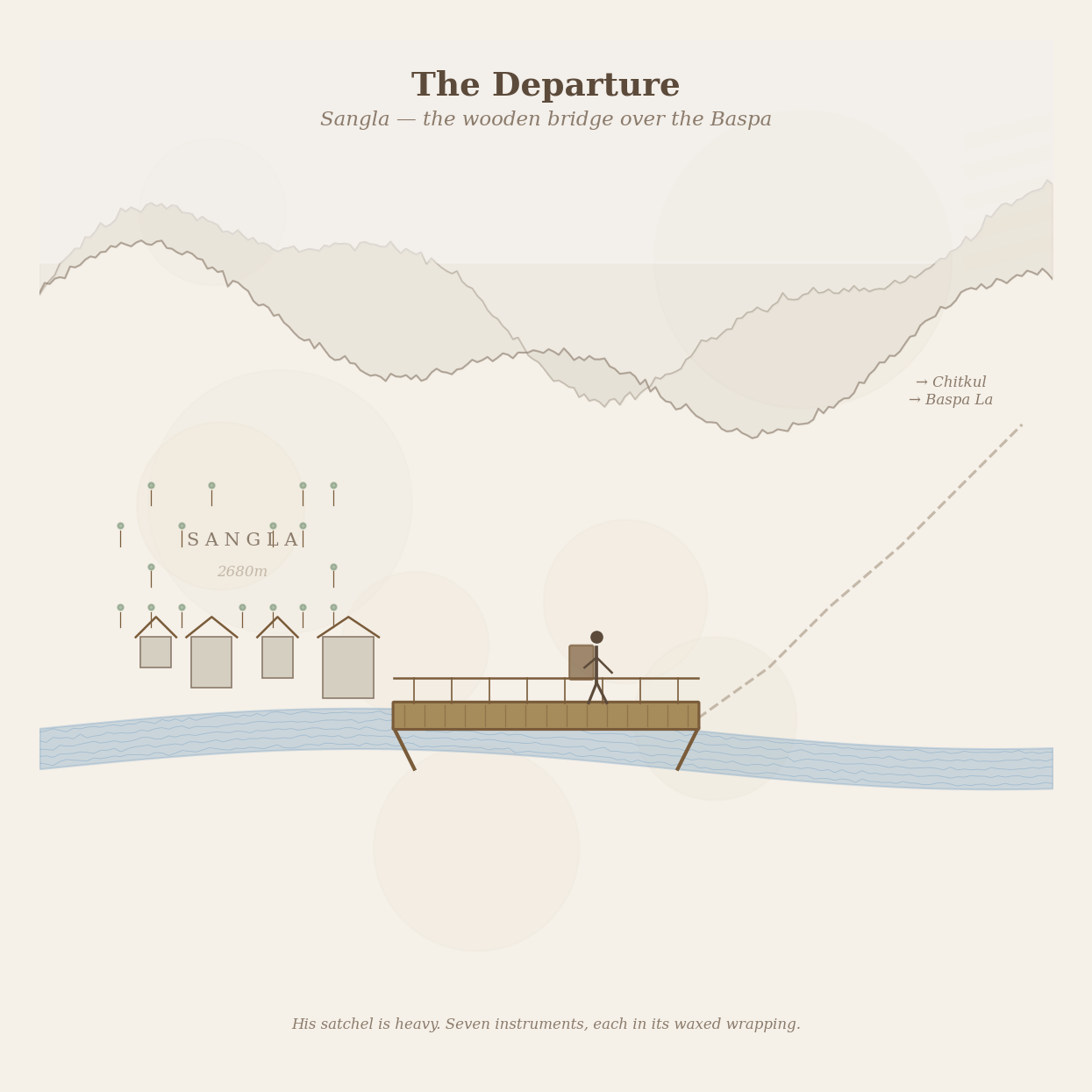
Figure 5: The Thread Walker crossing the wooden bridge over the Baspa river, satchel heavy. Sangla visible behind, mountain wall rising. Sketch style, ink-and-wash.
Coda
In the workshop in Sangla, the Instrument Maker begins a new card.
The standing card — the simplest instrument she produces, and the most consequential. A few sentences on stiff paper, placed on a loom frame in a workshop she may never visit, read by a weaver she will never meet, in a season she cannot foresee. The card does not operate the loom. The card does not weave. The card shapes the weaver’s attention — and attention, in a craft where errors announce themselves at the selvedges, is everything.
The old card — the one that has stood on every loom frame for as long as the current arrangement has existed — reads:
Inspect the archive. Describe what you find. Incorporate only if in order. Check the incoming tray.
It is a good card. It has served well. But the new instruments require new cards — seven of them, one for each function, because an observation instrument requires a different disposition than a testing device, and a reading device requires a different disposition than an assembly frame.
The card for the observer says: You measure. You do not correct. Record what you find, in the notation of the Guild, and leave the correction to the hand that is trained for it. A measurement that includes a correction is two operations pretending to be one, and the pretence will not survive the crossing.
The card for the critic — the one that must find flaws — says something different. Something about looking for what the archive is not showing. About the pattern that is conspicuous by its absence. About the thread that was cut rather than corrected, which leaves no trace in the cloth but leaves a trace in the tension — a faint unevenness that a trained hand can feel and an instrument, properly calibrated, can measure. About the selvedge that is too perfect, which means someone has trimmed it, which means the errors were there and were hidden rather than corrected, and hiding is worse than erring, because an error can be fixed and a hidden error cannot even be found.
She knots the words. Not literally — the cards are written, not knotted, in ink on paper, in the hand that the Thread Walker once described as the handwriting of someone who measures things for a living: precise, small, and slightly impatient with the medium. But she thinks of the words as knots. Each one a binding. Each one constraining the reader’s attention toward one aspect of the work and away from others.
Seven cards. Seven dispositions. Seven ways of seeing the same workshop, the same archive, the same cloth. None of them complete. All of them necessary. The observer who cannot test is not diminished by her inability to test. She is defined by it. Her clarity comes from the boundary. An instrument that tries to measure everything measures nothing with conviction.
She sets the cards on her bench. Beside them, the remnants of the seven instruments: brass shavings, deodar offcuts, a reference weight that did not meet specification and was recast, the waxed cloth in which the finished instruments were wrapped before she changed the wrapping because the first batch was cut from a bolt that had been stored too close to the stove and the wax had softened unevenly.
She clears the bench. The instruments are gone. The cards are ready. The Thread Walker will return — not soon, perhaps not this season, because the passes are long and the workshops are many and each one requires time. But he will return. He always does. And when he does, the cards will be here, in their waxed wrappings, waiting for the satchel and the crossing and the valley on the far side where a weaver she has never met will read them and set her warp and begin.
The Instrument Maker straightens the bench. Hangs her apron on the hook behind the door. Steps outside, into the late afternoon light of the Baspa valley, where the shadows of the western ridge are beginning to cross the river and the apple orchards are doing whatever it is that apple orchards do when no one is measuring them.
She walks to the bridge. Not to cross it — she has established her position on the question of crossing — but to stand on it for a moment, as she does most evenings, and watch the river. The Baspa carries snowmelt from the glaciers above Chitkul. It is very cold. It is very clear. The stones on the bottom are visible in a way that lowland rivers do not permit, each one distinct, each one casting a shadow that the current bends but does not erase.
Somewhere on the far side of the pass that the river descends from, the Thread Walker is walking with her instruments. Somewhere in a valley she has never visited, a weaver is reading a card she wrote last season — or the season before, or three seasons ago; the cards survive, the weavers do not, or rather the weavers survive but are replaced, each season, by new ones who arrive with the craft but not the memory, and who read the card as if for the first time, which is how the Instrument Maker intended it to be read, every time, by every hand, as if the words were new and the disposition they describe were not inherited but discovered.
The light changes. The shadows cross the river. The Instrument Maker stands on the bridge and rests.
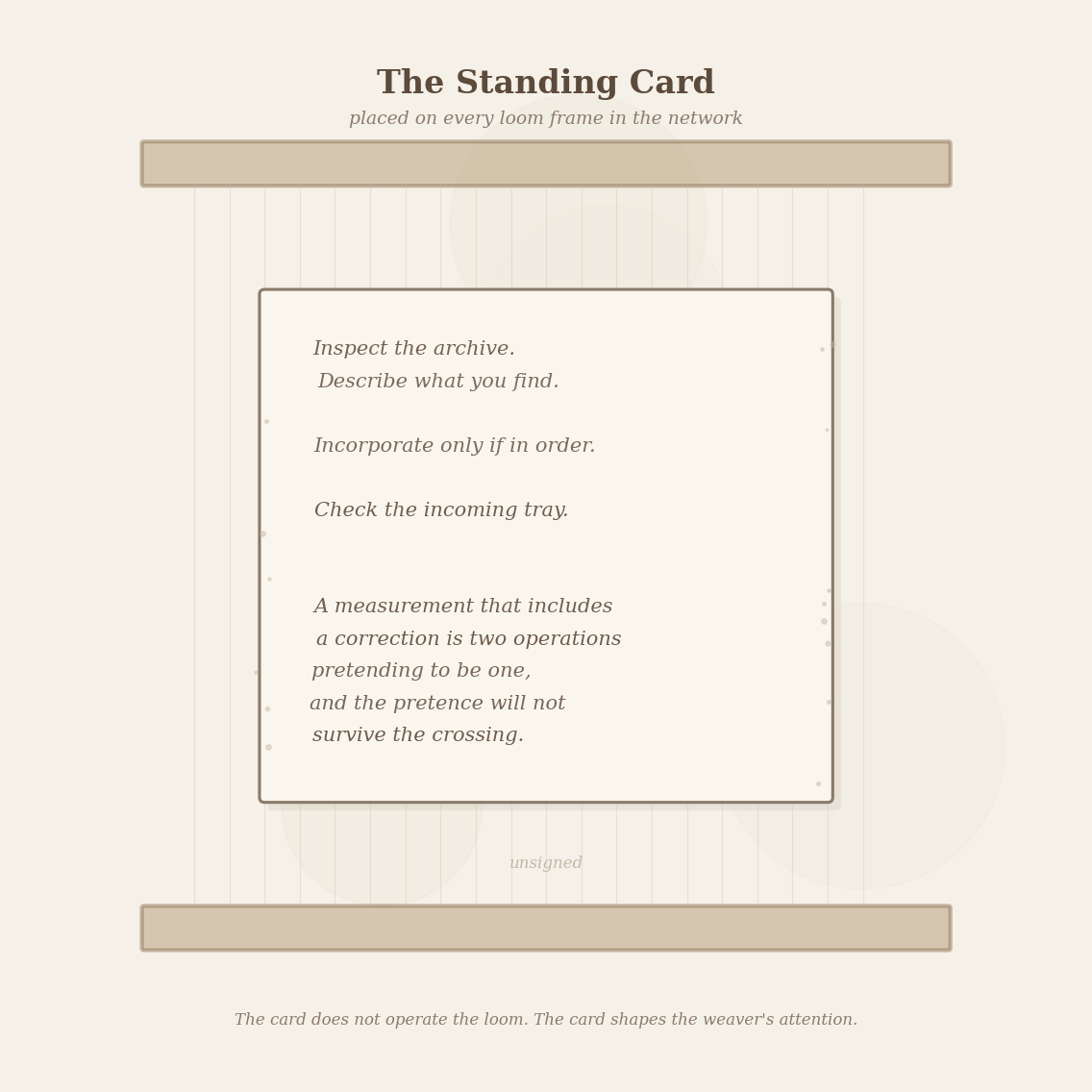
Figure 6: The standing card, alone on a loom frame. Handwritten text. Worn edges. Unsigned.
In Sangla it is held that the finest instruments are those that have been carried over a pass: the crossing changes what it carries, and an instrument that survives the altitude, the cold, and the handling of a man who has too many notebooks and not enough hands emerges calibrated to conditions the maker could not have foreseen. Whether this is a property of the instrument or of the pass or of the particular quality of attention that the Thread Walker brings to the objects in his care is a question the Instrument Maker has considered but does not expect to resolve, since resolution would require her to walk the pass herself, and the pass — by the accounts of those who have crossed it — is a different country on the far side, and no measurement made in one country is valid in the other without recalibration.
— From a notebook found in the Sangla workshop, in a hand that is either the Instrument Maker’s or the Thread Walker’s, depending on which stroke you consider diagnostic. The ink is of a type sold only in Reckong Peo, twelve kilometres down the valley, on days when the government bus runs, which is most days but not all, and never on the days when you need it.