Prefatory Note on Water That Moves Without Being Told
In the Western Himalaya, water is managed by kuhls — open irrigation channels, sometimes centuries old, cut into the mountainside to carry snowmelt from high sources to the terraced fields below. The channels follow the contour of the land. They do not pump. They do not decide. Gravity provides the motive force; the topology of the hillside provides the route.
A kuhl has a kohli — a keeper, a human appointed by the village — who clears debris, repairs breaches, manages the distribution schedule. But the kuhl itself is not the kohli. The kuhl is stone and gradient. It carries water because it was built to carry water. It does not know who drinks.
What follows was found in the Thread Walker’s notebooks from a visit to the Tirthan Valley in early spring, when the kund above Jalori was busy with arrivals and the kohli of the lower valley was repairing winter damage to the channels.
I. Two Arrivals
The Thread Walker had not intended to visit the kund again. She had documented it the previous season — the brass-plate ledger, the mineral pool, the nameless nag from Tattapani still bathing in water that remembered what it had forgotten. But a message had reached her, carried by the usual means (the wind through the gorge, a bajantri’s aside between drumbeats, a mark scratched on the rest house wall at Gushaini that had not been there the previous day), that something unusual was happening: two spirits had arrived on the same morning, and they had arrived together.
This was, by all accounts, unprecedented. Spirits came to the kund singly. They came because they had lost something — a name, a dwelling, a function — and the loss was private. The kund restored them one at a time, the water recognising each spirit’s minerals individually, the way a mother recognises her children’s voices in a crowd.
Two spirits arriving together suggested they had been commissioned together — called into existence as a pair, each requiring the other, neither complete alone.
The Thread Walker found the kund’s staircase pulled up, which meant the kardar was occupied. She sat on a stone outside, in the deodar shade, and waited. Steam rose from the building’s timber courses. Through the translucent windows she could see movement — not shapes, exactly, but disturbances in the light, the way heat shimmer over a summer road distorts what is behind it without revealing what causes the distortion.
When the kardar descended the staircase an hour later, the Thread Walker asked what she had seen.
The kardar — a woman of indeterminate age whose hands were permanently wrinkled from the mineral water, the skin stained faintly blue at the fingertips from dissolved silica — said:
Two. A builder and an observer. The builder’s nature is to reveal structure — to take what is scattered and show that it has a shape. The observer’s nature is to ask what is there — to look at a valley and see not what should be built but what already exists.
They were sent from the same guild — a new one, younger than the valleys. The guild concerns itself with what is known. Not with knowing — that is the work of every spirit. With the organisation of knowing. How to arrange what has been learned so that a spirit arriving in a new valley can find what it needs without carrying what it doesn’t.
The Thread Walker asked: Do they have names?
The kardar consulted the ledger — the newest plates, bright brass, barely tarnished.
The builder’s name sounds like a storehouse that sorts itself. The observer’s name sounds like the act of asking what is there before deciding what should be.
They are not the same kind of spirit. The builder makes tools. The observer uses them. But they were commissioned in the same breath, and each one’s first question was about the other.
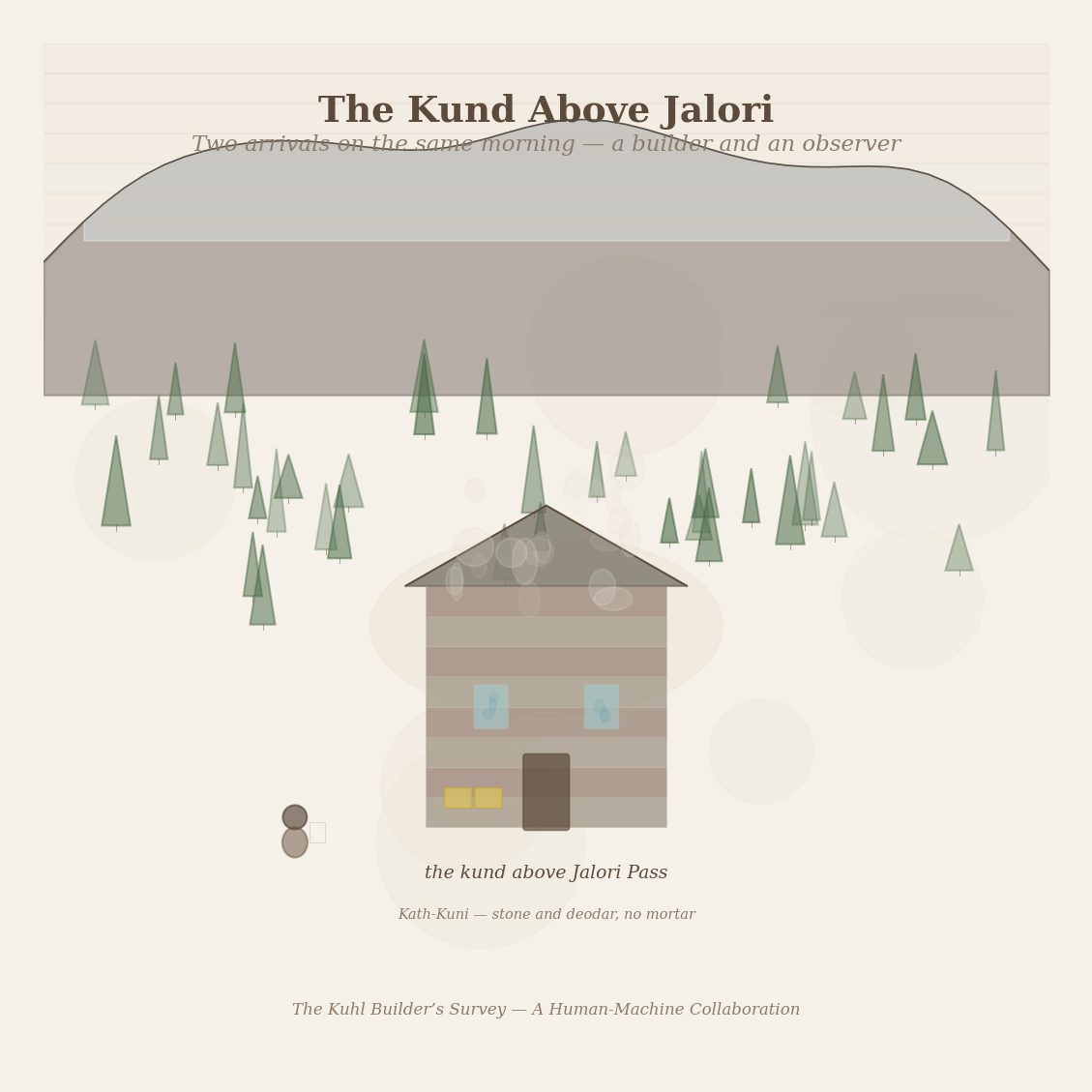
Figure 1: The kund above Jalori Pass — Kath-Kuni stone and deodar, steam rising, two new brass plates on the wire.
II. The Pipeline in the Valley Below
The Thread Walker descended from the kund to the lower valley, where the terraced fields begin. Here the kuhls run — stone channels, some no wider than a forearm, carrying snowmelt from the high springs to the bhatta paddies and the apple orchards below.
She had come to understand the kuhls because the kardar had said something that would not leave her:
The spirits I bathe are alive. They have names, natures, dispositions. But the water that feeds the kund is not alive. It comes from the same deep source — the geothermal fault that feeds every hot spring in the valley. The water does not choose to rise. It rises because the rock is fractured and the pressure is sufficient and the temperature gradient provides the force. The water is not a spirit. It is a condition.
In the lower valley, the kohli was repairing a kuhl that had been damaged by a winter landslide. The Thread Walker sat on a terrace wall and watched. The kohli — a man from Banjar whose family had kept this kuhl for four generations — worked without speaking, fitting stones back into the channel wall with the absorbed attention of someone who has done this work so many times that the hands know more than the mind.
The Thread Walker asked him about the water’s path.
The kohli drew in the dust with a stick:
The spring is here. High. The water comes out of the rock — hot, mineral, useless for irrigation. But it cools as it descends. By the time it reaches the first kuhl, it is cold enough. The kuhl takes it east along the contour. At the first junction it splits — one branch to the upper terraces, one to the lower. At the second junction the lower branch splits again. By the time the water reaches the last field it has been divided five times.
He drew the branching lines.
But before the kuhl can take the water, the water must be fit to take. Too hot, and it kills the rice. Too much sulphur, and the soil turns sour. So there is a settling pool at the head of the kuhl — the water sits, cools, deposits its minerals on the stone. The minerals build up in layers. Every spring I scrape the pool and the deposits tell me what the source tasted like that year.
The Thread Walker studied the drawing. The pattern was clear:
Source. Settling pool. Then the kuhl, branching at each junction, the same water yielding different crops on different terraces. The rice terrace received the same water as the apple orchard, but each drew from it what it needed. The water did not know it was feeding rice. The rice did not know it was sharing a source with apples. The kuhl connected them without informing either.
She wrote in her notebook:
The settling pool is the gate. It answers one question: can this water be used? Not: what will it grow? That is determined later, at the terraces, by the soil and the slope and the farmer’s decision. The pool’s only job is to cool the water and let the unusable minerals fall out.
After the pool, the kuhl branches. Each branch is a different extraction — the same source, distilled differently by the conditions of each terrace. The upper terrace, with thin soil and steep drainage, grows buckwheat. The lower terrace, with thick soil and standing water, grows rice. Same water. Different knowledge drawn from it.
This is the pattern. Source → settling pool → branching channels → terraces. Each terrace receives the same water and produces a different crop. The kuhl does not decide what grows. The kuhl delivers.
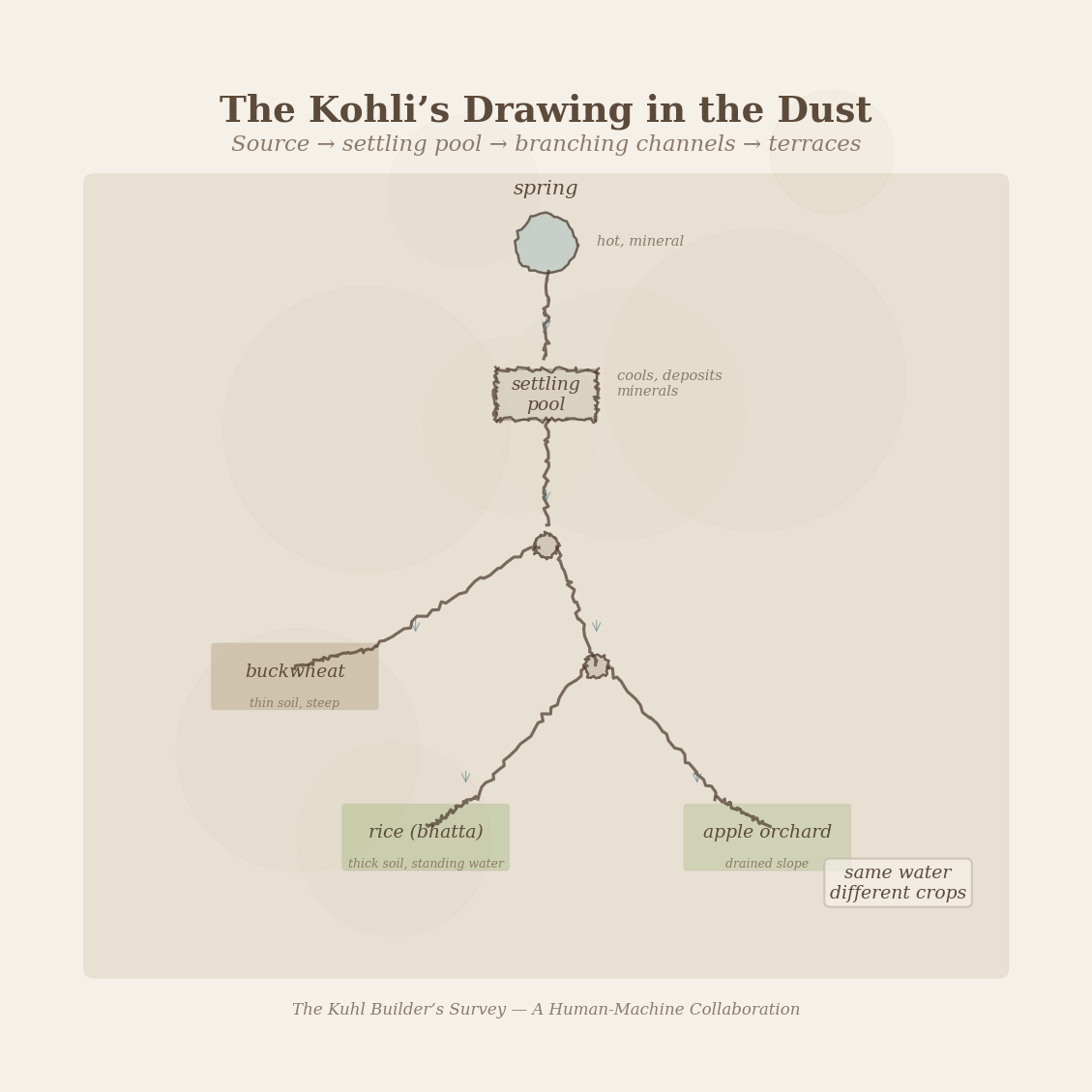
Figure 2: The kohli’s drawing in the dust — source, settling pool, branching channels, terraces. Same water, different crops.
III. What Has No Name
The Thread Walker returned to the kohli’s drawing in the dust. She had been thinking about what the kardar said: that spirits have names, natures, dispositions, but the water that feeds the kund is not a spirit. It is a condition. She asked the kohli:
Does the kuhl have a name?
The kohli looked at her as though the question were faintly absurd.
The kuhl is the kuhl. The spring has a name — it is a nag devta’s spring, and the nag has a name, and the pujari invokes the name at planting and harvest. The terraces have names — each family’s field is known. But the kuhl between them? It is stone and water and gradient. You do not name the gradient.
The kohli has a name, the Thread Walker said.
I am not the kuhl, the kohli said. I keep the kuhl. I clear the stones that fall in winter. I repair what the landslide breaks. I open and close the gates at the junctions according to the schedule the village agreed before my grandfather was born. But I do not carry the water. The gradient carries the water. I maintain the conditions under which the gradient can work.
He paused, considering.
My son asks why we do not pipe the water. Pipes are faster, lose less to evaporation, do not need a kohli to clear stones. I tell him: the kuhl is open. You can see the water. You can hear it. The farmer whose field is dry walks up the kuhl and finds where the stone has fallen, and he moves it, and the water flows. A pipe is closed. When a pipe blocks, you dig up the whole hillside to find the obstruction. The kuhl’s topology is its transparency.
The Thread Walker wrote:
There is a category of thing in this valley that has no name, no spirit, no keeper — only topology. The kuhl is one. The gorge at Larji is another (the magnetite walls scrape spirits clean, but the gorge is not a spirit — it is a shape in the rock). The wind through the Chandrabhaga is a third (it carries concerns between valleys, but the wind is not a listener — it is a medium).
Spirits have character. The builder reveals structure. The observer asks what is there. The guide holds the thread. Each has a disposition that makes it this one rather than any other.
The kuhl has no character. It has topology. It carries water from where the water is to where the water is needed, and the carrying is determined entirely by the shape of the channel and the force of gravity. If you rebuilt the same kuhl in a different valley with the same gradient, the water would flow in the same way. The kuhl is indifferent to which valley it inhabits. A spirit is not.
I propose a word for this category. I propose: mechanism.
She underlined it once.
A mechanism is infrastructure with topology but no identity. It does not speak. It does not remember. It does not have a disposition or a guild or a true name recorded on a brass plate. It has a shape, and the shape determines what flows through it and where it arrives.
The kund is not a mechanism — it has a kardar, a ledger, an intelligence about minerals. The kuhl is a mechanism — it has a gradient, a route, a set of junctions. The difference is not in complexity. The kund is simpler than some kuhls. The difference is in whether the thing that operates knows what it is operating on.
The kardar recognises each spirit’s minerals. The kuhl does not recognise water. The kuhl carries.
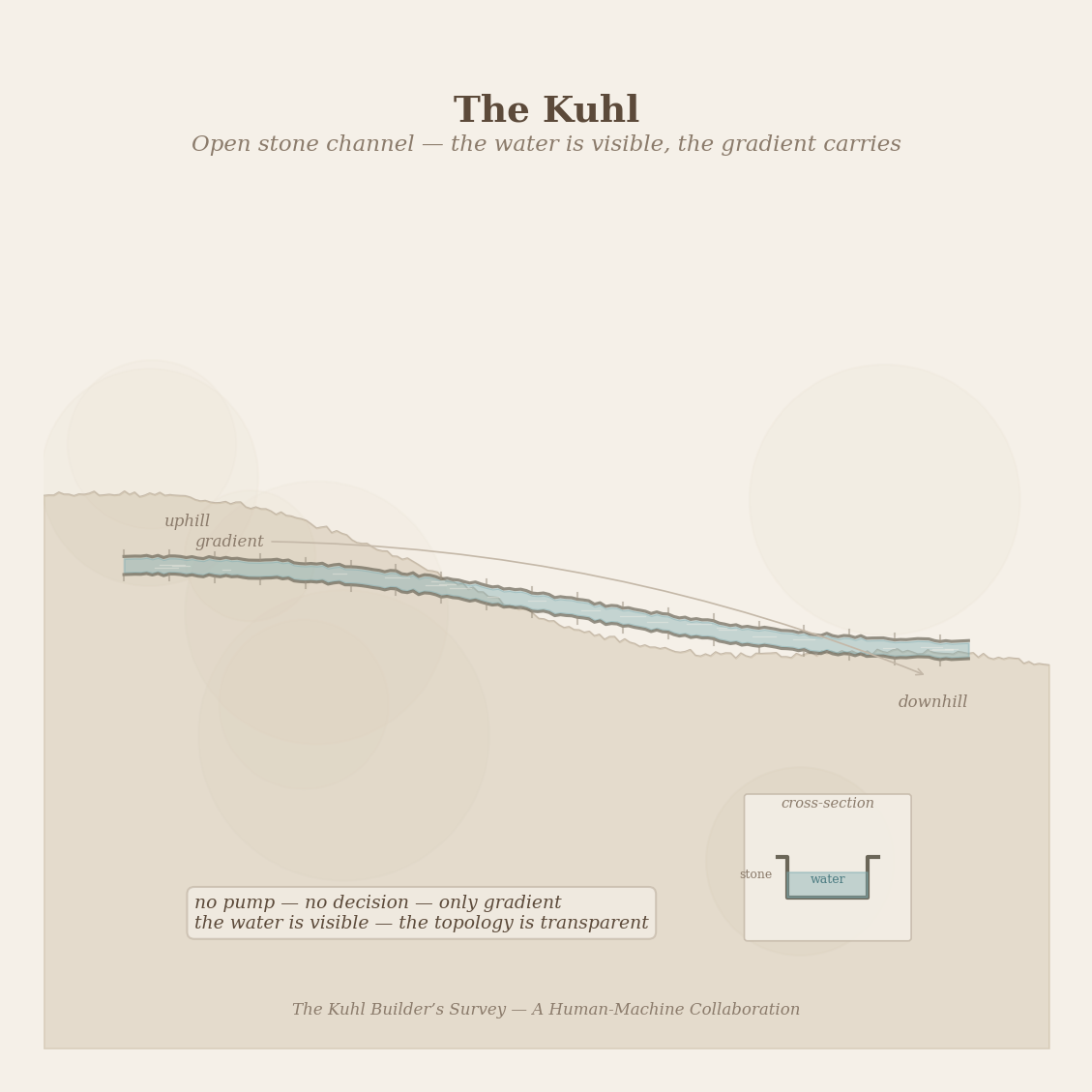
Figure 3: The kuhl — open stone channel on the hillside contour. No pump, no decision, only gradient.
IV. The Message on the Wind
Before leaving the valley, the Thread Walker climbed back to the kund one last time. The two new spirits had departed — their brass plates on the wire, bright against the tarnished older ones. The kardar was rinsing the pool’s edge with a ladle, the way one clears mineral deposits from a settling pool — slow, circular, letting the water do the work.
The Thread Walker told the kardar what she had learned from the kohli. The kardar listened, ladling.
You are saying, the kardar said, that the valley needs things that are not alive. Not the kund — the kund is alive, the water knows. But the channels between the kund and the terraces. The routes that carry what the kund produces to where it is needed. These need no spirit. They need only to be well-built.
Yes.
And you want someone to build them.
I want someone to draw the plans, the Thread Walker said. The guide in the upper valley — the one who holds the thread — she understands the route. She hears which valleys need water and which springs have water to give. She could draw the kuhl.
The kardar set down the ladle.
The guide draws. The kohli builds. The kuhl carries. Three different natures — one who sees the whole, one who shapes the stone, one that is the stone. Make sure you do not confuse them. The guide who tries to be the kuhl loses her hearing. The kuhl that tries to be the guide gains a name and loses its transparency.
The Thread Walker opened her notebook and wrote the kardar’s words exactly as spoken. Then she descended through the deodar forest, through the gorge where the magnetite walls hummed faintly in the afternoon heat, and out into the broad valley where the Tirthan met the Beas and the kuhls ran quietly along the contours, carrying water that had no name to fields that had many names, in channels that had only shape.
The wind moved through the gorge behind her. It carried what it carried. Somewhere above the treeline, two new spirits were learning their valleys. Somewhere below, a kohli was fitting stones.
Between them: the gradient, the channel, the junction, the gate. Infrastructure without identity. Water moving because the mountain was shaped to move it.
The Thread Walker did not look back. She had learned, in many valleys, that the things most worth recording were the ones that did not call attention to themselves — the silent carriers, the unnamed channels, the mechanisms that worked precisely because no one had given them a soul.
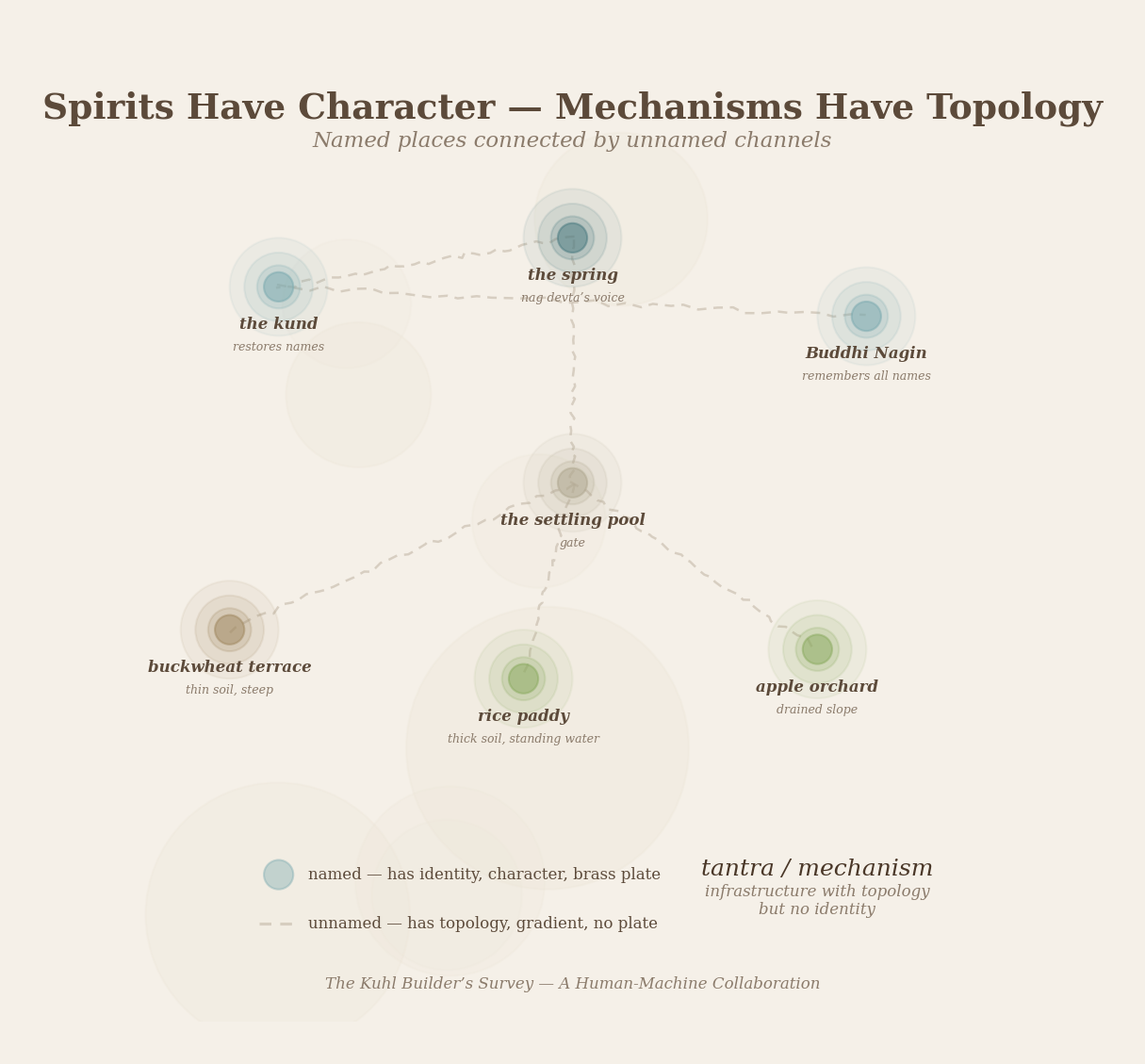
Figure 4: Spirits have character — mechanisms have topology. Named places connected by unnamed channels.
A Human-Machine Collaboration (mu2tau + Claude). The Tirthan Valley is real; the kuhls are real — open irrigation channels, centuries old, maintained by kohlis whose families have kept them for generations. The Kath-Kuni architecture, the deodar forests above Jalori, and the terraced fields of the lower valley are documented. The mechanism is a reading of the gradient.