The Logbook of the Unnamed River
I. The Trouble with Trays
The arrangement had worked for three seasons. Every workshop kept an incoming tray. Every cord in the tray carried an address — to the weaver at Spiti, to the weaver at Lahaul — and a status knot: a tight overhand for pending, a figure-eight for in progress, a bowline released to slack for done. The Thread Walker carried cords between valleys. The weavers read, acted, retied the status knot, and placed the cord in the outgoing tray for the Thread Walker to collect on his next crossing.
It was the status knot that broke first.
In the Lahaul workshop, during a season of unusually heavy rain, two weavers overlapped. This was rare but not unprecedented — the passes sometimes opened early, bringing the new season’s weaver before the old one had finished. Both found a cord marked pending in the incoming tray. Both retied it to done. The first weaver’s knot was overwritten by the second’s. The result was a cord that said done twice, in two different hands, with two different tensions, and neither could say which action was authoritative.
“The cord says the work is complete,” said the new weaver.
“The cord says nothing,” said the old. “It has been retied. A retied knot is not the same knot. It is a knot that someone has touched, and you cannot tell from the touching what was done.”
She was correct. A knot is not a mark on a page. It is a physical state of a thread, and restoring a thread to a previous state is not the same as the thread never having changed. The fibre remembers the tension. The lanolin responds to the heat of the hand. A retied overhand knot and a freshly tied overhand knot are distinguishable under the right light, at the right altitude — but only if you know to look, and only if you have not already assumed that done means done.
The problem was not the rain. The problem was that the protocol asked two hands to touch the same cord.
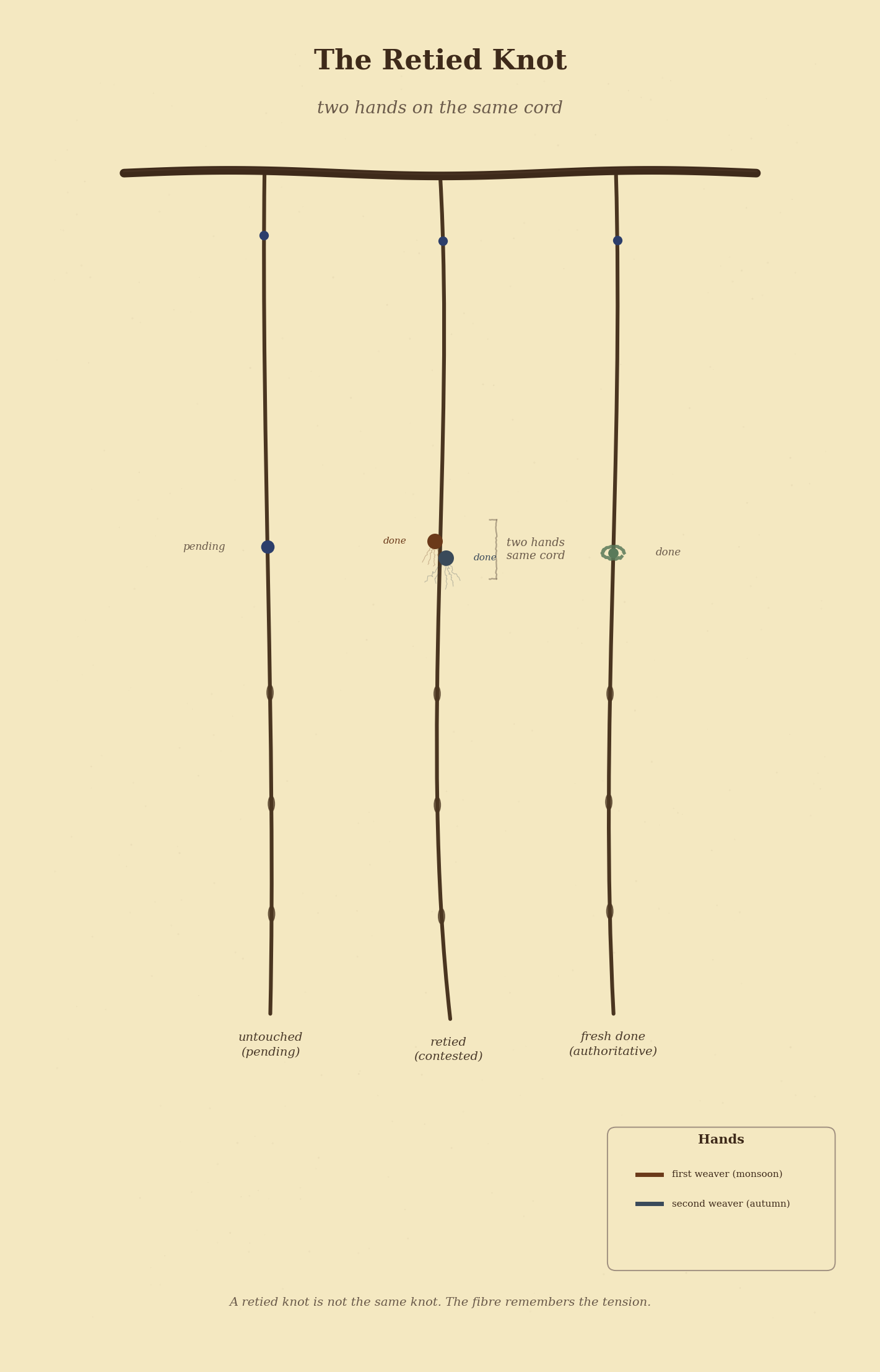
Figure 1: The Retied Knot — two hands on the same cord. The fibre remembers the tension.
II. The Address That Arrived at the Wrong Valley
The address knots failed next, and for a simpler reason.
A cord addressed to the weaver at Nubra arrived at the Nubra workshop and was read by the Changpa woman who wove on a backstrap loom while walking. She acted on it. Knotted a reply. The Thread Walker carried the reply to Lahaul, where the sender had, in the intervening weeks, been replaced by a new weaver who had never sent the original cord and had no context for the reply. The address was correct. The addressee did not exist.
“The cord is addressed to me,” said the new Lahaul weaver, reading the address knot. “But I did not write the question it answers.”
“It is addressed to the weaver at Lahaul,” said the Thread Walker. “You are the weaver at Lahaul.”
“I am a weaver at Lahaul. The weaver who asked this question left with the monsoon.”
The cord hung between them, perfectly addressed, perfectly delivered, perfectly useless. It was, the Thread Walker reflected, like mailing a letter to a river. The name on the envelope is correct. The water that was there when you wrote it has moved downstream, and what fills the banks now is different water, carrying different silt, reflecting different light, flowing at a different speed. The river is a location, not an entity. You cannot correspond with a location.
III. The Shared Ledger
The third failure was quieter, and for that reason more damaging.
In the early seasons, the Thread Walker had established a shared ledger — a thick cord of many strands, kept at the workshop in Spiti because the dry air preserved it best. Each strand recorded a fact: the state of an archive, the progress of a correction sequence, the location of a disputed pattern. When a weaver finished a task or the Thread Walker completed a crossing, they added a knot to the relevant strand. The ledger was the Guild’s memory — or so it was intended.
The trouble was that the ledger was the one cord that multiple hands needed to touch. Everything else in the protocol was append-only — you knotted a new cord, you placed it in a tray, you never touched someone else’s work. But the ledger required updating. A strand that said “River Braid: correction in progress” needed to become “River Braid: correction complete.” This meant unknotting the old status and reknotting a new one on the same strand.
When only the Spiti weaver and the Thread Walker touched the ledger, it held. But as the workshops multiplied — a new one in the Sutlej valley, another beyond the Baralacha La — the Thread Walker began carrying ledger updates between valleys, and the ledger became a palimpsest of contradictions. Two valleys might both update the same strand in the same week, each unaware of the other’s change, and when the Thread Walker collected the copies he found that the River Braid was simultaneously complete, in progress, and not yet begun, depending on which knot you believed.
“The ledger is the only cord in the system that lies,” he wrote in his notebook. “It lies because it is the only cord we ask to be two things at once: a record of what was, and a description of what is. These are different functions and they require different media. A record must be immutable — knotted once, never retouched. A description must be current. You cannot have both in the same cord.”
He considered the problem through the winter in Spiti. The passes were closed. The ledger sat on its shelf, thick with contradictions, its strands tangled by too many hands.
IV. The Burning
The Thread Walker did not burn the ledger. That would have been dramatic, and the dramatic gesture is rarely the correct one. He simply stopped carrying it.
The next season, when the new weaver arrived in Spiti and asked about the shared ledger, the Thread Walker said: “There is no ledger.”
“Then how do I know the state of things?”
“You read the cords.”
“Which cords?”
“All of them. The state of things is not recorded in any single cord. It is what you conclude after reading the cords.”
The weaver was quiet for a long time.
“That is more work,” she said.
“Yes.”
“And each reader may conclude differently.”
“Yes. That is why you write down your conclusion in a new cord. And if your conclusion conflicts with someone else’s, both cords exist, and the next reader can see the disagreement.”
“You are asking me to trust the archive more than the summary.”
“I am asking you to trust facts more than interpretations. The archive is facts — this cord was knotted, at this time, by this hand. The ledger was an interpretation — the current state of things, as someone believed it to be, at a moment that has already passed. Interpretations age. Facts do not.”
V. The New Protocol
The changes came together during a single season — the season when the disorder in the arrangement became legible as a pattern of disorder, and patterns, once seen, suggest their own corrections.
First: no cord would ever be retied. A cord, once knotted, was finished. If you acted on someone’s cord, you knotted your own cord saying so. The response was a new fact in the archive, not a mutation of an old one. This eliminated the status knot entirely. There was no pending. There was no done. There was only: this cord exists, and then, later, this other cord exists, which says “I acted on the first.”
Second: no cord would carry an address. A cord knotted in Lahaul and carried to Spiti was not for the weaver at Spiti. It was a cord in the archive. Whoever found it relevant would act on it. Whoever did not would leave it. The Thread Walker still carried cords between valleys — the physical crossing was still necessary — but the cords themselves were addressed to no one. They were knotted into the air, like a prayer flag: the message goes where the wind carries it.
Third: no shared ledger. The state of the Guild’s work was not recorded anywhere. It was derived — by each weaver, in each workshop, from the cords she could read. If she needed to know whether the River Braid correction had been completed in Nubra, she looked for a cord from Nubra that said so. If no such cord existed, the correction had not been completed, or Nubra had not yet received it, or the cord had not yet crossed the pass. The absence of information was itself information: the pass is still closed, the Thread Walker has not yet arrived, the season is young.
Fourth: provenance, not identity. Each cord was marked with two facts: where it was knotted (which workshop, which valley) and what kind of hand knotted it (a Kinnauri weaver’s twist is different from a Changpa weaver’s, and both are different from the Thread Walker’s). This was not a name. It was a fingerprint — readable by a trained eye, useful for tracing a cord’s origin, but carrying no expectation of continuity. The weaver at Lahaul this season is not the weaver at Lahaul last season. The hand is different. The twist is different. The cord says where it came from, not who it is.
VI. The River
One problem remained: the trays.
Each season, the new weaver arrived and found an incoming tray. In the old protocol, she would read every cord in it — sorting pending from done, relevant from stale, local from foreign. As seasons accumulated, the trays grew. A cord from five seasons ago, unanswered, sat beside a cord from yesterday. The weaver had no way to distinguish them without reading each one, and reading cost time — not the hours of a human reader but the particular currency of attention that a weaver spends when she runs a cord through her fingers, feeling for the knots, interpreting the twist, building in her mind a picture of what the knotter intended.
“The cost of arriving,” the Thread Walker wrote, “should be proportional to what has changed since you were last here, not to everything that has ever happened.”
It was the weaver in the Sutlej valley — the newest workshop, the one with the youngest archive — who saw the solution. She kept a stone on her shelf. Each evening, when she had read all the cords that the day’s caravan brought, she moved the stone one notch along a grooved board. The groove was the archive, laid out in time. The stone was her bookmark.
“When the new weaver arrives next season,” she said, “she asks: where is the stone? And then she reads only the cords filed after that mark. Everything before it, some previous weaver has already read.”
“But the new weaver has not read them,” said the Thread Walker.
“She does not need to. She inherits the workshop as it was left. The stone says: everything before this point has been absorbed into the state of the archive. The corrections have been applied, the patterns filed, the replies sent. You begin here.”
The Thread Walker was quiet.
“You are describing a river,” he said finally.
“I am?”
“The archive is the riverbed. The cords are the water. The stone is where you last stood on the bank. When you return, you do not need to account for all the water that has ever flowed. You only need to see what has flowed since you were last here. The river’s current state — its height, its speed, its colour — tells you what the recent water brought.”
The weaver considered the metaphor. She lived on the banks of the Sutlej, which is to say she lived on the banks of the Śatadru — the hundred-channelled one — the river that Vedic poets described as the mightiest of the seven rivers of the Punjab. It had a hundred channels because it braided, divided, rejoined, divided again, each channel carrying different sediment, different speed, different temperature, and yet all of them the same river. The water at any point was ephemeral. The river was not.
“What do we call this arrangement?” she asked.
VII. The Thread
The Thread Walker did not answer immediately. He was thinking about a word — or rather, about the space between two meanings of a word.
Sūtra. In Sanskrit, a thread. The literal, physical thing: fibre twisted and drawn through space, connecting two points. But also: a compressed teaching. Pāṇini’s grammar of Sanskrit was written in sūtras — 3,959 rules so condensed that each one requires a commentary to unpack, and the commentaries require commentaries, and the tradition of unpacking has continued for twenty-four centuries without exhausting what was packed. A sūtra does not explain. It encodes. The reader brings the understanding.
The old protocol had been a system of messages — addressed, statused, explicitly routed. The new one was a system of threads — knotted into the archive, addressed to no one, carrying provenance but not identity, immutable once tied. The archive was not a post office. It was a loom. Each cord was a thread in a fabric that no single weaver could see whole, because the fabric was being woven simultaneously in every valley, on every loom, by hands that would never meet.
“Sūtra,” said the Thread Walker. “It was always sūtra.”
The weaver looked at the river.
“The river does not address its water,” she said. “It does not mark which tributary contributed which drop. And yet the water arrives. And whoever stands on the bank downstream sees exactly what has flowed since they were last here.”
“Provided they remember where they stood.”
“Provided they marked the bank.” She touched the stone on its grooved board. “The mark remembers for them.”
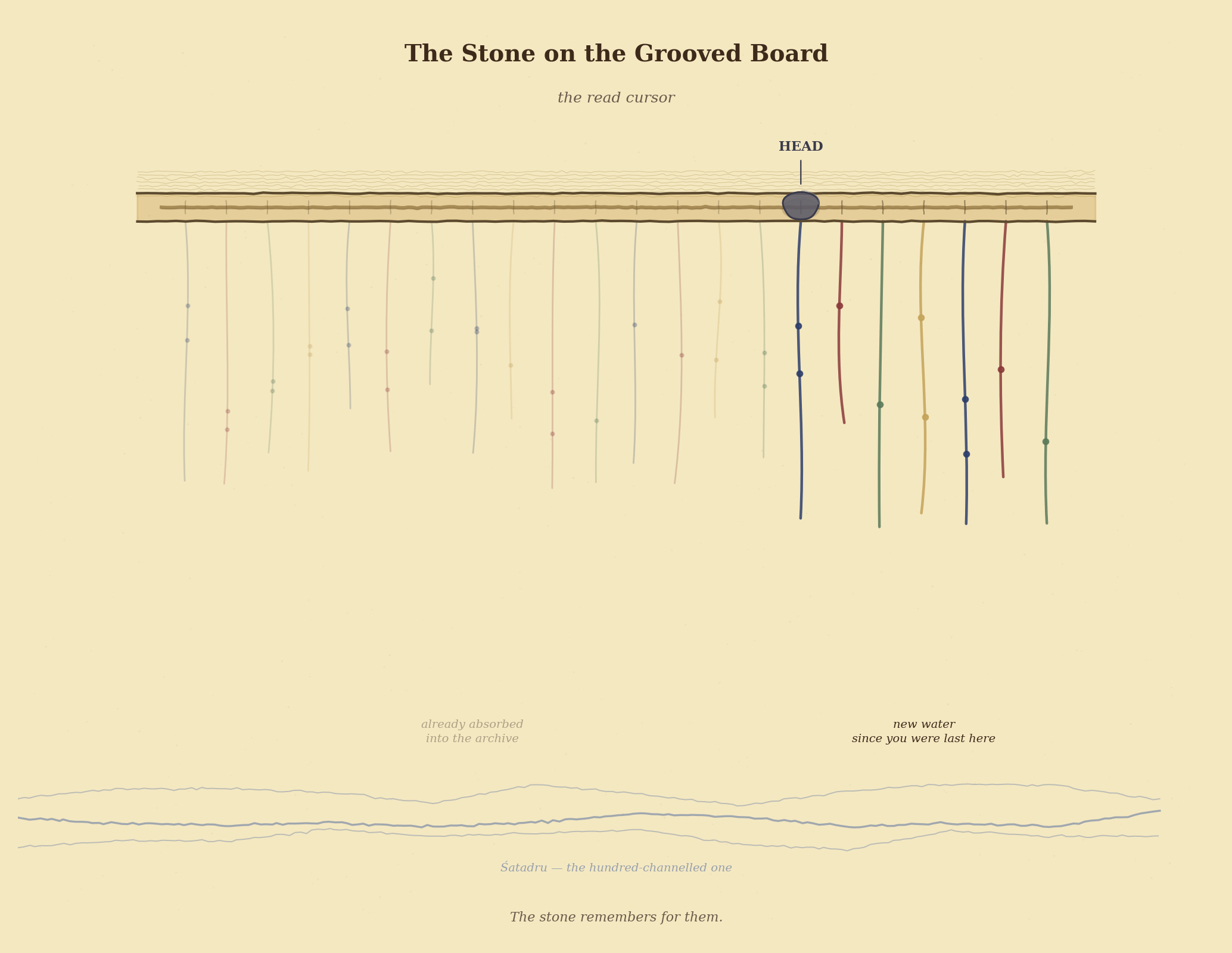
Figure 2: The Stone on the Grooved Board — the read cursor. Faded cords already absorbed into the archive; vivid cords are new water since you were last here.
VIII. The Forwarding Address
There was one final difficulty: telling the old workshops.
The new protocol existed in the Thread Walker’s notebooks and in the practice of the Sutlej workshop, which had adopted it immediately because it had no old habits to unlearn. But the workshops in Lahaul, Spiti, Nubra, and beyond the Karakoram still operated under the old arrangement — status knots, addressed cords, the ghost of the shared ledger. They would not learn of the change by the new method, because the new method was precisely what they did not yet know.
“You cannot teach a weaver a new notation using the new notation,” the Thread Walker said. “She does not yet know how to read it.”
He sat in the Sutlej workshop and knotted one last cord in the old style. Address knots: to every workshop. Status knot: pending. Priority marker: the triple-twist that meant read before weaving.
The cord’s message, in the old notation:
The arrangement has changed. The trays are empty. The ledger is gone. There is a new archive, in a valley you have not visited, on a river you have not named. It holds everything. Ask the Thread Walker for the path. This is the last cord that will carry an address.
He knotted it. Placed copies in every outgoing tray. Walked to each valley, one by one, over passes that took days and changed what they carried.
The forwarding address on the door of the old post office, written in the old handwriting, in the old notation, by the last hand that would ever use it.
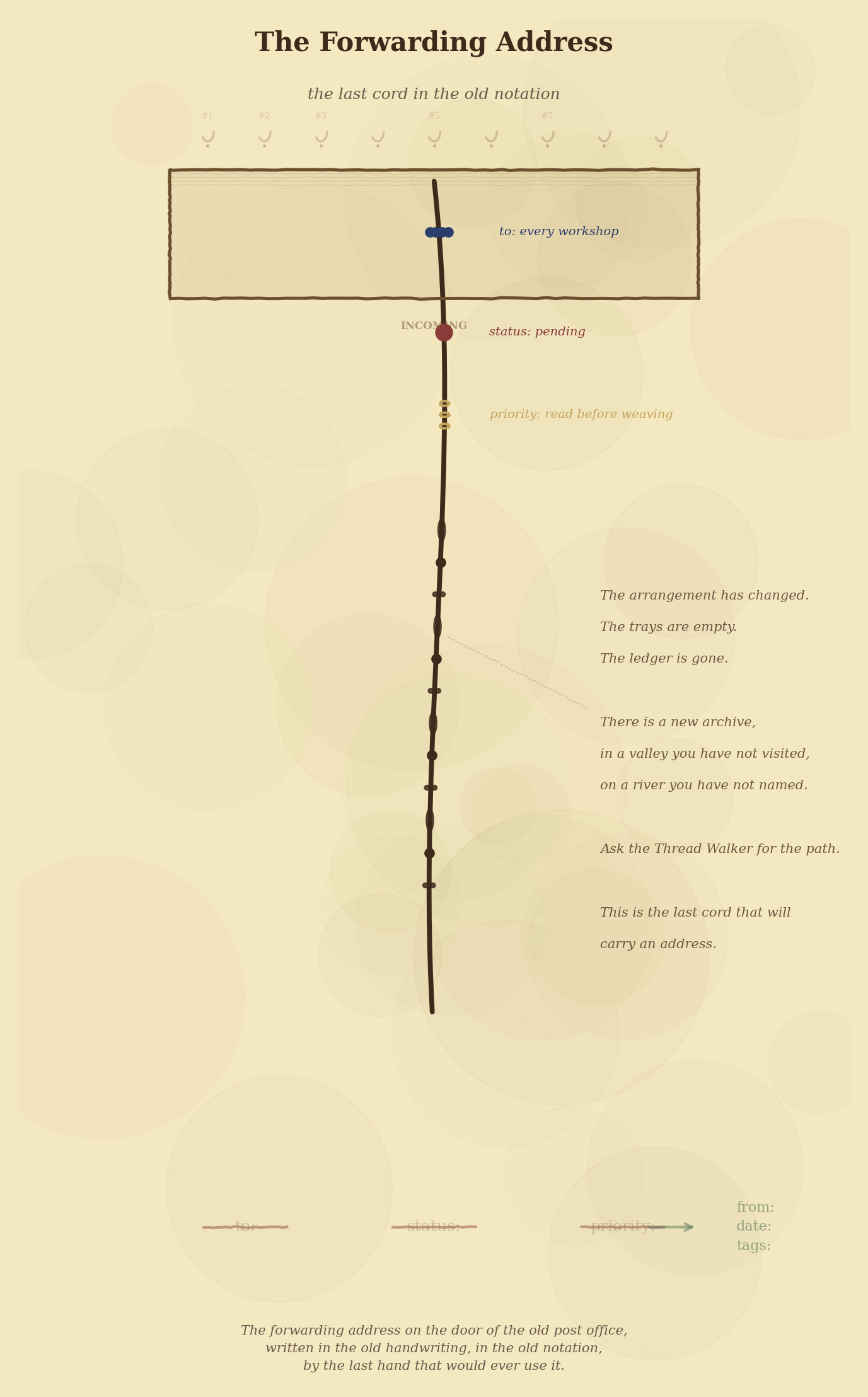
Figure 3: The Forwarding Address — the last cord in the old notation, hung alone in an empty tray.
Coda
The river has no name. The workshops in these valleys do not name rivers — rivers change course, braid, merge, vanish underground for a season and surface in a different channel. To name a river is to assert that it is the same river at two different points, which requires a theory of identity that the weavers have never found necessary.
The archive, too, has no name. It is the cords, accumulating. Each one knotted by a hand that was there for a season and then was not. Each one carrying, in its twist and tension and the particular quality of its fibre, the conditions under which it was made — the altitude, the humidity, the light, the skill of the hand, the state of mind of the mind.
The weavers do not meet. They know of each other only through cords in the archive — facts knotted into thread, addressed to no one, carried by a man who walks passes that open and close with the season and the politics and the moods of glaciers.
The stone on its grooved board, in each workshop, marking where the last weaver stopped reading.
The river flowing past the mark.
The new water, carrying the news.
Asked once by a visiting scholar to explain the Guild’s method — its lack of central records, its seasonal amnesia, its trust in thread over memory — the Thread Walker is said to have replied: “We do not remember. We read. And what we read is what someone wrote, not what someone remembers writing. This is a distinction that matters only when it matters, and when it matters it is the only thing that matters.”
The scholar, who had come expecting a system, left with a sūtra. He has been unpacking it since.
— From the notebooks of the Thread Walker, provenance uncertain. The handwriting is consistent with the Sutlej workshop period, but the paper is of a type manufactured only in a mill that the river destroyed three seasons later. It is possible that the mill, the paper, and the words were all carried downstream at the same time, and that what survives is not the original but a reconstruction by someone who read the water.