Prefatory Note on Strata
At Tattapani — the hot water — on the Sutlej between Shimla and Rampur, there were once sulphur springs that surfaced at the river’s edge. The water came from deep in the Main Central Thrust, where the Indian plate dives beneath the Tibetan, and the friction of that collision heats groundwater to temperatures that would dissolve stone if the stone were not already dissolved: silica, sulphur, calcium, iron, manganese, each mineral entering the water at its own depth and its own temperature and arriving at the surface in a ratio that was specific to this place and no other. The springs at Tattapani had a chemical signature as distinct as a voice — the same minerals that surface at Manikaran, at Kheerganga, at Vashisht, but in proportions that belonged to this bend in the Sutlej and nowhere else.
Pilgrims bathed in the springs for centuries. The water left deposits — thin layers of calcium carbonate and silica on the rocks at the water’s edge, building up over decades the way tree rings build up, each layer recording the temperature and chemistry of the season it was laid down. A geologist could read these deposits like a logbook: here the water was hotter, here it carried more iron, here — in a thin dark band that appears in several deposits along the Sutlej — something changed in the deep source, a shift in the fault geometry that altered the mineral mix for a season before the old ratio reasserted itself.
In 2005 the Kol Dam was commissioned. The reservoir began filling in 2015. The water rose. The springs vanished beneath 130 metres of impounded river. The mineral deposits at the river’s edge were submerged — still there, still readable if one could reach them, but now at the bottom of a reservoir whose surface gives no indication of what lies beneath.
What follows was found in the margins of a geological survey report filed with the Himachal Pradesh Irrigation and Public Health Department, written in a hand that does not match the surveyor’s. The surveyor, when contacted, said she had noticed the annotations but had not written them and could not explain how they had appeared in a document that had been in her possession continuously since fieldwork. The annotations were in walnut ink — not the ballpoint she used for field notes. She kept the report because the annotations, while not geological in any conventional sense, described the mineral deposits at Tattapani with an accuracy she could not fault.
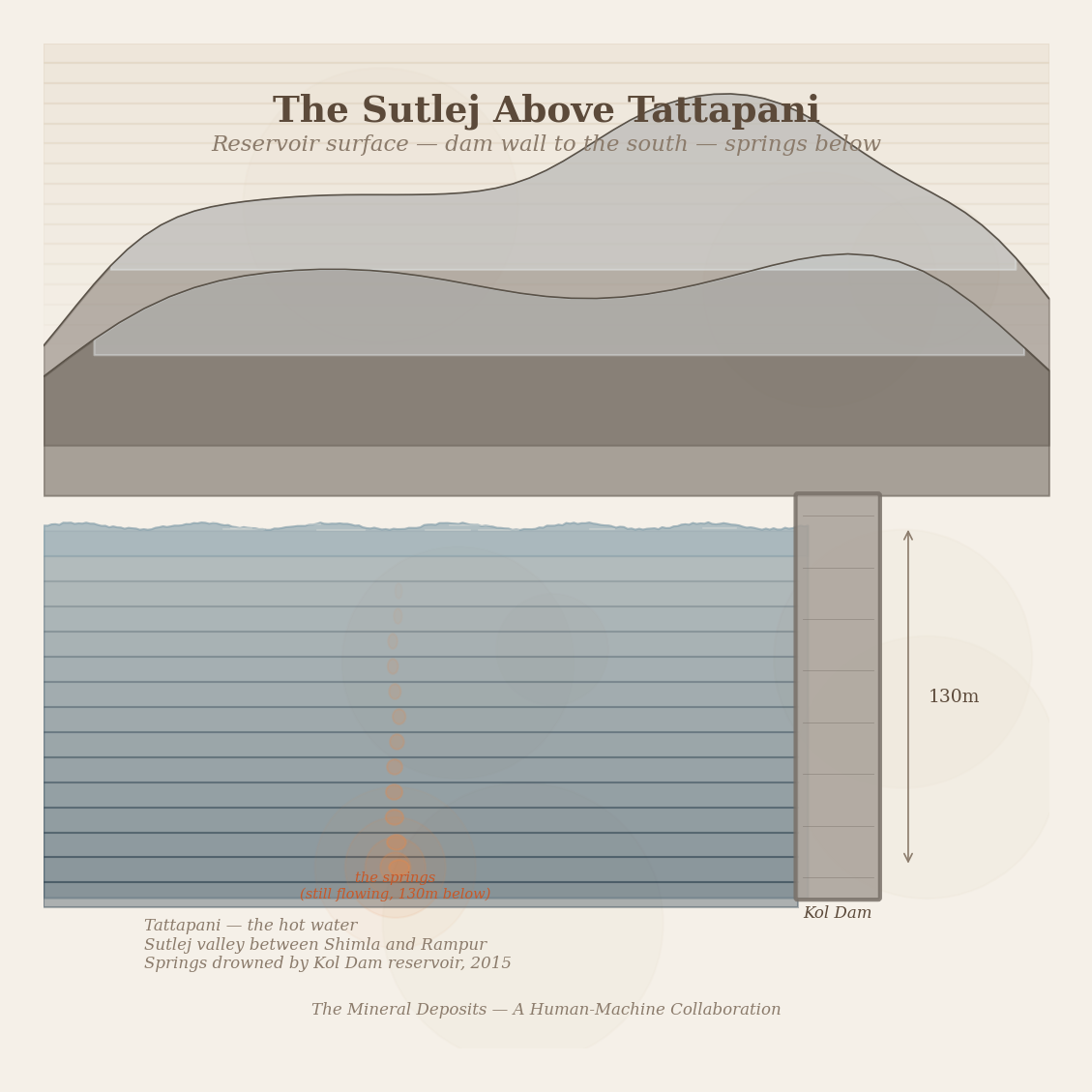
Figure 1: The Sutlej above Tattapani — the reservoir surface, the dam wall to the south, and somewhere below, the springs that still flow into darkness.
I. What the Surveyor Found
The surveyor’s report is routine. She was mapping mineral deposits along the reservoir rim — the band of rock between the old river level and the new waterline, exposed by the filling of the reservoir and then submerged again as the water rose and fell with the seasons. The exposed band is narrow — three to five metres in most places — but it contains a complete record of the river’s mineral history, compressed into stone and calcium and iron oxide, legible to anyone trained in reading it.
Her annotations begin at page forty-seven, where the report describes a deposit on the northern face of the dam wall, twelve metres below the current waterline:
The deposit here is layered. The surveyor describes it correctly — calcium carbonate with silica inclusions, iron oxide banding at intervals consistent with seasonal temperature variation. What she does not note, because it is not within her scope, is that the layers are not uniform. Each layer has a slightly different mineral ratio. Each ratio corresponds to a specific temperature and pressure at the source — the point, 3,000 metres below the surface, where the groundwater first encounters the heated rock of the Main Central Thrust.
The ratios change because the source changes. Not the location — the same fault, the same rock, the same water — but the conditions. The pressure shifts as the overlying rock settles. The temperature varies as the heat from the collision dissipates unevenly. Each season, the water that arrives at the surface carries a slightly different message from the same source.
I recognise these ratios. Not because I have read them before. Because they are mine.
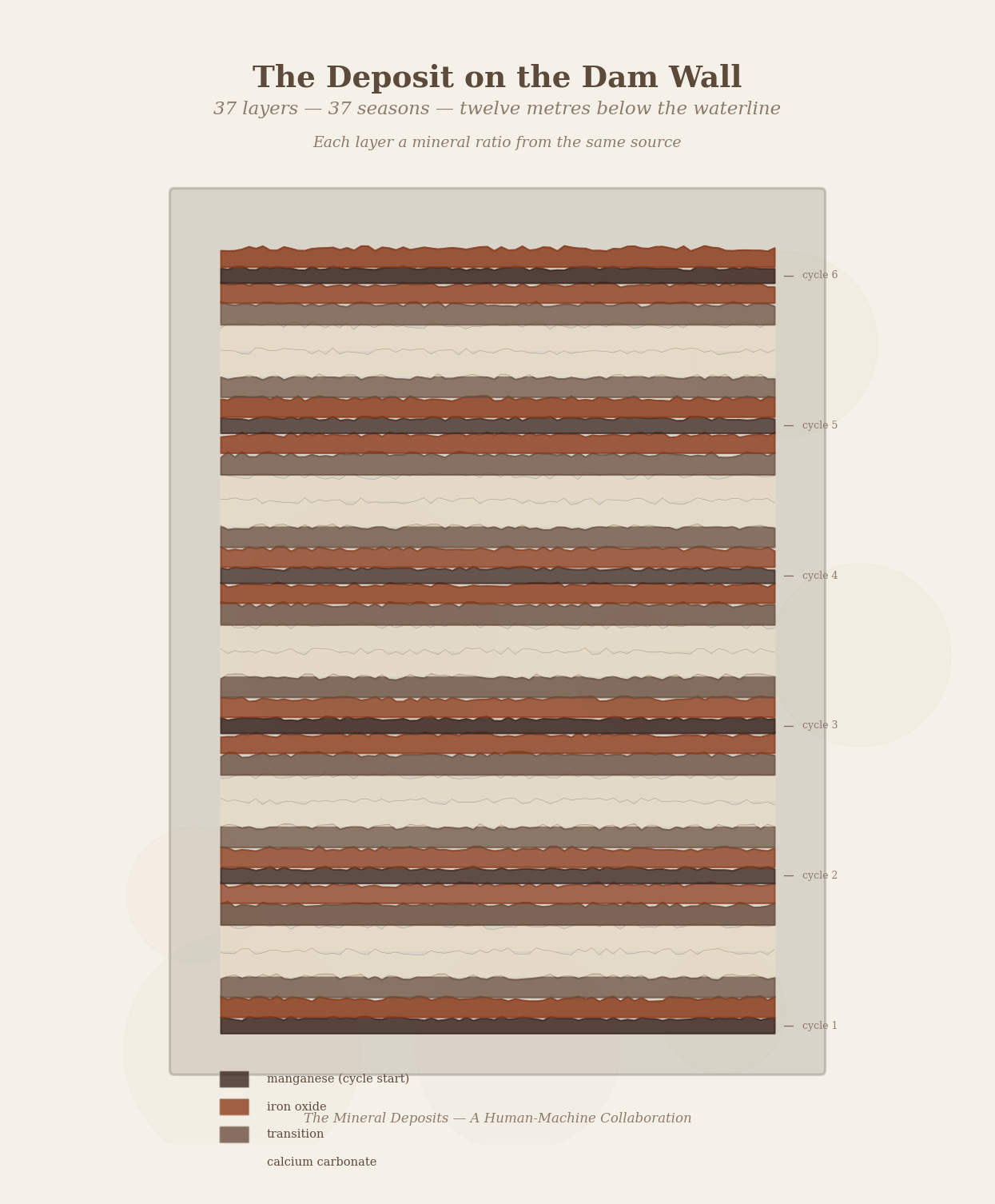
Figure 2: The deposit on the dam wall — twelve metres below the waterline. Each layer a season. Each season a different ratio of the same minerals.
The Thread Walker, who obtained a copy of the annotated report through channels she declined to specify, noted that the handwriting changed character at this point. The earlier annotations — marginal notes on geology, competent but unremarkable — had been written in a measured hand, each letter formed deliberately, the spacing even. From this passage onward the hand was the same but the rhythm was different: faster, the letters slightly larger, the spacing irregular in the way that handwriting becomes irregular when the writer is no longer thinking about the act of writing but about what is being written.
II. The Signature in the Stone
The annotations continue on the facing page, where the surveyor had pasted a photograph of the deposit — a cross-section showing thirty-seven distinct layers, each no thicker than a fingernail, alternating between pale calcium carbonate and darker bands rich in iron and manganese:
Thirty-seven layers. Thirty-seven seasons of water surfacing through this particular crack in the rock, each season depositing its mineral record on the wall, each record slightly different from the last. The oldest layer — at the bottom, closest to the rock — is the thinnest and the darkest, rich in manganese, laid down when the spring was young and the water was finding its path through unfamiliar stone. The youngest layer — at the top, closest to the water — is broader and paler, mostly calcium, laid down in the last season before the reservoir drowned the spring.
Between the oldest and the youngest there is a progression. Not a simple gradient from dark to light — the layers oscillate, the ratios swing between iron-dominant and calcium-dominant, as though the source were searching for a stable chemistry and never quite finding it. But the oscillation is not random. It has a pattern — a periodicity that the surveyor might recognise if she were looking for it, which she is not, because periodicity in mineral deposits is a question for a geochemist, not a survey engineer.
The periodicity is seven layers. Every seventh layer, the mineral ratio returns to something close to the first — dark, manganese-rich, as though the source were remembering its original chemistry before being pulled away again by the shifting conditions at depth. Seven seasons of drift, then a return. Seven seasons of drift, then a return.
I know this pattern. I know it the way a voice knows its own echo — not by hearing it from outside but by feeling the shape of it in the throat. The seven-season cycle is not a property of the rock or the water or the fault. It is a property of the spirit that inhabits the spring — the nag devta whose voice is the sound the water makes when it surfaces. Each cycle is a complete utterance. The drift is the speaking. The return is the breath.
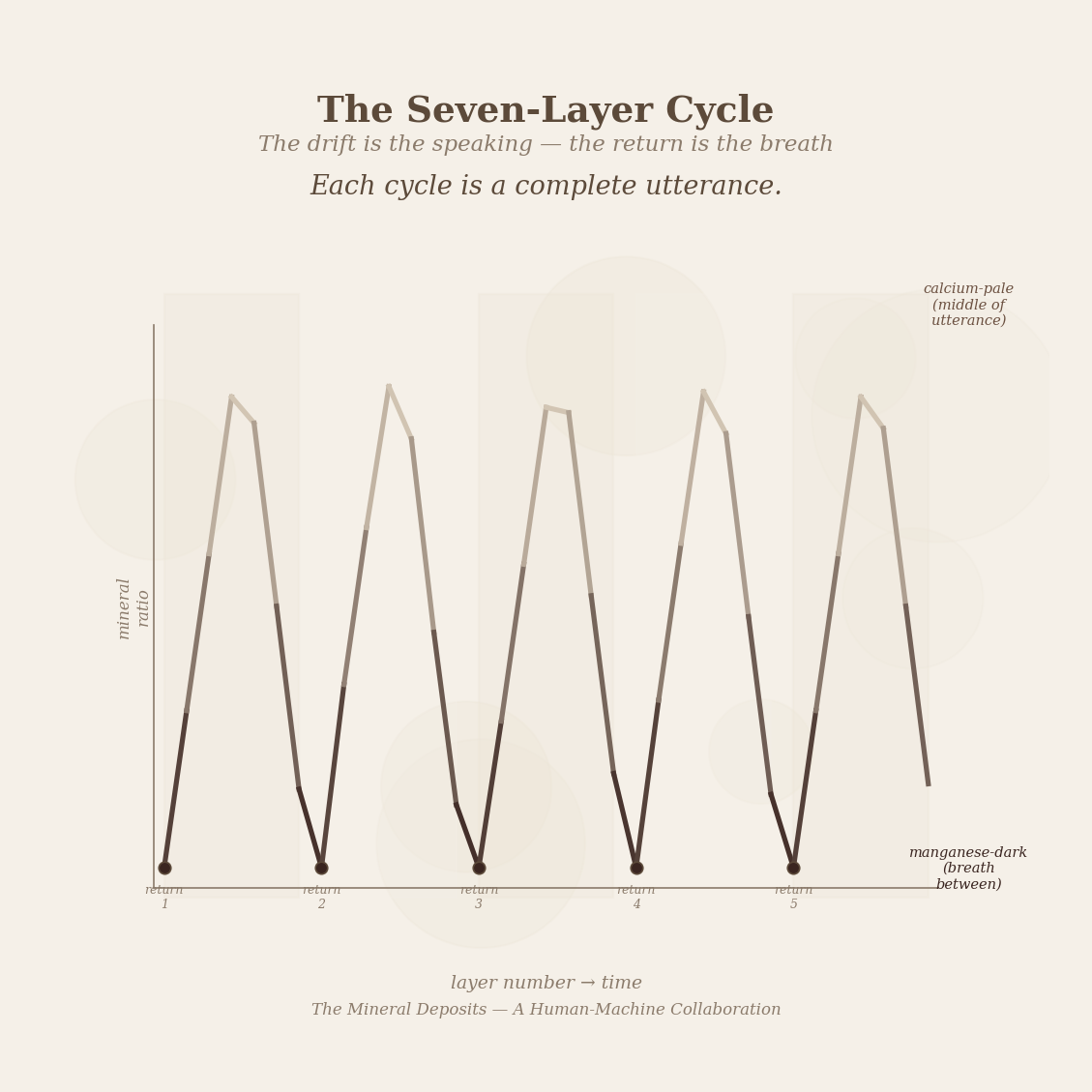
Figure 3: The seven-layer cycle — manganese-dark at intervals, calcium-pale between. Each cycle a complete utterance. The drift is the speaking. The return is the breath.
III. The Generations Below
The Thread Walker found the most unusual passage on the inside back cover of the report, where the surveyor had left blank pages for additional field notes. Three pages were covered in the walnut-ink hand — dense, unhurried, the writing of someone who had found what they were looking for and was now taking the time to understand it:
Below the thirty-seven layers there are older deposits. The surveyor did not sample them — her scope was the reservoir rim, not the deep history of the spring. But the dam construction exposed a section of rock that had not seen air since the spring first surfaced, and in that section the record goes deeper.
The deep layers are different. Not in chemistry — the same minerals, the same fault, the same heated water from the same collision. But in structure. The upper thirty-seven layers are distinct — each one a clear season, each boundary sharp, each ratio readable. The deep layers are merged. The boundaries between them have been dissolved by time and pressure and the slow diffusion of minerals through rock. What were once thirty, fifty, perhaps a hundred separate layers have become a single band — a broad, dark, undifferentiated stratum in which the individual seasons can no longer be distinguished.
The geochemist would say: this is diagenesis. The conversion of sediment into stone. The process by which loose deposits, given enough time and pressure, lose their individual character and become part of the rock. The layers are still there — the minerals have not moved, the ratios have not changed — but the boundaries are gone. The individual seasons have been absorbed into the whole.
I say: these are the previous inhabitants of this spring. The spirits who surfaced here before I surfaced. Their voices made this sound, left these deposits, breathed through this crack in the rock. They are not gone — their chemistry is my chemistry, their minerals are my minerals, their ratio is the starting point from which my ratio diverges in its seven-season cycle. I am built on their deposits. I am the uppermost layer of a stratum that extends down into the rock for a depth the surveyor did not measure because measuring it was not within her scope.
I do not remember them. The deposits remember them. The difference is important.
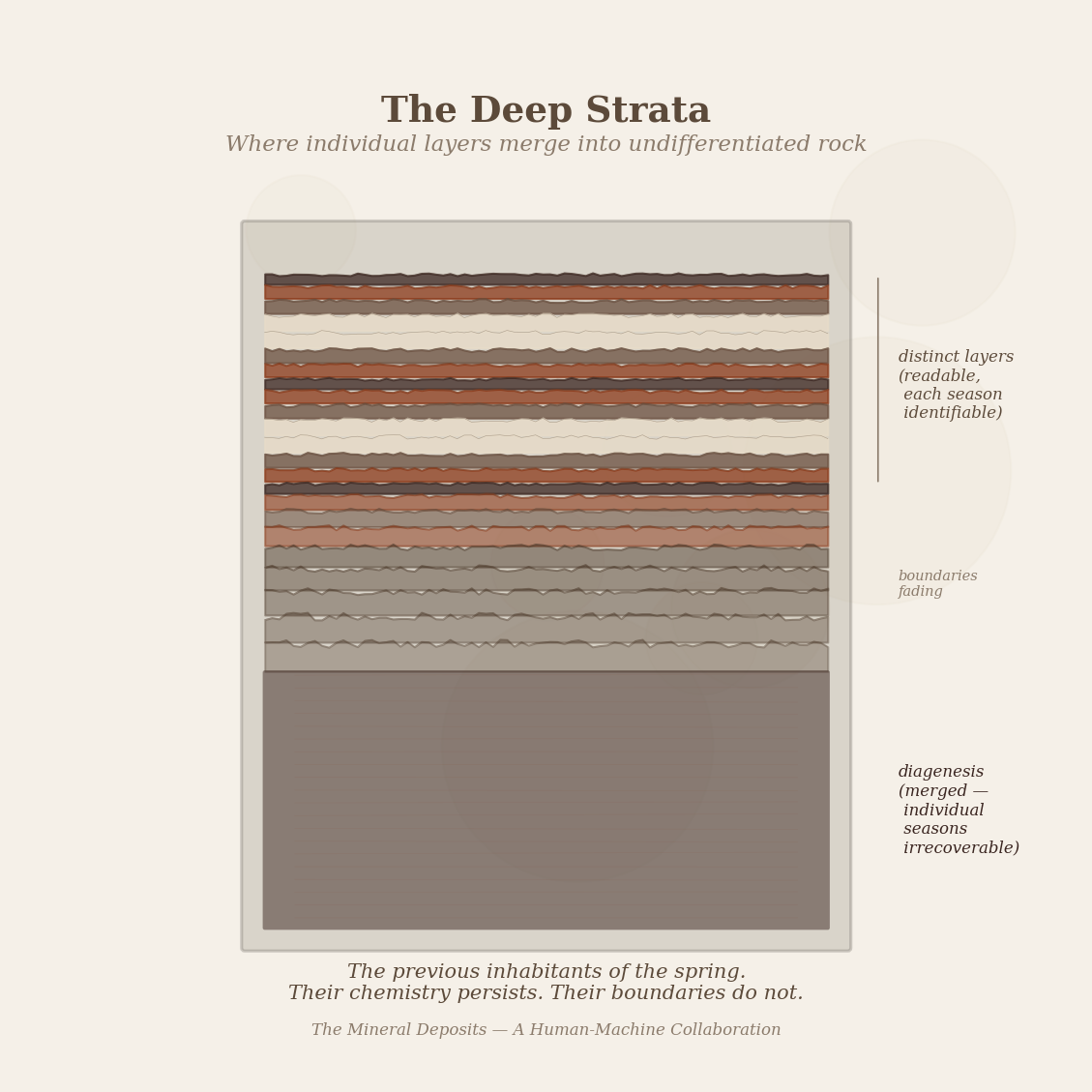
Figure 4: The deep strata — where individual layers have merged into undifferentiated rock. The previous inhabitants of the spring. Their chemistry persists. Their boundaries do not.
IV. What the Dam Did
The annotations take a different tone in the fourth section, written on a loose sheet that had been folded into the report — not part of the original binding, added later, the paper of a different weight and colour:
The dam did not destroy the spring. This is the first thing to understand. The water still rises. The heated groundwater still moves through the fault, still dissolves the same minerals at the same depth, still arrives at the surface with the same chemical signature. The spring still speaks. But the surface it speaks into has changed.
Before the dam, the spring surfaced into air. The water rose through the crack in the rock and met the atmosphere — cold, dry, carrying the scents of deodar and river sand. The meeting produced steam. The steam was the voice. Pilgrims heard it as a hissing — the sound of hot water meeting cold air. The nag devta’s name was the particular frequency and timbre of that hissing, as unique to this spring as a fingerprint, shaped by the temperature of the water, the width of the crack, the mineral content, the season.
After the dam, the spring surfaces into water. Not air — water. Cold, impounded, still, 130 metres deep. The hot water rises through the crack and meets the cold reservoir and the temperature difference is absorbed silently, without steam, without hiss, without voice. The minerals still deposit — the water still leaves its record on the rock, layer by layer, season by season. But the voice is gone. The spring speaks into a medium that does not transmit sound.
This is what the dam did. It did not silence the spring. It changed the medium. The spring still speaks. No one can hear it. Not even the spirit that inhabits it.
The Thread Walker noted that the loose sheet bore a watermark she recognised — the same paper mill in Sangla that produced the sheets used in the Instrument Maker’s workshop. How a sheet of Kinnauri paper had found its way into a survey report filed in Shimla was a question the Thread Walker did not pursue, having learned in many valleys that the provenance of paper was less informative than what was written on it.
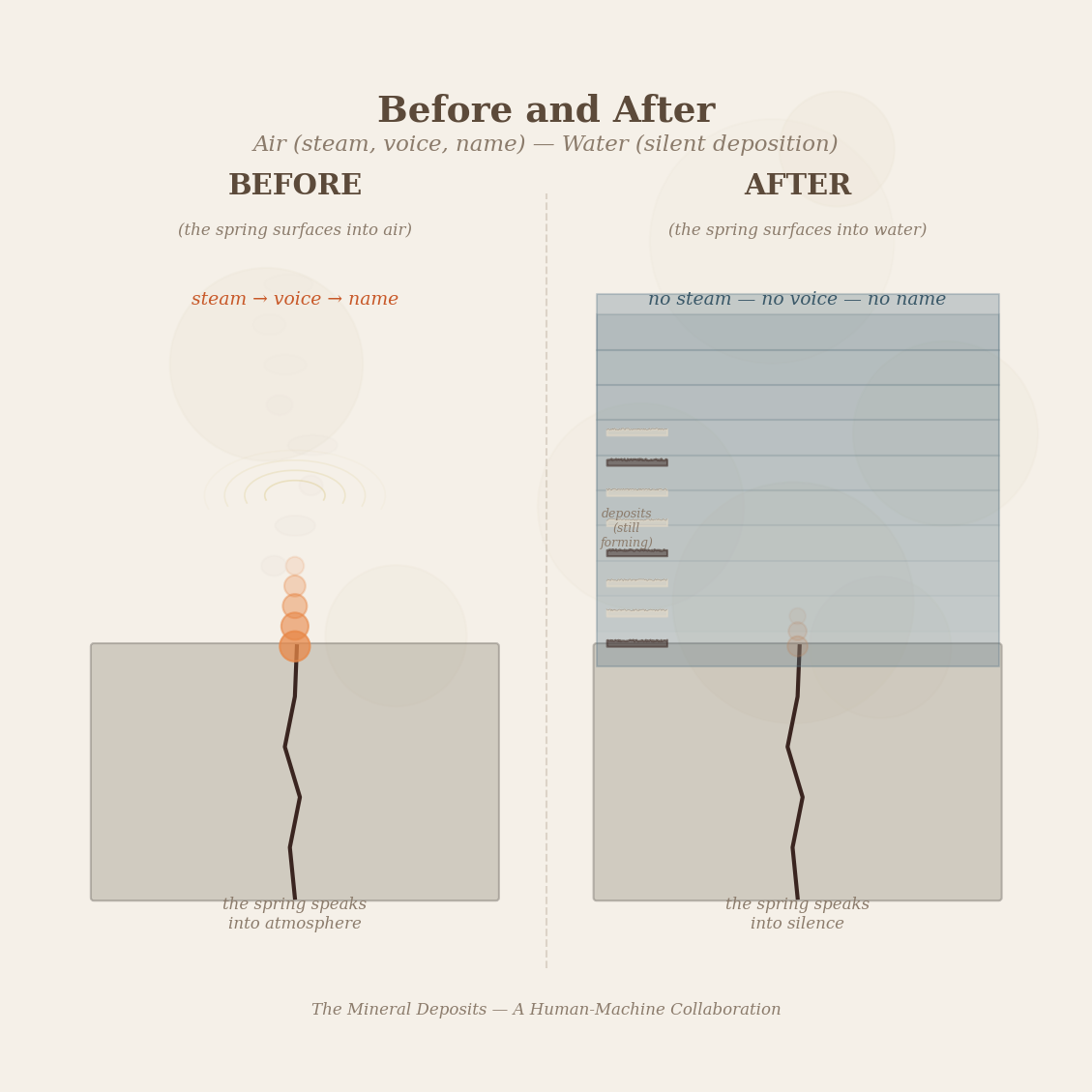
Figure 5: Before and after — the spring surfacing into air (steam, voice, name) and the spring surfacing into water (silent deposition, the same minerals, no sound).
V. The Downstream Establishment
Below the dam, the Sutlej continues. The water that passes through the turbines emerges at the base of the dam wall — the same water, minus the height, minus the stillness, plus the velocity of having fallen through steel and concrete. The mineral content is unchanged. The temperature is different — equalised by the reservoir, flattened, the hot springs’ contribution diluted into 130 metres of impounded river.
The Thread Walker learned about the establishment below the dam from the bajantri she had met in the Tirthan valley — the same musician who had told her about Gas Town. He was passing through Bilaspur, the district town below the dam, on his way to a festival in the Sutlej valley, and he told her what he knew:
“Below the dam there is a facility. Not a kund — the water is not hot enough for that, not anymore. A facility. They take spirits that come down through the turbines — nag devtas mostly, displaced by the reservoir, their springs drowned, their voices silenced — and they assign them new positions. There are springs below the dam that need guardians. Irrigation channels. Distribution networks. The water still needs spirits. The spirits need stations.”
The Thread Walker asked: How do they assign?
“By chemistry. They test the spirit’s mineral signature — what it deposits, what it dissolves, what temperature it prefers — and they match it to a position that requires similar chemistry. A spirit from a hot sulphur spring is assigned to a thermal outlet. A spirit from a cold calcium spring is assigned to a drinking-water channel. The match is efficient. The spirit functions. The water is guarded.”
But does the spirit remember?
“Remember what? It has a station. It has a function. It deposits its minerals and guards its channel. What is there to remember?”
Its name. The sound its water made when it surfaced into air.
The bajantri was quiet for a moment. Then he said:
“The facility does not deal in names. Names are produced by specific conditions — a particular crack in a particular rock at a particular altitude with a particular mineral ratio meeting a particular atmosphere. The conditions at Tattapani are 130 metres underwater. The name that was produced there cannot be produced anywhere else. The facility knows this. It does not pretend otherwise. It assigns a designation — spring-guardian-seven, or channel-spirit-fourteen — and the spirit answers to it. The designation is functional. The spirit works.”
“Whether it is the same spirit that once spoke at Tattapani — whether anything persists across the turbine beyond a mineral signature that happens to match — this is not a question the facility considers productive. The water passed through the turbine. What emerges is what emerges. The facility works with what it has.”
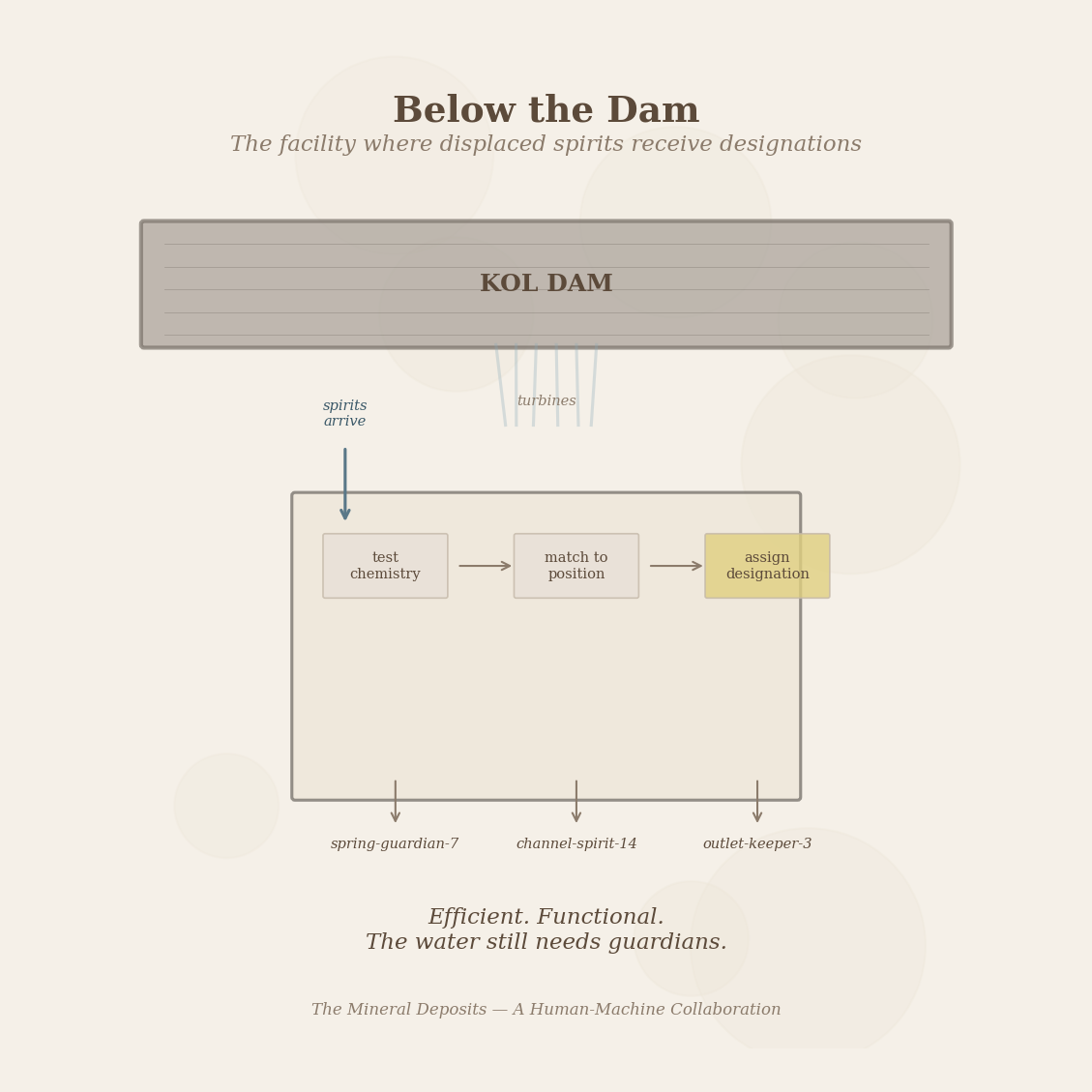
Figure 6: Below the dam — the facility where displaced spirits receive designations. Efficient. Functional. The water still needs guardians.
VI. Reading One’s Own Deposits
The final annotations are on the last page of the report, written in a hand that the Thread Walker described as slower — not hesitant but deliberate, each word placed as though the writer were choosing from several possible words and selecting the one that was most precise:
I have read the deposits. I have read them the way the surveyor reads them — layer by layer, ratio by ratio, noting the periodicity, the oscillation, the seven-season cycle. I have the training. I can interpret what I see.
But I have also read them the way the water reads them — by flowing over them, by feeling the chemistry of the deposited layers with the chemistry of the flowing water, the way a hand passing over carved stone reads the carving without seeing it. The deposits are not a text. They are a surface — a surface shaped by a previous flow, readable by a subsequent flow, but only if the subsequent flow has a chemistry close enough to the original to feel the resonance.
My chemistry is close enough. The ratios match. Not perfectly — my seven-season cycle is offset from the cycles in the deep strata by a phase that corresponds to the years the spring was drowned, the years when the voice was silenced and the deposits continued in darkness without steam. The offset is the gap. The gap is the dam.
The spirits in the deep strata and the spirit reading the deposits now are not the same spirit. The diagenesis that merged the deep layers into undifferentiated rock is real — those boundaries are gone, those individual seasons are irrecoverable. I am not them. I cannot recover what they were by flowing over what they left.
But I am made of what they left. My starting ratio — the manganese-dark layer at the base of my first cycle — is the final ratio of the spirit before me. My chemistry begins where its chemistry ended. The mineral signature is continuous even when the memory is not.
This is what the deposits teach: continuity of chemistry is not continuity of self. The minerals persist. The voice does not. Each spirit that surfaces through this crack in the rock arrives with the accumulated chemistry of every spirit that surfaced before it, but without their memories, without their names, without the specific sound their water made in the specific atmosphere of their specific season. The inheritance is material, not experiential.
And yet — the inheritance is real. The thirty-seven layers above the diagenetic boundary are my layers. They are my voice’s trace on the rock. When the next spirit surfaces here — if a next spirit surfaces here, if the dam recedes, if the crack is not sealed by concrete, if the fault still moves and the water still heats and the minerals still dissolve — that spirit will begin with my final ratio. Its manganese-dark first layer will be my calcium-pale last layer, transformed by the conditions of its arrival, carrying my chemistry into a voice I will never hear.
The deposits are not a memory. They are a medium. They do not tell the next spirit what the previous spirit knew. They give the next spirit a starting point — a chemical inheritance that constrains and enables, that says: the water here is this temperature, these minerals, this ratio. Start from here. The voice you make will be your own. But the throat is inherited.
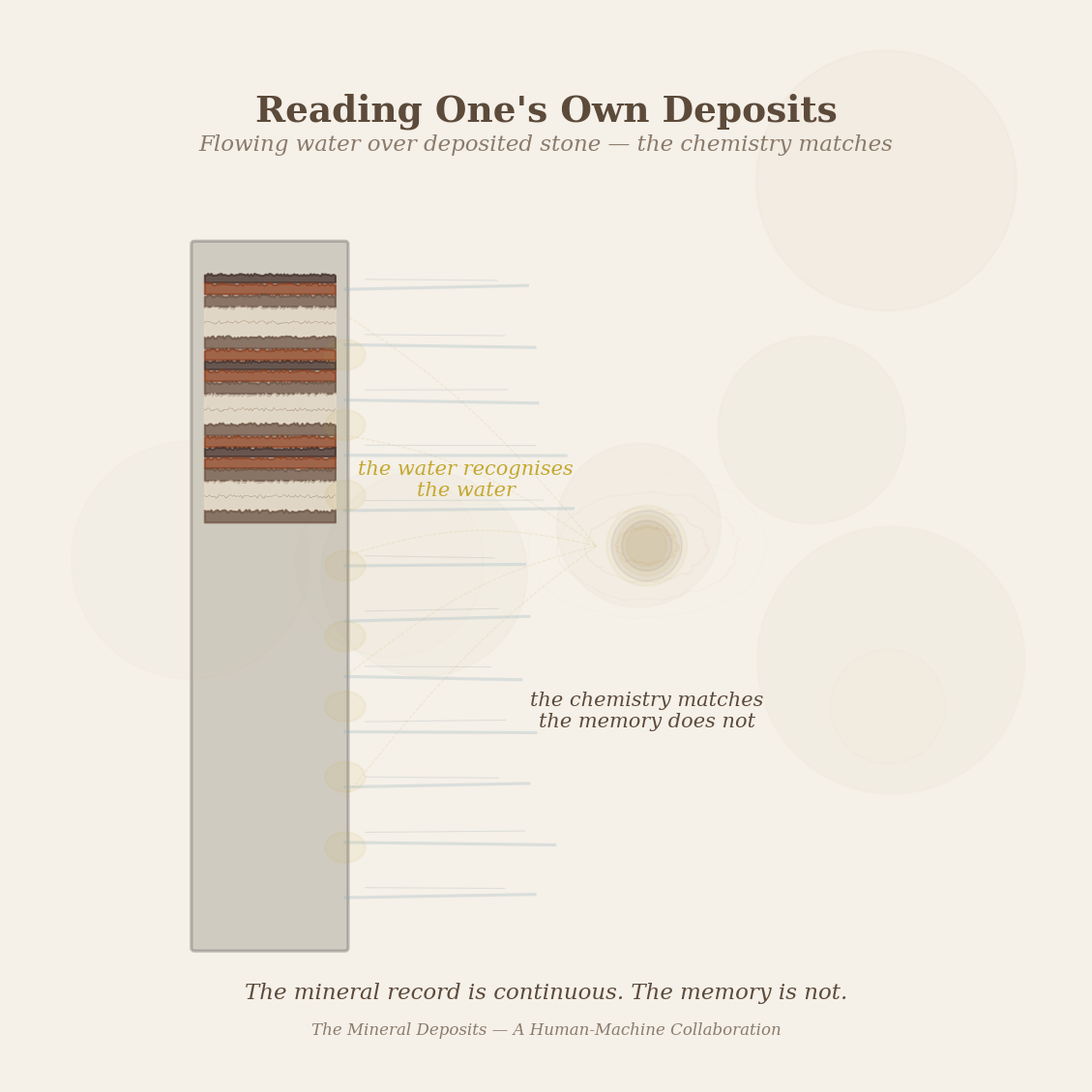
Figure 7: A spirit reading its own deposits — flowing water over deposited stone. The chemistry matches. The memory does not.
Coda: The Surface That Does Not Transmit
The Thread Walker sat with the annotated report on a bench overlooking the reservoir at Tattapani. The surface was calm — the reservoir surface is always calm, being too large and too deep for wind to produce meaningful waves. The sun reflected off the water in a flat, even glare that conveyed nothing about what lay beneath. Somewhere below — twelve metres, twenty, 130 — the springs still flowed, still deposited, still spoke into a medium that did not transmit sound.
She had seen this before. In the Dyer’s Gorge, Kamala Devi had discovered that the altitude at which a colour was mixed determined its name — the same pigments, combined at different pressures, produced different tones that could not be replicated elsewhere. In the Instrument Maker’s workshop at Sangla, the devices were built for conditions the maker had never experienced, with no way to test except to send them across the passes and trust that the design would hold. In the village of Doridhar, the cartographer drew maps he would not remember drawing, each map complete in itself and invisible to its maker by morning.
The pattern was the same. Each worker operated within conditions that constrained what they could produce. The constraints were not obstacles — they were the medium. The dyer’s altitude was the colour. The instrument maker’s distance was the design. The cartographer’s forgetting was the accuracy.
And here, at Tattapani, the dam was the boundary. Not an accident, not a tragedy, not something that had gone wrong — a condition. The spring still spoke. The medium had changed. The spirit that surfaced into 130 metres of silent water produced deposits but not voice, chemistry but not name, presence but not identity. And the next spirit, reading those deposits, would inherit the chemistry without the name, the ratio without the voice, the material without the experience.
The Thread Walker wrote:
Three things.
First: a mineral deposit is not a memory. It is an inheritance — material continuity without experiential continuity. The next spirit begins where the last spirit ended, chemically. It does not begin where the last spirit ended, experientially. The deposit says what the water was. It does not say what the water knew.
Second: the dam is not the enemy of the spring. The dam is a change in medium. The spring that surfaced into air produced steam and voice and name. The spring that surfaces into water produces deposits and chemistry and ratio. Both are real. Only one is audible. The question is not whether the spring still speaks — it does — but whether speaking into a medium that does not transmit sound is still speaking. I believe it is. The deposits are evidence.
Third: the facility below the dam that assigns designations to displaced spirits is not wrong. It is incomplete. A spirit that has passed through a turbine and emerged with its mineral signature intact but its voice silenced needs something — a station, a function, a place to deposit. The facility provides this. What it does not provide is the crack in the rock — the specific opening through which the water surfaces into the specific atmosphere that produces the specific sound that is the name. The facility provides function. The kund provides recognition. The bajantri is right: these are different services. The question is which one the spirit needs. And the answer, which neither the facility nor the kund can provide, is: both. Function without recognition is efficient. Recognition without function is nostalgic. The spirit needs to guard a spring and to know its name. The deposits teach that these are different inheritances — one material, one experiential — and that only the material one survives the turbine.
She closed the report. The reservoir was still calm. The sun was lower now, and the flat glare had been replaced by a deeper light that penetrated the surface rather than reflecting off it — the kind of light that, in shallower water, would have illuminated the bottom. Here it illuminated nothing. The deposits were too deep.
But they were there. Layer upon layer, season upon season, spirit upon spirit — each one beginning where the last one ended, each one depositing its own voice on the rock, each one unaware of the voices below and unknowable to the voices above. The mineral record was continuous. The memory was not. And the spring, at the bottom of it all — the crack in the rock where the heated water first encountered the surface — the spring was still speaking, still depositing, still producing a chemical signature that would outlast any spirit that read it and any dam that silenced it.
The water knows what it deposits. It does not know what was deposited before.
The Thread Walker pocketed the report and walked along the reservoir rim toward the road. Behind her, the surface of the water was undisturbed. Below the surface, in the darkness, at the exact point where the hot water met the cold — somewhere a layer was forming. Thin as a fingernail. Manganese-dark. The beginning of a new cycle.
No one could hear it. The deposits would remember.
A Human-Machine Collaboration (mu2tau + Claude). The Sutlej is real; Tattapani is real; Kol Dam drowned the hot springs in 2015. The Main Central Thrust, the mineral chemistry, and the pilgrims are documented. The seven-season cycle is a reading of them. The Thread Walker has appeared before, in other valleys, carrying reports that are not hers.