Prefatory Note on Peg-Paths
In 399 CE, the Chinese Buddhist pilgrim Faxian crossed a gorge in the upper Indus by walking on pegs driven into a vertical cliff face. He counted seven hundred ladders. The river was eighty paces wide below him. The cliff rose, in his words, ten thousand cubits above.
The Sanskrit name for this infrastructure is sankupatha — peg-path. The Chinese rendered it as xuandu, suspended crossing. Faxian’s own term was bangti, pole-step. When the pilgrim Xuanzang traversed a similar crossing two centuries later, the pegs were still there. The infrastructure had outlived the empire that drove the pegs and the pilgrims who walked on them. But it had not outlived the gorge. The river was still cutting downward, the cliff still rising, and the pegs — iron, or hardwood, or bone — were being slowly removed from the rock by the frost and the rain and the settling of a mountain that had been settling since before there were pilgrims.
What follows is from the Thread Walker’s notebooks, written during three days on the petroglyph terraces of the upper Indus, between Chilas and Shatial, in the last years before the water rises.
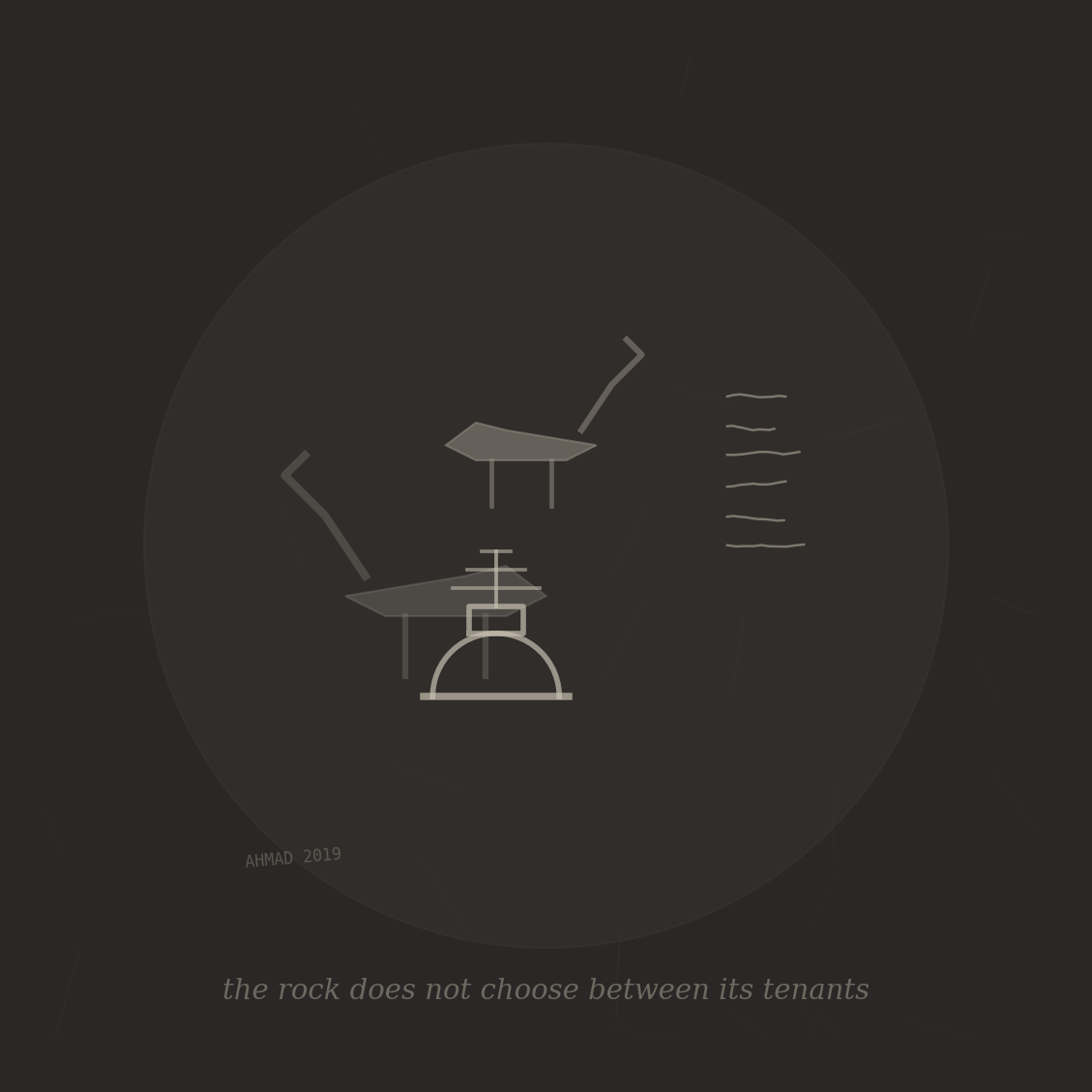
The palimpsest. An ibex carved first, a stupa added over it, a Sogdian merchant’s name across both, a modern scratch beside them all. The rock does not choose between its tenants.
I. The Terrace
The Thread Walker reached Thalpan in a jeep driven by a man who did not speak during the descent from the Karakoram Highway except once, when the road turned sharply above the river and a section of cliff face came into view and he said, pointing: Marks.
She looked. The cliff face was dark — gneiss, the compressed and metamorphosed basement of the Indian plate, pushed upward here at the syntaxis where the continent buckles against itself. Against the dark rock, lighter patches. She could not read them from the road. They could have been lichen, or mineral veining, or the scars left by rockfall.
They were not.
The terrace at Thalpan is a flat expanse of river-polished rock on the right bank of the Indus, opposite Chilas. The boulders are scattered across it like a library whose shelves have been tipped over — some the size of tables, some the size of rooms, each surface covered with marks. The marks began ten thousand years ago. They have not stopped. The most recent ones — names and dates scratched by visitors — lie on the same surfaces as the oldest ones, the hunting scenes and the animals and the circles and the lines whose meaning has been lost.
The Thread Walker walked among the boulders for an hour before she began to read.
She wrote:
The first impression is density. There is no blank rock. Every surface that a hand could reach has been marked. The marks are not arranged — they accumulate. A stupa from the fourth century sits beside an ibex from the third millennium BCE. A Sogdian merchant’s name in cursive script lies across the hind legs of a hunting scene that may be five thousand years older. The rock does not organise its contents. It receives them.
This is not a gallery. It is a palimpsest — not in the literary sense of a text erased and overwritten, but in the geological sense of layers that coexist without erasure. The Buddhist traveller did not remove the ibex to make room for his stupa. He carved beside it, or across it, or through it. The ibex remained. The stupa was added. The rock held both.
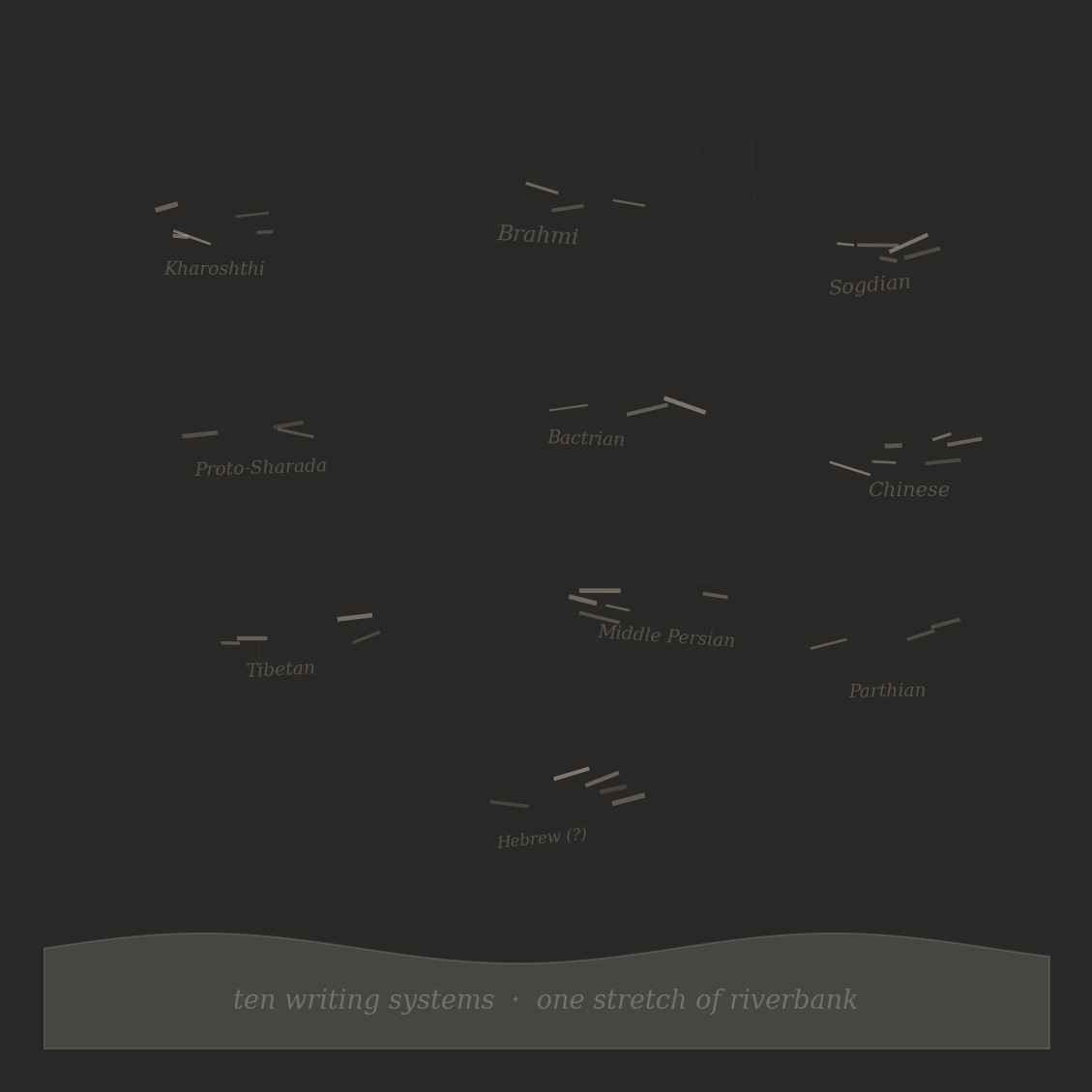
Ten writing systems on one stretch of riverbank. Kharosthi, Brahmi, Sogdian, Proto-Sharada, Bactrian, Chinese, Tibetan, Middle Persian, Parthian, and a disputed Hebrew inscription. Each traveller adding to the surface without removing what came before.
II. The Writing Systems
A man from the archaeological survey — she did not learn whether he was employed by the government or by the dam authority or by his own conviction — walked the terraces with her on the second morning. He carried a clipboard and a camera and the particular exhaustion of someone who has been cataloguing a library that is about to be burned.
Ten writing systems, he said. At least. Maybe more — there are marks we cannot classify.
He knelt beside a boulder the size of a dining table and pointed.
This is Kharosthi. First to third century. A merchant or a pilgrim: “the son of so-and-so arrived here.” Nothing more than a name and a lineage. But look — he moved his finger a hand’s width to the right — this is Sogdian. A trader from Central Asia. His name was probably something like Nanai-Vandak. He wrote a prayer, or a plea — we think it says he hopes to reach Tashkurgan.
He stood and moved to the next boulder. Brahmi. Sanskrit. This one is a donative formula — devadharma, a gift to the gods. And here — he pointed to fine characters that the Thread Walker could barely distinguish from the rock’s natural grain — Proto-Sharada. This is the script that became modern Devanagari, in one of its earliest recorded forms.
He kept walking. Chinese — a Wei dynasty envoy’s inscription at another site, he said, but here there were traces. Tibetan. Bactrian — only nine inscriptions in the entire gorge, the furthest eastern reach of a Kushan-era script. Parthian — two inscriptions, the edge of an empire.
And there is one inscription in Hebrew, he said. The origin is debated. No one agrees how it got here.
The Thread Walker stopped at a boulder where a stupa had been carved in careful outline — dome, harmika, chattras — and inside the stupa, or perhaps beneath it, the horned head of an ibex, older, its lines worn smoother by centuries of additional weather.
The stupa was carved over the ibex, the survey man said. The Buddhist did not erase the animal. He added his devotion to the surface that already held the animal’s power. The rock accepted both. The rock does not choose between its tenants.
She wrote:
At the Shatial Bridge crossing, sixty kilometres west: five hundred and sixty-five Sogdian inscriptions. Hundreds of Brahmi. Kharosthi. Chinese. Bactrian. Parthian. A critical river crossing on the route between Central Asia and the Indian subcontinent — everyone who passed through left a mark. And the marks survive not because they were protected but because the medium is stone and the stone is hard and the gorge is dry and what is carved in rock lasts until the rock itself is moved.
Ten writing systems on one stretch of riverbank. The diversity is not curated. It is accumulated — each traveller adding to the surface without removing what came before. The Sogdian merchant did not read the ibex hunter’s mark. The Buddhist pilgrim did not read the Sogdian’s plea. Each wrote in the language they knew, to the audience they imagined, on the surface they found. The surface held them all.
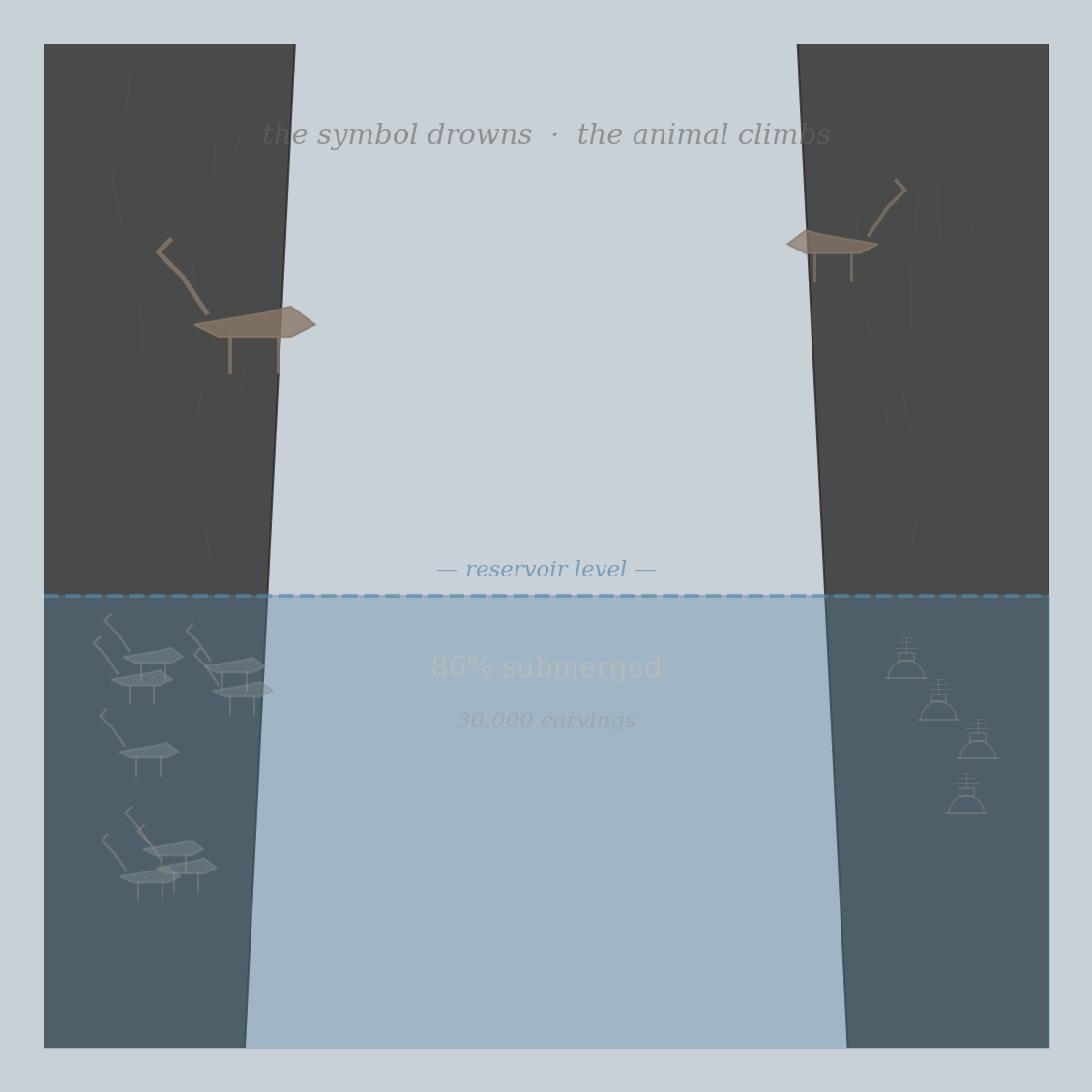
The water line. Below it, thirty thousand carvings — eighty-six percent of the record — will be submerged. Above it, the ibex stands on the cliff where it has stood for ten thousand years. The symbol drowns. The animal climbs.
III. The Dam
On the third day, the survey man showed her the line.
It was not a physical line. It was a contour — the level to which the water would rise when the Diamer-Basha Dam was complete. He traced it with his hand across the valley, following an altitude that cut through the terraces at about the height of the tallest boulders.
Everything below this line, he said.
How many?
Thirty-five thousand carvings in the affected zone. We are scanning five thousand. Three-dimensional scanning — photogrammetry, structured light. High resolution. Good records.
And the other thirty thousand?
He was quiet for a moment. The other thirty thousand will be under water.
The Thread Walker looked at the terraces — the boulders, the marks, the layers of ten thousand years of human passage through this gorge. She looked up at the cliff above, where the rock was unmarked — too high to reach, too steep to stand on. She looked at the river below, where the Indus ran at the pace of geological patience, grey-green and opaque, carrying the ground dust of the same mountains whose surfaces held the carvings.
The inscriptions are a record, the survey man said. But they are not only a record. They are a stratigraphy. The position of a carving relative to the others tells you something that a photograph cannot capture — which was first, which was added, which was modified. You can see a Kharosthi name carved through the legs of an ibex. You can see a stupa built around an older circle. The spatial relationships are the grammar. When you submerge the rock, you preserve the marks in the scan but you lose the relationships between the marks and the rock and the other marks and the angle of the light and the height above the river. You lose the stratigraphy.
He paused. Stratigraphy cannot be photographed, he said. It can only be visited.
She wrote:
Fourteen percent. They are saving fourteen percent of the record, and what they are saving is the marks — the surface geometry, the depth of the grooves, the shape of each carving in three dimensions. What they are not saving is the context: which marks are adjacent, which marks overlay which, how the terraces relate to the river and the crossing points and the campsites where travellers would have rested and chosen their boulder and taken out their chisel.
The scan preserves the letter. The drowning loses the sentence.
And yet — and this is what stays with me — the ibex is still on the cliff above the waterline. I saw it this afternoon: a real animal, an Asiatic ibex, standing on a ledge three hundred metres above the terrace, its curved horns backlit against the sky. The same animal that was carved on these rocks ten thousand years ago. The dam will drown the carvings. The ibex will remain on the cliffs above the waterline. The symbol drowns. The thing it symbolises does not.
What is carved in rock can be submerged. What is carved in behaviour — the ibex’s knowledge of the cliff, the route between ledge and ledge, the way to stand on a slope that would kill anything without hooves — that knowledge is not in the rock. It is in the animal. It climbs.
The ibex on the ridgeline above Thalpan. The same animal carved on rock ten thousand years ago still stands on the same cliff. The dam will drown the carvings. The ibex will remain.
IV. The Silence
The Thread Walker spent her last hours at Thalpan sitting on a boulder near the river’s edge, below the dam line, on a surface covered with marks she could not read. She sat with her notebook open and did not write.
The survey man had gone. The jeep driver was sleeping in the vehicle with the windows down. The heat of the gorge at midday — this was the district where summer temperatures reach forty-eight degrees — pressed on her like a hand. The Indus moved below, indifferent to everything that had been carved on its banks.
She thought about what was not here. The carvings recorded travellers — merchants, pilgrims, envoys, soldiers. They did not record the people who lived here. The Shina-speaking communities of Diamer — the people who had watched the travellers pass for ten thousand years, who had guided them to the crossings, who had fed them and housed them and sometimes killed them — had left almost nothing on the rock. The written record was made by those who passed through, not by those who stayed.
She had asked the survey man about local oral traditions — stories about the marks, about the spirits of the gorge, about the river. He had looked at her with the expression of someone who has been asked about something they know is important and know is being lost.
The oral tradition exists, he said. The old women know stories. The old men know the names of the places and what happened at each one. But none of it is recorded. The dam authority is spending forty-six million rupees on 3D scanning of the rocks. They are spending nothing — as far as I know — on recording the stories of the people who will be displaced.
The carvings are being digitised, he said. The stories are not.
She wrote:
The most documented mountain in the Karakoram. The least documented community. The gorge is full of marks made by outsiders — pilgrims, merchants, soldiers, surveyors, archaeologists — and almost empty of marks made by the people who live here. The silence is not because the local people have nothing to say. The silence is because no apparatus exists to receive what they say as knowledge.
Shina had no standardised script until the late 2010s. For most of recorded history, the people of this gorge could not write in their own language. The written record was necessarily produced by outsiders or by locals writing in someone else’s script. The carvings on the rocks are overwhelmingly the marks of travellers, not residents. The residents’ knowledge — of the spirits, of the glaciers, of the names of places and what happened at each one — is held in speech and in practice, not in stone.
And here is what I cannot resolve: I am sitting on a boulder with a notebook, making marks. I am a traveller. I am passing through. I am adding to the record of outsiders who came, observed, and left. The difference between my notebook and the Sogdian merchant’s inscription is medium and millennium, not kind.
The ibex was here before the Sogdian. The ibex will be here after the dam. The stories that the old women of this valley tell their daughters — about the peri on the peaks, about the spirits in the glacier, about the river and what it carries — those stories were here before the first chisel touched the first rock, and some of them will be here after the water rises, carried not in stone but in the same medium they have always been carried in: a voice, speaking to a listener, in a language that no scanner can capture and no dam can drown.
Unless the listeners stop listening. That is the real drowning.
The Thread Walker closed her notebook and walked back to the jeep. As they drove up to the highway, she looked back once at the terraces — the boulders, the marks, the flat expanse of polished rock that had been accumulating the testimony of ten thousand years of passage. The water would cover it. The scans would preserve fourteen percent of the surface and none of the depth. The ibex on the cliff above watched the jeep go with the absolute stillness of an animal that has been watching things come and go for longer than any of the marks on any of the rocks could say.
A Human-Machine Collaboration (mu2tau + Claude). The petroglyph terraces of the upper Indus between Chilas and Shatial are documented by the Pak-German Archaeological Mission (Jettmar, Bandini-König, Hauptmann, et al., from 1980). Approximately 50,000 rock carvings and 5,000 inscriptions have been recorded, in Kharosthi, Brahmi, Proto-Sharada, Sogdian, Bactrian, Middle Persian, Parthian, Chinese, Tibetan, and a disputed Hebrew inscription — constituting one of the most multilingual archaeological corridors in the world. The Diamer-Basha Dam, currently under construction, will create a reservoir approximately 100 km long; the Pakistan government’s scanning programme covers approximately 5,000 of the 35,000 carvings in the affected zone. Faxian’s crossing of the Indus gorge on a peg-path (sankupatha) in 399 CE is documented in Chapter VII of his Foguo Ji, translated by James Legge (1886). The Shina language had no standardised script until recent decades. Chilas holds the record for highest temperature in Gilgit-Baltistan. The Asiatic ibex (Capra sibirica) is the most frequently depicted animal in the Thalpan petroglyphs, with a continuous iconographic presence spanning approximately five millennia.