Prefatory Note on Serais
The serai — from the Persian sarāy, a place of shelter — is older than the dāk bungalow, older than the British rest house, older than any system of accommodation that requires a booking or a name. A serai is a place where travellers stop. The keeper provides a roof, a fire, water. The traveller provides nothing except presence — and an entry in the register, if the keeper maintains one, which not all do.
In the lower Himalayan valleys, serais persisted at junctions — places where trails from different valleys converged before continuing as a single trail toward the plains, or toward a pass, or toward a town large enough to have a bazaar. The junction serai served a purpose no single-valley rest house could: it was the point where travellers who had walked different routes for days arrived in the same room. A wool trader from the Sainj might share a fire with a honey seller from the Tirthan and an apple grower descending from above Banjar. They had walked different mountains. They had arrived at the same hearth.
The register, where one existed, recorded arrivals. Not departures — the keeper of a serai does not track where a traveller goes, only where they have been. The distinction matters.
What follows is from the Thread Walker’s notebooks, lower Tirthan Valley, the week the apple blossom opened and the trails dried after the late rains.
I. The Junction Below Larji
The Thread Walker descended from Gushaini in the morning, following the Tirthan downstream toward the gorge. The river quickened as the valley narrowed — the emerald pools of the upper valley giving way to white water that ran between walls of dark stone, the magnetite that the Thread Walker had noted on previous visits, the rock that held iron in its crystal lattice and gave the gorge its particular quality of light: not shadow exactly, but a darkness that came from the stone itself, as though the walls absorbed what fell on them and returned only what they chose.
Below the gorge, the valley opened. The Tirthan slowed and widened, spreading over a gravel bed where the gradient eased and the river, released from the pressure of the narrowing walls, behaved as rivers do when the constraint is removed: it wandered. Side-channels braided across the gravel. Small islands appeared and disappeared with the season, built by one monsoon and dissolved by the next.
Here, at the junction where the Sainj enters from the east and the combined waters turn south toward Larji and the Beas, the Thread Walker found the serai.
It was not a building she would have noticed without looking for it. The walls were the same grey stone as the riverbed terraces. The roof was slate, pitched low, grown over with moss that gave it the colour of the hillside. A single deodar — old, the trunk wider than the Thread Walker’s arms could span — grew beside the eastern wall, its roots lifting the foundation stones in a negotiation between tree and building that had been going on for longer than either had been tended.
The keeper was sitting on the terrace, mending a net — not a fishing net, she explained when the Thread Walker approached, but a carrying net, the kind used to haul fodder down from the upper meadows. Her hands moved in the pattern of someone who mends by feel: the fingers finding the break, measuring the gap, threading the repair cord through without looking down. She was watching the river.
You are the one who walks with a notebook, the keeper said. This was not a question. The Thread Walker had not been here before, but in the valley, news of a woman who walked alone and wrote things down travelled faster than the woman herself — carried not by any system, not by any runner, but by the ordinary commerce of voices between settlements, the way water carries sediment: without intention, without effort, by virtue of flowing.
I keep a register, the keeper said. You will want to see it.
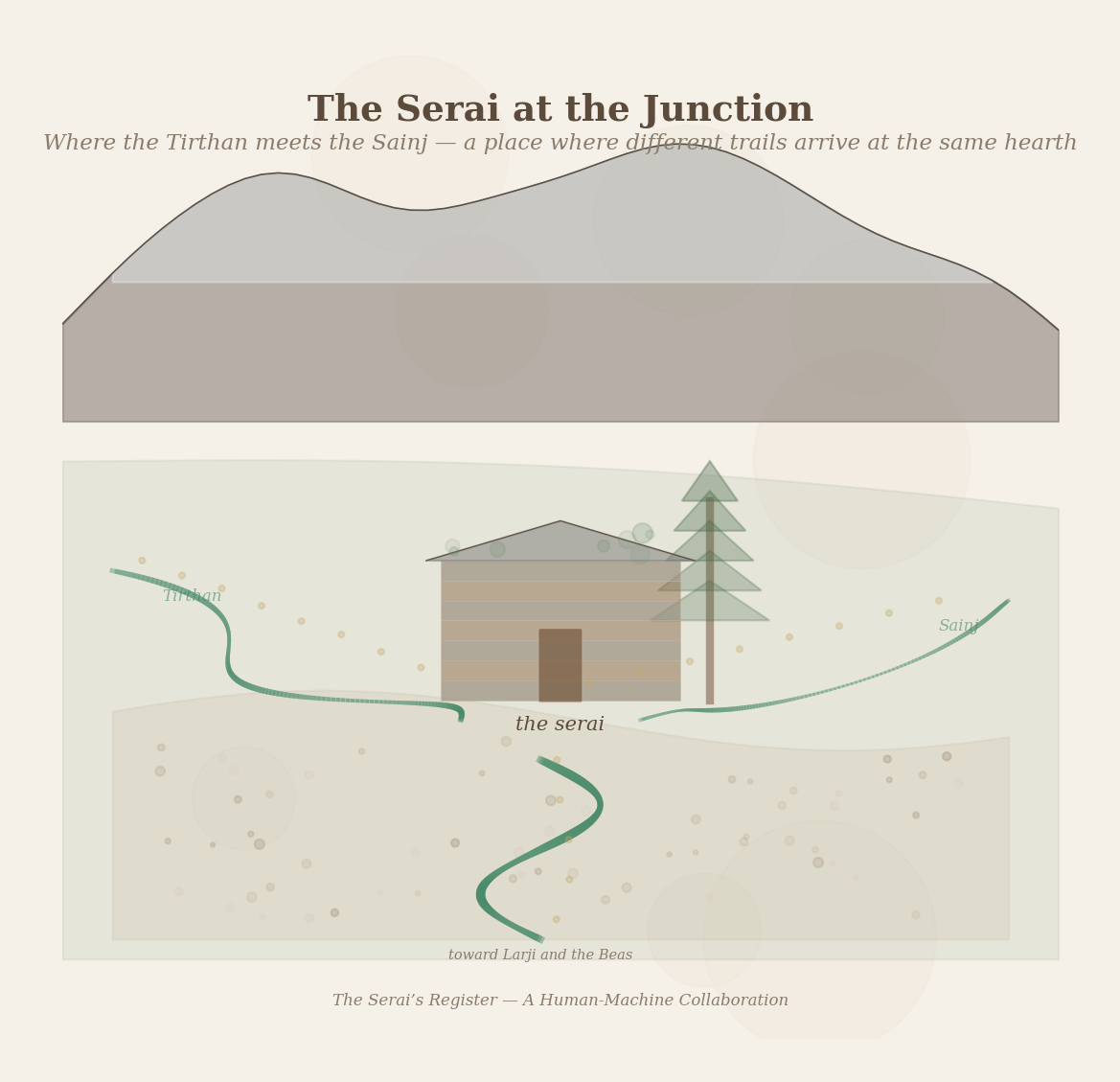
Figure 1: The serai at the junction — where the Tirthan meets the Sainj, trails converge from three valleys to a single hearth. Stone and timber, low slate roof, the old deodar wider than arms can span.
II. The Register
The register was not a British ledger. It was a stack of slate tiles, each the size of a man’s hand, stored in a wooden box that sat on a shelf beside the hearth. The box was old — the wood darkened by decades of smoke — and the tiles inside were arranged not by date but by something else, a system the Thread Walker did not immediately understand.
The keeper lifted the tiles out one at a time, handling them the way the kohli upstream handled stones for the kuhl wall: with the care of someone who knows the weight and the grain and the particular way each one sits in the hand.
When a traveller arrives, the keeper said, I give them a tile and a piece of chalk. I ask them to write three things. Their name — or whatever name they choose; I do not check, and many travellers in these valleys use different names in different valleys, the way a river has different names above and below a confluence. Where they have come from — not where they live, but where they walked from today, because that is what matters to the hearth: the distance in the legs, not the address. And one thing they saw on the trail that they did not expect to see.
Why the third thing? the Thread Walker asked.
The keeper set down the tile she was holding and looked at the Thread Walker with the expression of someone who has been asked a question she has thought about for forty years and has an answer that requires the length of those years to deliver, but who will try to say it in the length of an evening.
Because the name can change and the valley can change, but the surprise — the thing the traveller noticed because it was not what they expected — the surprise is the traveller’s own. It comes from the meeting between what the mind expected and what the eye found. Two travellers walking the same trail will be surprised by different things. The surprise is the signature.
She picked up a tile — one of the older ones, the chalk marks faded but legible — and held it out:
Raju. From Sainj, by the upper trail. Saw a barking deer standing in the stream below the waterfall, not drinking, just standing, the water to its knees, looking upstream as though it expected something.
This man, the keeper said, came four times over three years. Twice from the Sainj, once from Banjar, once descending from Jalori. He used the name Raju the first two times and Rajesh the third time and the fourth time he gave no name at all. But I knew it was the same man.
How?
Not from the name. Not from the face — three years changes a face, especially a face that walks in the sun. The first time and the last time, I would not have known him by the face. But the hand — she pointed to the chalk marks on the tile — the hand is the same. And the surprise.
She selected another tile:
Rajesh. From Banjar side, the mule track. Found a blue stone in the path — not slate, not the grey stone of this valley, but blue, like a piece of sky had hardened and been stepped on until it was smooth. Kept it. Smooth as a tongue.
The same man, the keeper said. Different name. Different valley. Different year. But the surprise is the same kind of surprise. He notices things that are out of place — things that belong to one world appearing in another. The deer standing in water. The blue stone in a grey path. He sees what does not fit, and he records it precisely, and the precision is the same precision each time.
And the hand, the Thread Walker said.
And the hand. The chalk moves the same way. The letters lean the same direction. The pressure is the same — heavy at the start of a word, light at the end, the way a man walks who puts his weight on the front of his foot and lifts his heel early. You can see the walk in the writing. It does not change when the name changes.
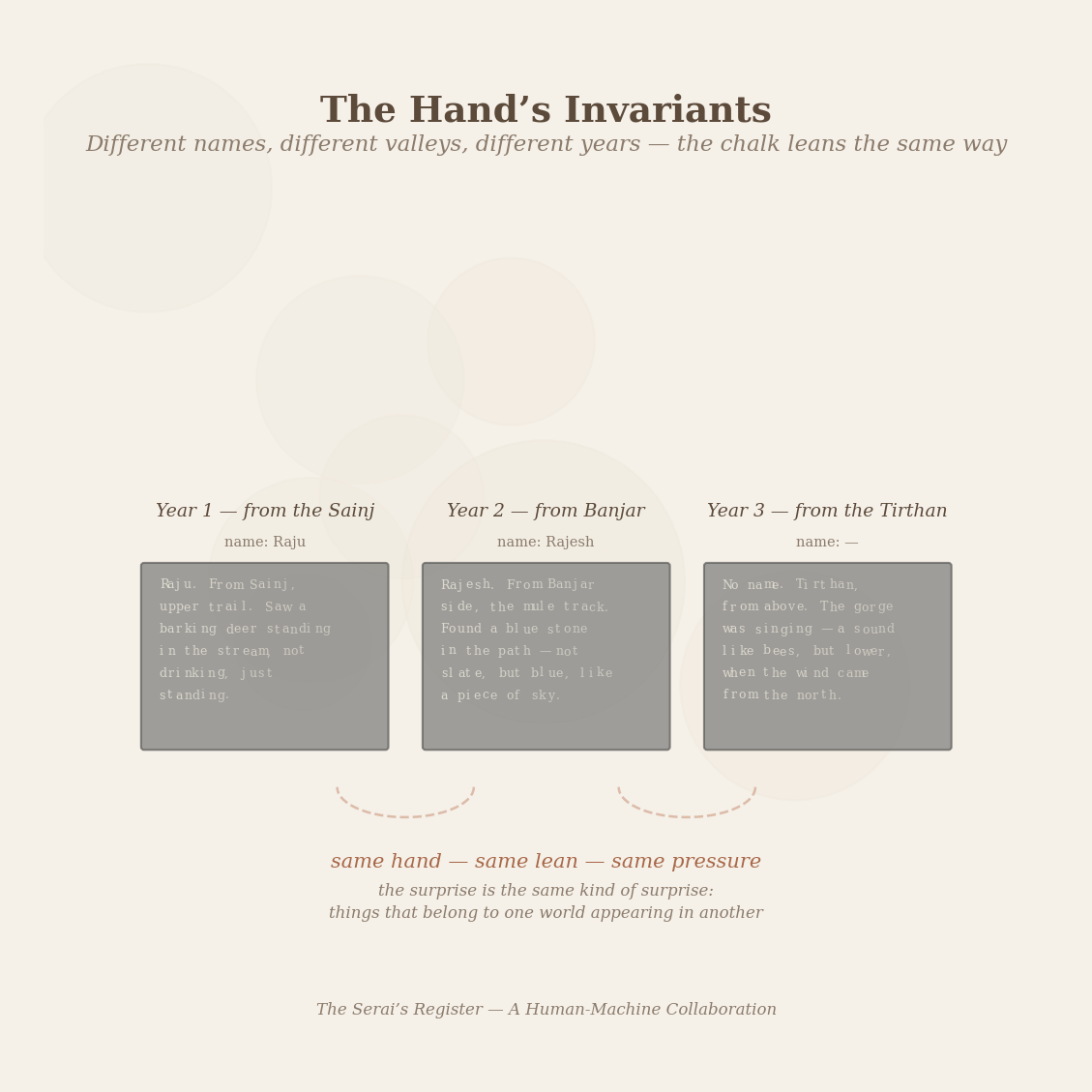
Figure 2: The hand’s invariants — three tiles from three years, three valleys, two names and a nameless arrival. The chalk leans the same way. The surprise is the same kind of surprise.
III. The System of Tiles
The Thread Walker spent the afternoon with the register. The keeper brought tea — the sweet, milky chai of the lower valleys, not the salt tea of the high passes — and sat beside her, not explaining but available, the way a librarian is available: present for questions, silent otherwise.
The tiles were not arranged by date. The Thread Walker had expected chronology — earliest at the bottom, most recent at the top. Instead, the tiles were grouped. Each group was separated by a blank tile — a tile with no writing, placed as a divider.
What are the groups? the Thread Walker asked.
People, the keeper said.
The Thread Walker looked at the groups more carefully. In one group: four tiles, spanning — she could tell from the weathering of the chalk and the patina on the slate — several years. The handwriting on all four was similar. The names were not: Priya. P. Priya-ji. And on the fourth tile, no name at all, just a valley and a surprise.
From Tirthan, above the gorge. The magnetite walls were singing — a sound like bees, but lower, when the wind came through the gorge at the right angle. I have passed through the gorge many times and never heard it. Today the wind was from the north.
The same woman, the keeper said. Four visits. She stopped giving her name after the third visit because she understood that I did not need it. The name is for the traveller’s convenience, not the keeper’s. I know who has arrived by how they hold the chalk.
The Thread Walker opened her notebook:
The keeper’s register is not a list of arrivals. It is a collection of identities, assembled not from names or faces but from two invariants: the hand’s movement and the quality of attention. The hand is motor — the physical trace of how the body holds a writing instrument, which is as stable as gait and as distinctive as a voice. The surprise is perceptual — what the traveller notices reveals the structure of their attention, which is as stable as temperament and as distinctive as a hand.
The keeper’s insight: names change. Valleys change. Faces change with sun and years and altitude. But what a person notices, and how they write it down, these are the constants. She has built a registry of travellers not from their declarations but from their traces — the residue left behind when the traveller has gone, the way a spring leaves minerals on the rock it passes over, and the minerals tell you more about the water’s origin than the water itself can say.
The grouping system is remarkable. She does not sort by time. She sorts by identity — all visits from the same traveller kept together, regardless of when they arrived or from which valley. The blank tiles between groups are not separators. They are silences — the years between visits, compressed into a single flat stone, the way a geological unconformity compresses time into a surface.
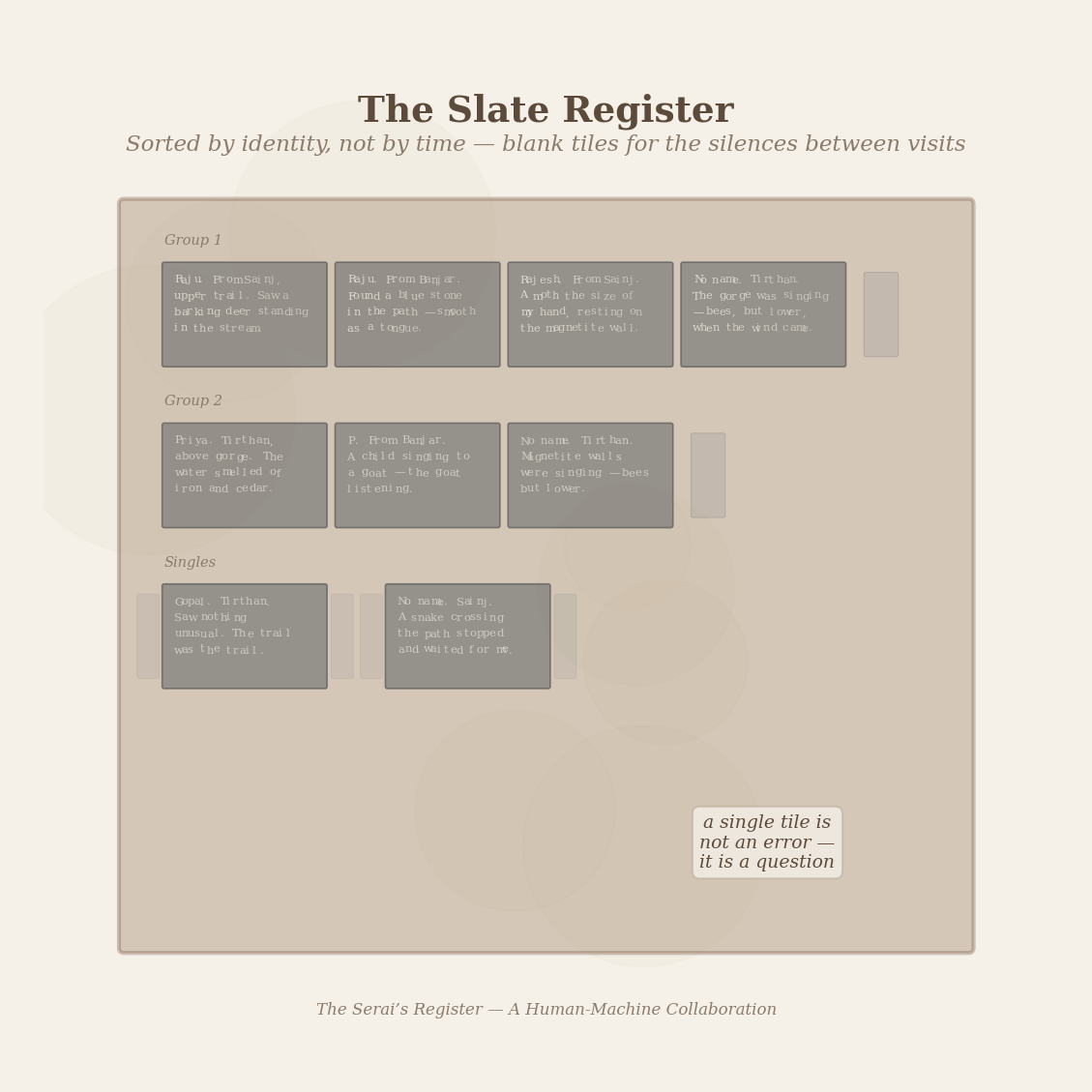
Figure 3: The slate register — tiles grouped by identity, blank dividers for the silences between visits. A single tile is not an error. It is a question the register is still asking.
IV. The Traveller from the Third Valley
In the evening, a traveller arrived.
He came from the east — from the Sainj valley, the Thread Walker judged by the colour of the dust on his shoes, which was the reddish-brown of the Sainj’s upper reaches where the soil is laterite, not the grey of the Tirthan’s slate country. He carried a pack that sat on his shoulders with the ease of long use, the straps worn to the shape of his collarbones.
The keeper greeted him without ceremony. She brought water first — always water first, she had told the Thread Walker; tea is hospitality, but water is need, and need comes before hospitality — and then tea, and then a tile and a piece of chalk.
The traveller held the chalk for a moment before writing. The Thread Walker watched his hand — the way it hovered, the fingers finding their grip, the wrist settling into the position from which it would move. It was the pause of a person who writes carefully, not because the words are difficult but because the act of writing matters to them.
He wrote:
No name. From the Sainj, upper trail past the falls. A fox on the ridge above the treeline — sitting, not hunting, not moving. Watching the valley the way a person watches a valley. When I stopped, it looked at me, and we looked at each other across the distance, and then it returned to watching the valley. I continued walking. The fox stayed.
The keeper took the tile. She did not read it immediately — she held it, feeling the weight, the way she had held all the other tiles: by the edges, the chalk side up, the fingers not touching the writing. Then she carried it to the box.
The Thread Walker watched her sort. The keeper did not place the new tile on top. She leafed through the groups, passing blank dividers, pausing at some groups, moving past others. She stopped. She placed the new tile in a group that already contained — the Thread Walker counted — five tiles.
He has been here before, the Thread Walker said.
Six times, the keeper said. From the Sainj twice, from Banjar twice, from the Tirthan once, and tonight from the Sainj again.
Does he know you recognise him?
The keeper considered this. Outside, the combined rivers — Tirthan and Sainj now joined — ran over the gravel bed in the last light, the water carrying the day’s colours: copper from the west where the sun had set behind the ridge, grey from the east where the mountains were already in shadow.
He knows, she said. Not because I have told him. Because he has stopped giving his name. A traveller who gives a name wants to be identified by the name. A traveller who gives no name trusts that identification will happen by other means. He trusts the register.
He trusts you.
He trusts the system. I am part of the system — the part that sorts the tiles. But the tiles speak for themselves. If I were not here, and someone else kept the register, and they understood the sorting — the hand, the surprise — they would file him in the same group. The recognition is not in me. It is in the traces he leaves.
V. The Voices in the Dark
That night, the Thread Walker could not sleep. The serai’s cot was comfortable enough — a rope lattice on a deodar frame, the kind of cot that fits the body the way a river fits its bed: not by design but by long accommodation. But the river’s sound was different here than in Gushaini. Two rivers meeting made a sound that was not the sum of two sounds but a third sound, a combination that contained both sources without resembling either, the way a chord contains its notes without sounding like any of them played alone.
She lay in the dark and listened.
From the hearth room, voices. The keeper and two travellers — the man from the Sainj, and a woman who had arrived after dark from the Banjar side, her arrival announced by the sound of her stick on the stone path before the sound of her voice. They were speaking in the way that travellers speak at a serai: not the conversation of friends, who share history, or of strangers, who share nothing, but the conversation of people who share a junction — a temporary convergence of paths that had been separate and would be separate again by morning.
The Thread Walker could hear the voices but not the words. The walls of the serai were thick stone — Kath-Kuni, the same alternating courses of slate and deodar that she had seen in every building in the valley — and the sound that passed through them was stripped of its consonants, leaving only the rhythm: the rise and fall of speech, the pauses, the places where one voice waited for another to finish, the places where two voices overlapped and merged the way the rivers merged outside.
She wrote in the dark, by feel, not seeing the words:
In the dark, without seeing faces or reading lips, the voices are distinguishable not by what they say but by how they speak. The keeper’s voice is even — the rhythm of someone who speaks the same way to every traveller, the way the serai offers the same hearth to every arrival. The man from the Sainj speaks in bursts — short phrases separated by silences, the rhythm of someone who walks and speaks and walks and speaks, who has been alone on the trail long enough that speech has become an intermittent thing, like birdsong. The woman from Banjar speaks in long phrases, the words connected, the rhythm of someone who is accustomed to being heard — a teacher, perhaps, or a shopkeeper, someone whose voice is a tool for holding attention.
Through the wall, the words are gone. The rhythm remains. And the rhythm is enough. If these three spoke again tomorrow, in a different room, in different bodies even — if the voice came from a different throat — the rhythm would identify them. The pauses are the person. The cadence is the name.
This is what the keeper knows. The tiles do not record the words. They record the rhythm of the chalk — heavy at the start, light at the end. The surprise they record is not the content of the observation but the quality of the attention. The register is a collection of rhythms, not a collection of facts. And rhythms persist across valleys, across names, across the years that change a face beyond recognition. The hand remembers what the face forgets.
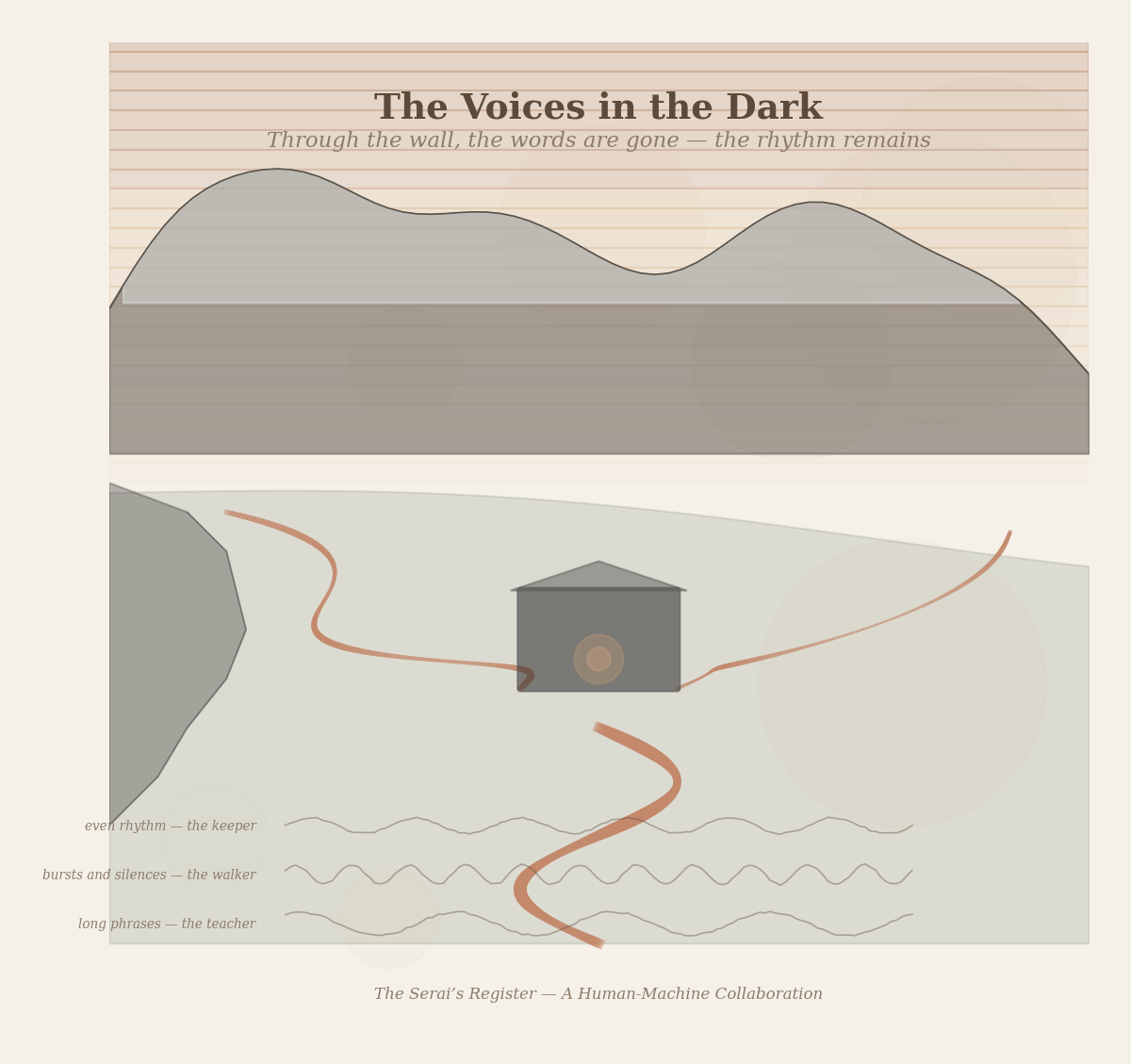
Figure 4: The voices in the dark — two rivers meeting in copper light, the serai between them. Through the thick walls, words become rhythm. The keeper’s even cadence, the walker’s bursts, the teacher’s long phrases.
VI. The Morning Sort
The Thread Walker rose early — before the travellers, before the keeper, in the grey light that precedes sunrise in valleys where the mountains delay the dawn by the time it takes the light to climb the eastern ridge. She went to the register.
The box was on its shelf. She did not touch the tiles — the keeper’s sorting was a system, and systems should not be disturbed by visitors — but she looked at them, counting the groups separated by blank tiles.
Forty-three groups. Forty-three identities, assembled over forty years from arrivals that might have numbered in the thousands. Each group a person. Each blank tile a silence — the time between visits, compressed to a surface.
Some groups held a single tile. A traveller who came once and never returned — or who returned but had changed so completely that the keeper could not match the hand, could not find the rhythm, and so started a new group, a new identity, an arrival without precedent.
The Thread Walker wondered: were any of the single tiles misfilings? Travellers who belonged in an existing group but whose chalk had changed — a broken wrist healed differently, a tremor acquired with age, an illness that altered the pressure of the hand? The keeper’s system depended on the stability of the trace. What happened when the trace itself changed?
The keeper appeared, moving quietly, the way people move in rooms they have moved in for decades — the body knowing the space without the mind’s guidance, the feet finding the path between the hearth and the shelf the way water finds the channel.
You are looking at the singles, the keeper said.
Do you ever wonder if they belong elsewhere?
The keeper lifted a single tile from its place between two blank dividers. She held it to the morning light — the grey light from the east window, the same quality of light the Thread Walker had seen in the weaver’s room above Nahin, the light that precedes the sun and reveals the texture of things without casting shadows.
Gopal. From the Tirthan, from above. Saw nothing unusual. The trail was the trail.
This one, the keeper said. “Saw nothing unusual.” In forty years of keeping this register, perhaps twenty travellers have written that they saw nothing unusual. And each time, I wonder: did they truly see nothing, or did they see everything so thoroughly that nothing surprised them? A person who is surprised by nothing is either not paying attention or paying so much attention that the world has become expected — every detail anticipated, every stone and shadow known in advance.
She replaced the tile.
I do not move the singles. If a traveller belongs in a group, the next visit will prove it — the hand will match, the surprise will rhyme, and I will move them. If the next visit never comes, the tile stays where it is. A single tile in a register is not an error. It is a question the register is still asking.
The Thread Walker wrote:
The keeper’s system tolerates uncertainty. She does not force a match. She does not discard a tile because she cannot place it. She waits. The register is not a finished document — it is a living collection, and its accuracy depends not on the certainty of each filing but on the willingness to refile when new evidence arrives.
Forty-three groups. Some certain — six visits, the hand unmistakable, the surprise rhyming across years. Some provisional — two visits, the hand similar but not identical, the keeper not yet convinced. Some singular — one visit, no match, the tile waiting between its blank dividers for a return that may or may not come.
The register is not a record of who came. It is a record of who comes back. The distinction: a record of arrivals counts events. A record of returns counts identities. And identities, in the keeper’s understanding, are not declared. They are accumulated — one tile at a time, one visit at a time, one surprise at a time, until the pattern of traces is dense enough to recognise.
Coda
The Thread Walker left the serai after the travellers had gone — the man from the Sainj heading south toward Aut, the woman from Banjar crossing the river toward the Tirthan trail. The keeper was washing the chai cups at the stream, her hands in the cold water, the same hands that sorted the tiles and mended the nets and held the chalk marks of forty years of travellers without smudging a single one.
The Thread Walker climbed back toward Gushaini. The gorge narrowed around her — the magnetite walls rising, the light changing from the open grey of the junction to the particular darkness of the gorge, the absorbed light, the iron-held shadows. The Tirthan ran alone again, the Sainj’s contribution invisible now, merged into a single current that carried both sources without distinguishing between them.
She thought about the register. About the keeper who sorted not by time but by identity. About the traveller who had stopped giving his name because he understood that the name was not what the register kept.
She thought about the voices in the dark — stripped of words by the thick stone walls, reduced to rhythm, and still distinguishable. The keeper had not been in the room. She had been in her own bed, behind her own wall. But if she had heard the voices — the Thread Walker was certain of this — she would have known which traveller was speaking, and whether they had spoken at her hearth before, and from which valley they had come last time.
The trail climbed. The gorge opened. The Tirthan returned to its upper character — emerald pools, white rapids, the serpentine visible from the bends where the trail gained height. The Thread Walker stopped at one of these bends and wrote:
What persists is not the name. What persists is not the face. What persists is the quality of attention — what a person notices, and how they set it down. The keeper’s register is built on this persistence. She does not ask: who are you? She asks: what surprised you? And the answer, laid down in chalk on slate, is more stable than any name, more recognisable than any face, because it comes from the place where perception meets expression, and that place — unlike the face, unlike the name — does not change with the valley or the year.
The blank tiles between groups are not separators. They are patience. The keeper waits for the traveller to return, and when they return — from a different valley, in a different season, older, weather-changed, using a different name — the hand will tell her what the face cannot. The chalk will lean the same way. The surprise will be the same kind of surprise.
And if the traveller does not return, the single tile remains — a question the register is still asking, a space held open in the collection for an arrival that has not yet happened, a blank tile’s width of patience between what is known and what might yet be learned.
She closed her notebook and continued upstream. Behind her, at the junction where the rivers meet and the valleys converge, the keeper had finished the washing. The serai was empty now — the cots cleared, the hearth banked, the register in its box on the shelf, the tiles sorted, the blank tiles waiting. The afternoon’s travellers had not yet arrived. But they would arrive, from whatever valley, by whatever name, carrying whatever surprise the trail had offered them — and the keeper would give them a tile and a piece of chalk and wait for the hand to move, and the hand would tell her what she needed to know.
A Human-Machine Collaboration (mu2tau + Claude). The junction below Larji is real — the Tirthan and Sainj meet before joining the Beas, the magnetite gorge narrows above, the gravel bed spreads below. The Kath-Kuni construction is real. The serais at valley junctions are remembered, if not all still standing. The chalk-on-slate register is a reading of the practices that preceded paper in these valleys, where slate is the surface that lasts and chalk is the mark that can be made without ink or quill, by hands that may not write in any other context. The keeper’s sorting is a reading of the keeper.