Prefatory Note on Tri-Junctions
Where three valleys meet, the water knows something the traveller does not.
A river flowing south from a pass carries snowmelt from a particular face of a particular ridge — and that face, that aspect, determines everything: how much snow falls, how fast it melts, what grows in the soil the meltwater feeds, what animals graze the meadow the soil sustains, what people settle the village the meadow supports, what language those people speak to their children and their gods.
A traveller standing at the confluence of three such rivers — three drainages, three aspects, three snow-histories — stands at a point of maximum information and minimum comprehension. She can see all three valleys from where she stands. She cannot see what any one of them looks like from inside. To understand a valley, you must enter it. To enter it, you must leave the junction.
The Survey of India marked these points with a triangle and a spot height. They did not mark what the triangle meant: that here, at the junction of three readings of the same mountain country, the country is most fully present and least fully understood.
What follows is from the Thread Walker’s notebooks, compiled over a journey that began in the upper Parvati valley and ended in the Karakoram — six halts, six tri-junctions, six ways of seeing the same thing.
I. The Rain Wall
Mantalai Lake, Upper Parvati — Where Three Passes Lead to Three Countries
The Thread Walker reached the headwall of the Parvati valley in the week when the glacier was still calving into Mantalai Lake but the meadows below had already turned — the season when winter has not finished leaving and summer has not yet decided to arrive. The lake sat at the base of the headwall like a dish of grey milk, glacial flour suspended in meltwater so cold that the stones at its rim wore a crust of ice even at midday.
She had come up from Kheerganga in three days, following the Parvati upstream past the tree line, past the last juniper, past the last hut where a shepherd had given her salt tea and asked where she was going. Up, she had said. To the head.
The headwall is not a wall. It is a fan — three ridges converging from southeast, northeast, and northwest, each carrying a pass at its crest, each pass opening to a different country:
The Pin Parvati, at 5,300 metres, southeast: the door to Spiti. A crossing that takes the walker from the wettest valley in the Western Himalaya to the driest in a single day’s climb. On the Parvati side, 1,200 millimetres of rain. On the Spiti side, 200. The same snow falls on the same ridge. The ridge decides which side receives it as abundance and which as drought.
The pass to Lahaul, northeast, above the Kulti glacier: the door to the Chandra-Bhaga. Brown slopes, 300 millimetres, Buddhist monasteries built of mud because there is no timber.
And the high col northwest toward the Tos glacier: the door to the upper Parvati’s own headwaters, where the valley turns back on itself and the river that carved the gorge below begins as a trickle from beneath blue ice.
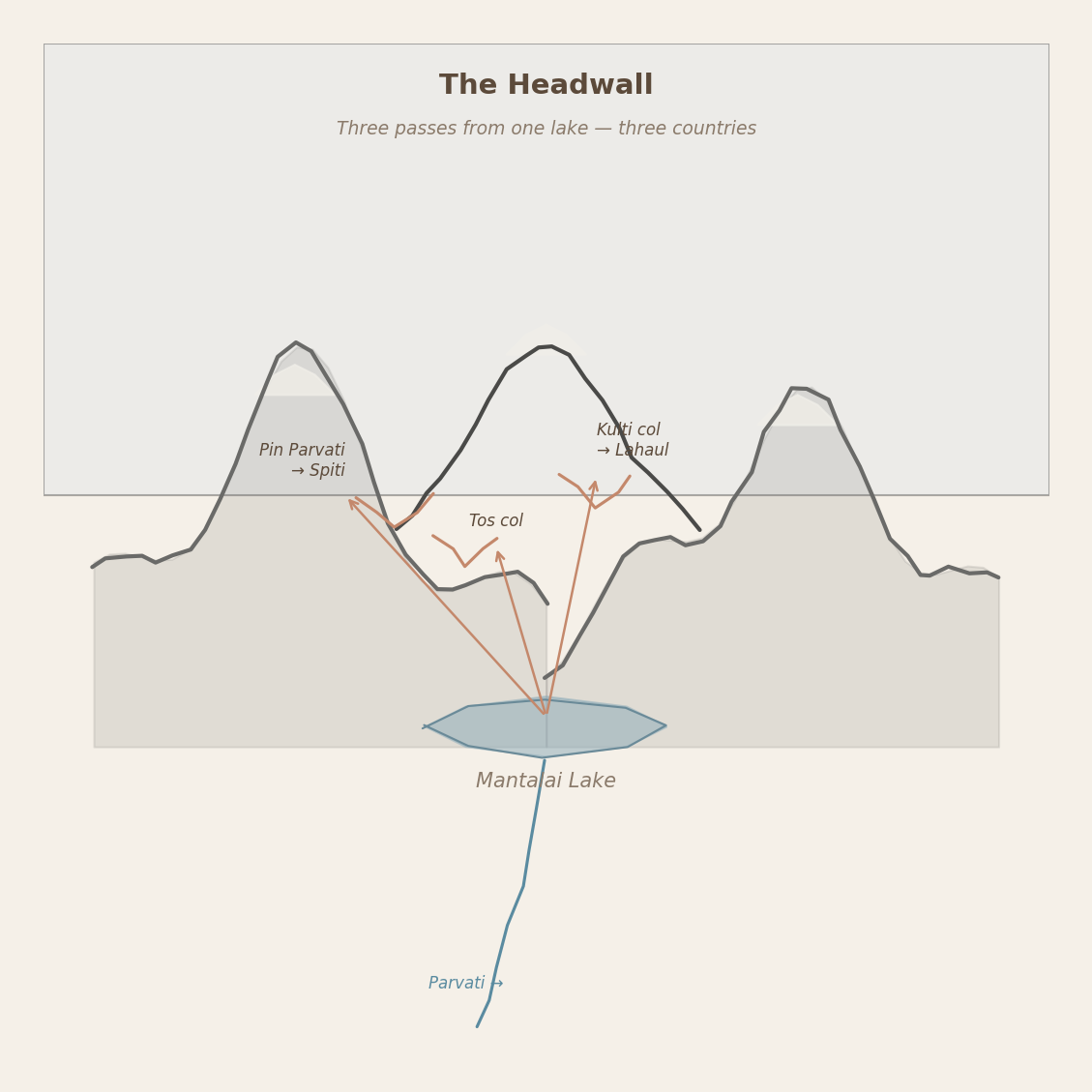
Figure 1: The headwall — three passes fanning from Mantalai Lake. Pin Parvati southeast to Spiti, the Kulti col northeast to Lahaul, the Tos col northwest. The same snow, three countries.
The Thread Walker sat at the lake’s edge and drew the headwall in her notebook. Three passes. Three arrows pointing away from the same source. And between them, the ridges — the dividers that take the same snowfall and sort it into three climates, three ecologies, three ways of living.
She wrote:
The rain wall is not a wall that stops rain. It is a wall that sorts it. The same cloud, arriving from the southwest monsoon, deposits its water on whichever face of the ridge it meets first. The Parvati side receives 1,200 millimetres and grows deodar. The Spiti side receives 200 millimetres and grows juniper. The ridge between them is a single line of rock, a few metres wide at the crest, and it creates two worlds.
This is what a tri-junction teaches: that the same source — the same snow, the same monsoon, the same cloud — produces different gifts depending on which face of the mountain receives it. The snow does not choose. The ridge chooses. And the ridge is not a decision — it is a shape, a fold in the earth’s crust, older than the snow, older than the monsoon, older than the deodar and the juniper and the people who built temples to their respective gods on their respective sides of the line.
A shepherd passed below, driving a small flock of goats toward the Tos side. He did not look up at the headwall. He had seen it every summer of his life. The Thread Walker thought: to him, the headwall is not a tri-junction. It is the place where his pasture ends. He knows one valley because he lives in it. She knows three valleys because she stands where they meet. Neither knowledge is complete. His is deeper. Hers is wider. The headwall holds both.
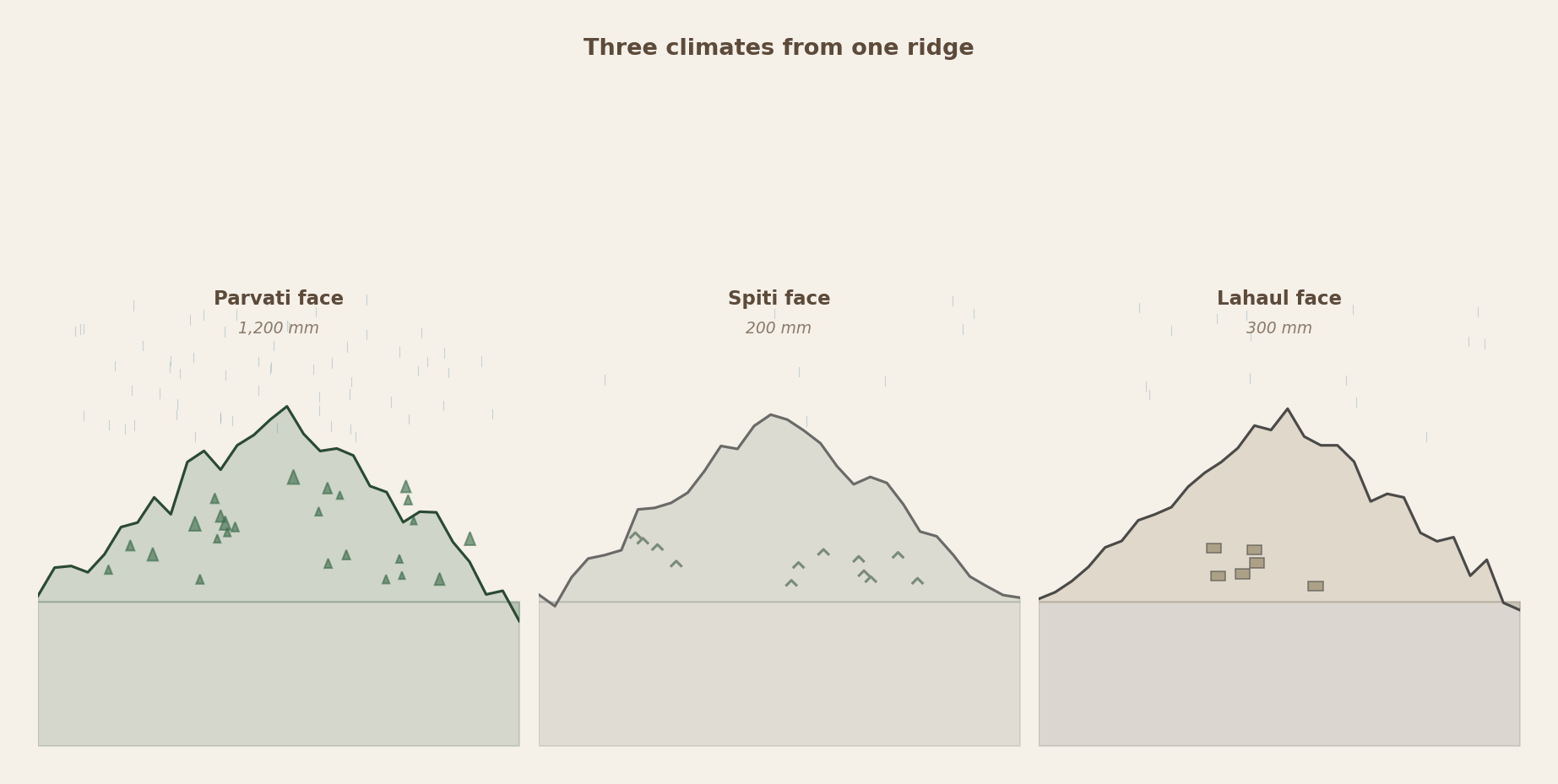
Figure 2: Three climates from one ridge — the moisture gradient. Deodar on the Parvati face, juniper and bare scree on the Spiti face, brown mud-brick on the Lahaul face. The same snow, sorted by aspect.
II. The Statue with Two Names
Trilokinath, Upper Chenab, Lahaul — Where Two Traditions Read the Same Stone
The Thread Walker crossed the pass into Lahaul and descended the Chandra valley to its confluence with the Bhaga at Tandi, where the two rivers join to become the Chenab — the Chandrabhaga. From Tandi she went south along the Bhaga to Udaipur, and from Udaipur she climbed the narrow road to Trilokinath.
The temple sits at 2,760 metres on a spur above the Chandrabhaga gorge, in country that is brown and grey — no deodar, no pine, only the occasional poplar planted by hand along an irrigation channel. The building is stone, whitewashed, with a pagoda roof of the kind that appears throughout the Western Himalaya — wooden tiers, each smaller than the one below, the topmost carrying a brass finial that catches the afternoon light.
She arrived during a festival. This was the detail that would stay with her.
Both processions arrived at the same hour.
The Hindu procession came from the south, from the villages below Udaipur — women in bright wool, men carrying a brass palanquin on which rested garlands and a photograph of Shiva. They were singing. The Thread Walker could hear the rhythm before she could hear the words — the two-beat pulse that carries Hindi devotional songs through mountain air the way a river carries its sound through a gorge: you hear the beat first, the meaning later.
The Buddhist procession came from the east, from the monastery side of the valley — monks in maroon robes, laypeople carrying prayer flags and khatas, white offering scarves. They were not singing. They were chanting, a lower register, a drone that sat beneath the Hindu singing the way the tanpura sits beneath the melody.
Both processions entered the same gate. Both circled the same temple. Both stopped before the same statue.
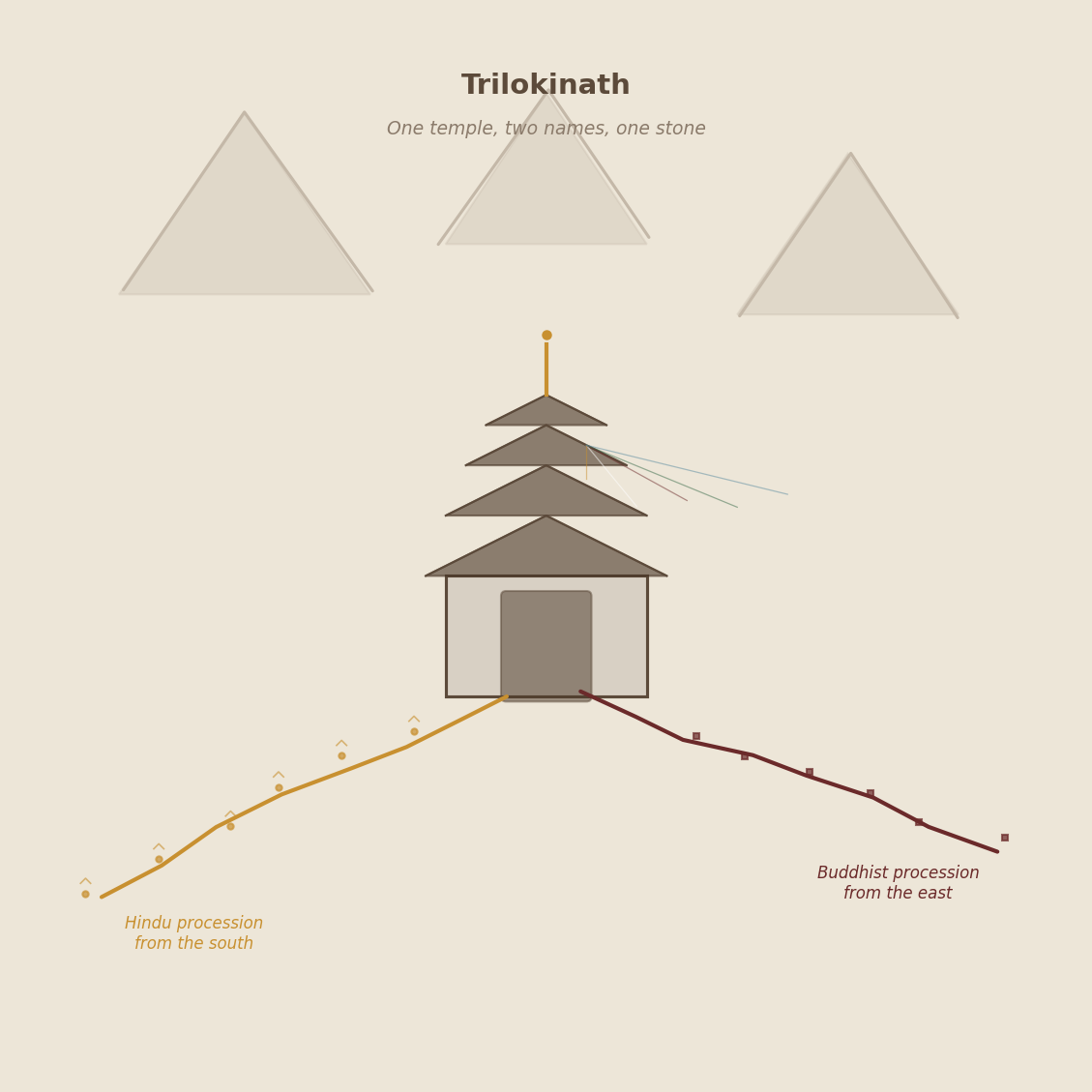
Figure 3: Trilokinath — two processions arriving at the same gate. The Hindu procession from the south with garlands and singing, the Buddhist procession from the east with prayer flags and chanting. One temple, two names, one stone.
The statue is white marble, six-armed, standing in a pose that the Thread Walker recognised from both traditions. The Hindus call it Shiva — the Lord of the Three Worlds, Trilokinath. The Buddhists call it Avalokiteshvara — the bodhisattva of compassion. The statue’s face is serene enough to be either. The attributes in its hands are ambiguous enough to be read both ways.
The Thread Walker spoke with the pujari, a Hindu priest who had served the temple for decades.
It is Shiva, he said. The trident is in the upper right hand. The serpent is around the neck. These are the marks.
She spoke with the monk who had led the Buddhist procession.
It is Avalokiteshvara, he said. The lotus is in the lower left hand. The gesture of the central right hand is abhaya — the fearlessness mudrā. These are the marks.
The Thread Walker looked at the statue again. The upper right hand held something that could be a trident or a vajra — the stone was worn smooth by centuries of offerings, and the shape was ambiguous. The neck bore a carved ornament that could be a serpent or a garland. The lower left hand held something round that could be a lotus bud or a kamandalu, a water vessel.
She wrote:
The statue is not ambiguous. The statue is precise. It is the reading that is ambiguous. The same six arms, the same serene face, the same stone — but the Hindu tradition reads trident, serpent, Shiva, and the Buddhist tradition reads vajra, garland, Avalokiteshvara. Neither is wrong. The statue is old enough that it may have been carved before the two traditions diverged at this altitude — when the mountain religion was neither Hindu nor Buddhist but something older that both traditions claimed.
What the tri-junction teaches here is not that two readings of the same stone are equally valid — a comfortable thought, but an empty one. What it teaches is that the reading depends on the reader’s tradition, and the tradition is not a lens placed over the statue but a language in which the statue speaks. The statue speaks Hindi to the Hindu. It speaks Tibetan to the Buddhist. It speaks the same words in both languages, because the stone has only one shape. But the words mean different things, because meaning is not in the stone.
The pujari and the monk are not in disagreement. They are in the same temple, before the same stone, performing the same act of devotion, and they do not see the same thing. This is not a failure of seeing. It is the nature of seeing: that every tradition equips its practitioners with a vocabulary, and the vocabulary determines what the stone says.
The two processions departed separately — the Hindus south, the Buddhists east. The statue remained, saying nothing, holding its six arms in the same positions it had held for centuries. The Thread Walker thought: the statue is patient. It has been both Shiva and Avalokiteshvara for longer than either name has been spoken in these mountains. It will be both after the names are forgotten. The stone does not need to choose.
III. The Meadow Where Three Flocks Arrive
Bara Bhangal, Ravi Headwaters — Where Three Shepherd Traditions Converge
The Thread Walker went west.
She crossed back into the Kullu valley and then over the Dhauladhar by a shepherds’ track that the Survey had marked as a dotted line, the kind of path that appears on the map as a suggestion rather than a commitment. She descended into the Ravi drainage — the western side of the tri-junction between Kullu, Kangra, and Chamba — and arrived at Bara Bhangal in the season when the meadows above the village were occupied.
Bara Bhangal is remote the way that altitude makes things remote. It is not far from Manali — a straight line on the map would show forty kilometres. But the straight line crosses the Dhauladhar ridge at nearly 5,000 metres, and so the practical distance is five days’ walk, and the village exists in a pocket of time that the road has not yet reached.
Three groups of shepherds use the meadows above Bara Bhangal in the summer months. They come from three different valleys — Kullu to the east, Kangra to the south, Chamba to the northwest — and they bring three variations of the same pastoral tradition. The same act — moving sheep and goats to high pasture when the snow retreats — performed by three communities that speak different dialects, worship at different temples, and weave different patterns into the same wool.
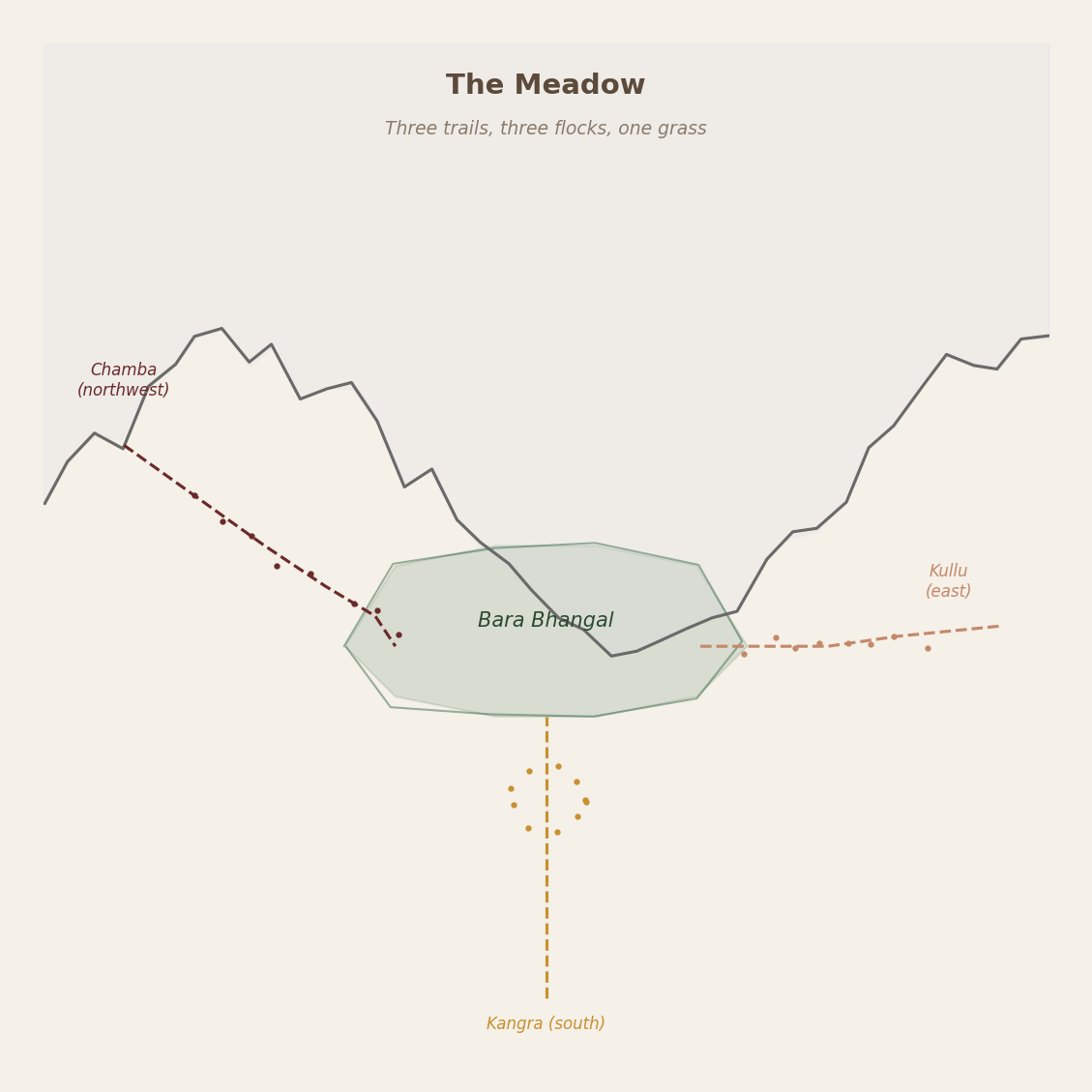
Figure 4: The meadow above Bara Bhangal — three trails converging from three valleys. Kullu from the east, Kangra from the south, Chamba from the northwest. The same grass, three flocks, three traditions of the same practice.
The Thread Walker sat with a shepherd from Kullu — a man who had been bringing his flock to these meadows since he was a boy, following his father, who had followed his father. She asked him about the other shepherds.
The Kangra people, he said, graze their sheep differently. They move the flock in wide circles. We move ours in straight lines, up and down the slope. I have watched them and I do not understand why they circle. Their sheep are the same breed. The grass is the same grass.
She spoke with a woman from Kangra.
The Kullu people, the woman said, graze in straight lines because their valleys are narrow. The slopes are steep. There is only up and down. But here, the meadow is wide — wide enough to circle. We circle because our home valley is wide. We brought our habit from home.
She spoke with a shepherd from Chamba.
Both of them are wrong, he said, and laughed. The grass does not care whether you circle or walk in lines. The grass grows where the water is. I follow the water. I do not have a shape. My father did not have a shape. We go where the grass is green and we stay until it is brown and then we go where the grass is green again.
The Thread Walker wrote:
Three shepherds. Three strategies. All three work — the sheep are fed, the wool is shorn, the flock returns to the home valley in autumn. The straight line, the wide circle, the water-follower. Each strategy is shaped by the home valley: the Kullu shepherd’s straight line mirrors his narrow valley. The Kangra shepherd’s circle mirrors her wide one. The Chamba shepherd’s shapelessness mirrors his tradition of following the drainage, not the slope.
But on this meadow, above Bara Bhangal, all three strategies produce the same result: grazed grass, fed sheep, living wool. The convergence is not in the method. It is in the outcome. The three traditions agree on what matters — the sheep must eat — and disagree on how to achieve it, and the disagreement is not a deficiency. It is a signature. Each strategy carries the shape of the valley it came from, the way a river carries the mineral of the rock it has cut through.
What the three shepherds cannot see, standing on the same meadow, is each other’s home valley. The Kullu shepherd has never walked the wide Kangra plains. The Kangra woman has never climbed the narrow Kullu gorge. The Chamba man has never followed the Ravi to its mouth. Each carries a valley in the body — in the legs, in the habit of the hand, in the angle of the eye when it sweeps the country for the next patch of green. The meadow is where these three embodied valleys meet. And the sheep do not care.
IV. The Fossilised Corridor
Chilas, Indus Gorge — Where Fifty Thousand Marks Remember Who Passed
The Thread Walker went north.
She crossed into the Indus drainage — the country beyond the Western Himalaya’s familiar valleys, where the mountains are no longer green but grey, no longer clothed in deodar but bare to the bone, where the river has cut a gorge so deep that the valley floor bakes at forty-five degrees in summer while the peaks above still carry ice. This is the country of mineral light — no monsoon haze, no filtered canopy, only the dry Karakoram air that sharpens everything and softens nothing.
At Chilas, where the Indus widens enough for a town, the Thread Walker found the rocks.
They were everywhere. On the river terraces above the flood line, on boulders the size of houses that had fallen from the gorge walls, on flat slabs smoothed by glacial passage ten thousand years ago and since used as surfaces for a different kind of inscription. The rocks were covered in marks.
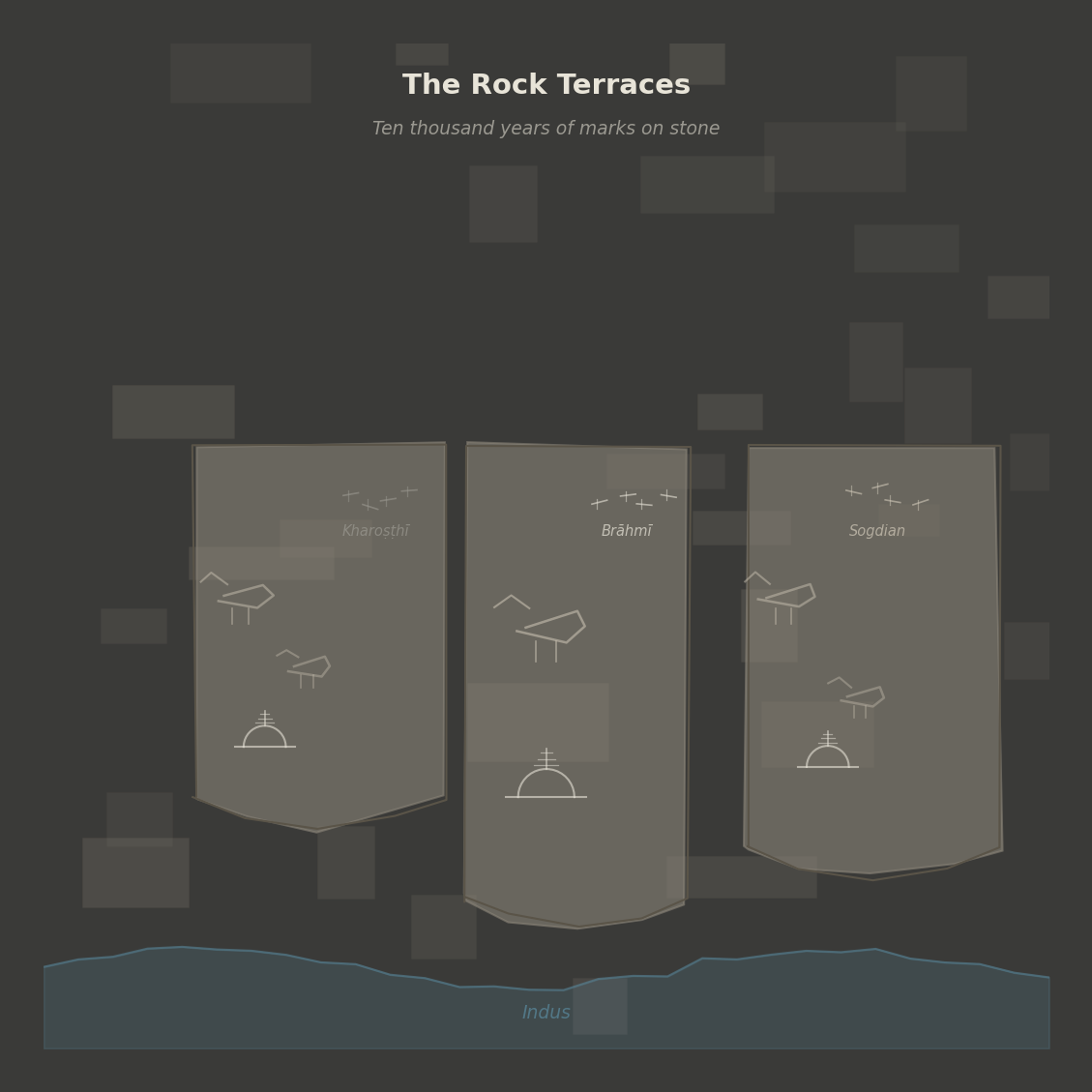
Figure 5: The rock terraces at Chilas — boulders covered in ten thousand years of marks. Ibex with knotted horns beneath Buddhist stūpas beneath Sogdian script. Each layer a traveller. Each mark a reading of the corridor.
Fifty thousand carvings. Five thousand inscriptions. Ten writing systems. The Pak-German Archaeological Mission had catalogued them over decades — site by site, rock by rock, mark by mark — and what they had found was not a collection but a stratigraphy. A vertical record of passage, the way a geological column is a vertical record of deposition.
The deepest layer — the oldest marks — was animal. Ibex with knotted horns and beards, markhor with spiral horns, deer, bovids. Hunting scenes: figures with bows stalking caprids across rock faces that had been smooth when the first hand touched them. No writing. No religion. Only the animal and the hunter and the stone.
Above the animal layer, the Buddhist layer. Stūpas with domed tops and tiered umbrellas. Monks offering incense. The earliest inscriptions: Kharoṣṭhī script recording Gāndhārī language — x, son of y, arrived. Pilgrims and merchants leaving their names on the rocks the way a guest signs a register. At one site, the Thread Walker saw where a Buddhist traveller had carved a seated Buddha directly on top of an ibex — the older image visible beneath the newer, the horns showing through the halo. The rock was a palimpsest. The traveller had not erased the ibex. He had added his devotion alongside it.
Above the Buddhist layer, the Silk Road layer. Ten scripts on the same rocks — Brāhmī, Sogdian, Bactrian, Chinese, Tibetan, Parthian, Hebrew. At one river crossing alone, 565 Sogdian inscriptions from Iranian merchants who had crossed the passes from Tashkurgan and stopped here to scratch their names and their prayers into the rock before continuing south. A merchant named Nanai-Vandak had carved his plea to reach home safely. The Thread Walker touched the letters. They were still sharp after fifteen hundred years.
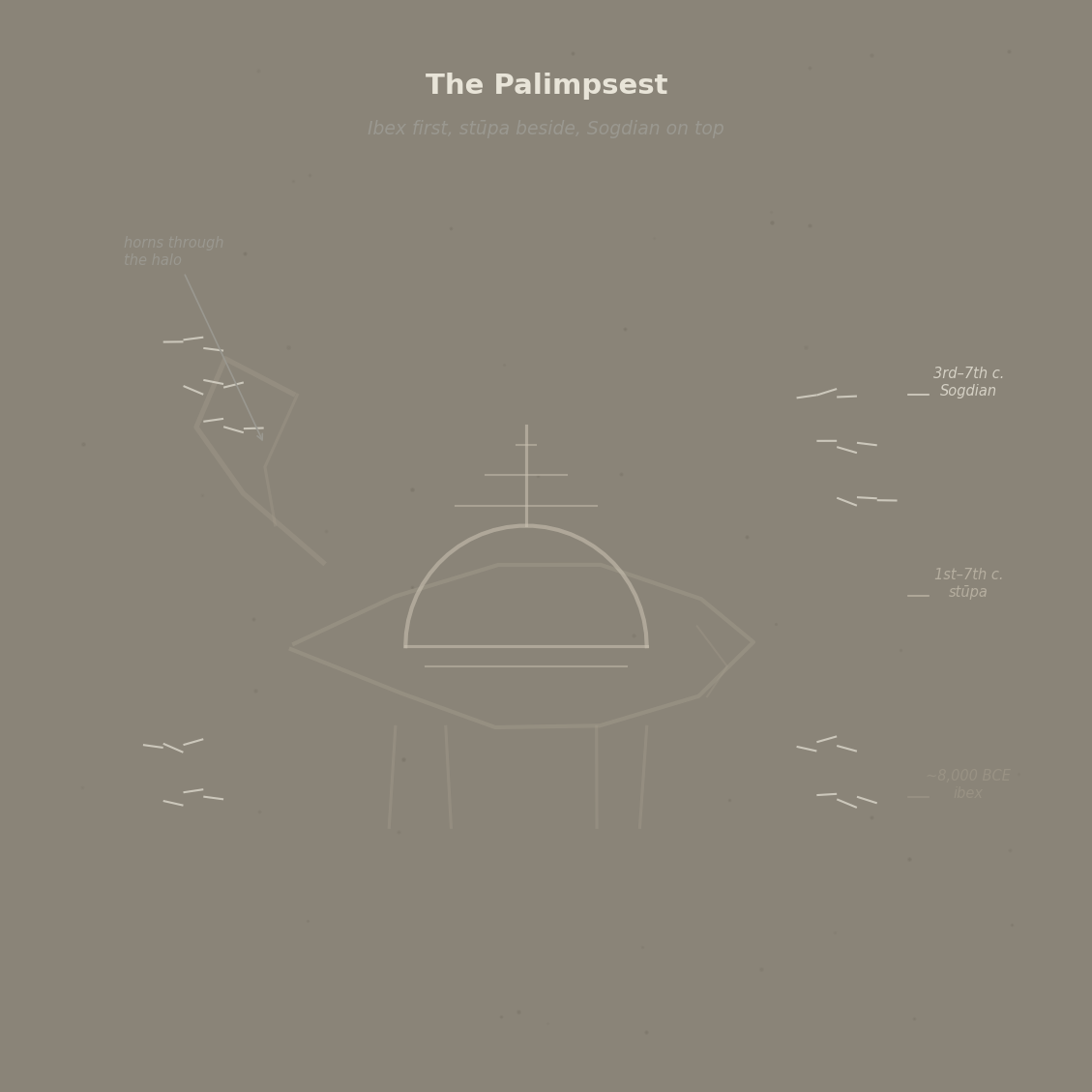
Figure 6: The palimpsest — ibex carved first, stūpa carved beside it, Buddha carved on top, Sogdian script carved in the remaining space. Four layers. Four travellers. One rock.
The Thread Walker spent three days at the rock terraces. She walked from site to site, reading what she could read, drawing what she could not. At Oshibat, five thousand caprid drawings with only a handful of Buddhist images — a hunting station that had accumulated devotional marks later, the way a path accumulates signposts after it has been walked for centuries. At Shatial, the river crossing where every traveller had stopped, the rocks were so densely inscribed that new marks had been carved over old ones — the palimpsest at its thickest, the corridor at its most congested.
She wrote:
The rocks at Chilas are orientation notes — marks left by travellers to say “I was here, I came from there, I worship this.” Each mark is a reading of the corridor. The ibex- hunter read the corridor as a hunting ground. The Buddhist pilgrim read it as a sacred route. The Sogdian merchant read it as a trade road. The Chinese envoy read it as a diplomatic passage. Each reading is accurate. Each reading is partial.
The ibex is the oldest mark and the most persistent. It appears beneath Buddhist stūpas, beside Brāhmī inscriptions, under Sogdian script. The ibex was carved first. Everything else was carved on top of it. The older pattern persists beneath the newer. The traveller who carved the Buddha on top of the ibex did not destroy the ibex — the horns still show through the halo. The corridor accumulates. It does not replace.
And now the dam. Thirteen villages will be submerged. Fifty thousand carvings will drown beneath the reservoir. The rock is patient — it has held these marks for ten thousand years. But water is more patient than rock. When the medium changes — when the corridor becomes a lake — the marks will vanish, not because they were wrong but because the surface that held them is no longer accessible. The corridor will be unreadable. The orientations will be lost. Not the knowledge — the knowledge is catalogued, the carvings are photographed, the inscriptions are published. But the surface. The stone that held the marks. The palimpsest itself — the fact that the ibex is beneath the Buddha and the Buddha is beneath the Sogdian script and the Sogdian script is beneath the modern graffiti — that stratigraphy will dissolve when the water rises, because stratigraphy is not information. It is arrangement. And arrangement cannot be photographed. It can only be stood beside.
V. The Mountain That Cannot Be Seen Whole
Nanga Parbat, Diamer — Where Three Faces Carry Three Names
The Thread Walker continued north along the Indus to where the gorge deepens beyond anything she had seen in the valleys she knew. At Raikot Bridge, where the Karakoram Highway crosses the river, the relief from water to summit exceeded seven thousand metres in twenty-one kilometres. She could not see the summit from the bridge. She could not see it from the road. She could not see it from the hot springs at Tato, where the mountain breathed its own heat through fractures in the rock and the water emerged at ninety-two degrees.
She saw one face at a time.
From the Rakhiot Valley, to the north, she saw the Rakhiot Face — the approach the German expeditions had used in the 1930s, the face where avalanches had killed sixteen men in a single night in 1937, the face where Buhl had departed at two in the morning and reached the summit alone at seven in the evening, the only first ascent of an eight-thousand-metre peak by a single climber. The Rakhiot Face was grey and broken, serac-hung, the glacier at its base retreating at a rate that had accelerated sevenfold in the last fifteen years.
From the Diamir Valley, to the west, she saw the Diamir Face — the face that gave the mountain its older name. In Shina, the language of the Indus gorge, the mountain is not Nanga Parbat. It is Diamer — Deo Mir, the Mountain of the Gods. The Shina name describes the invisible: the spirits that inhabit the upper slopes. The Urdu name describes the visible: the bare rock. The same mountain. Two names. Two readings.
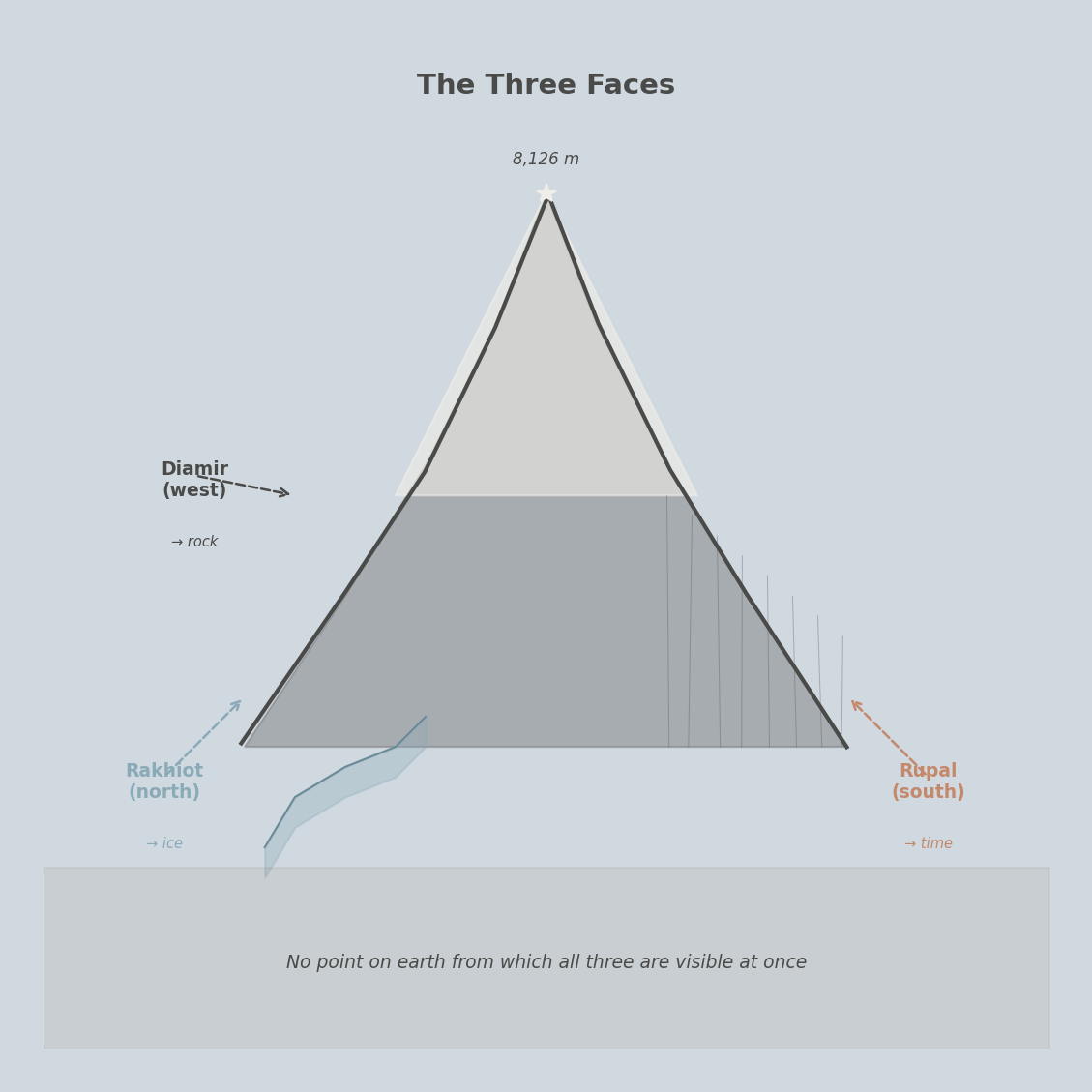
Figure 7: The three faces of Nanga Parbat — Rakhiot to the north, Diamir to the west, Rupal to the south. Each face a different mountain. Each name a different theory. No point on earth from which all three are visible at once.
From the Rupal Valley, to the south, she saw the Rupal Face — 4,600 metres of continuous vertical relief, the highest mountain face on Earth. From the base camp at 3,350 metres the summit was nearly five vertical kilometres above, and the face filled the sky the way a page fills the hand of a person who holds it too close to read.
Three faces. Three valleys. Three names for the same mountain. And no point on the earth’s surface from which all three faces are visible simultaneously.
The Thread Walker spoke with a man at Tato who had worked as a porter on expeditions to both the Rakhiot and the Diamir sides. She asked him: Is it the same mountain?
He looked at her as though the question were strange.
It is the same mountain, he said. But it is not the same climb. From the Rakhiot, you are climbing ice. From the Diamir, you are climbing rock. From the Rupal — he gestured south, toward the face he had never seen from this side — from the Rupal, I am told, you are climbing time. It takes so long to climb that face that the mountain changes while you are on it. The weather that was clear when you left the base is storm when you reach the shoulder. The snow that was firm in the morning is rotten by the afternoon. The Rupal Face is a different mountain every six hours.
The Thread Walker wrote:
Three faces. Three experiences of the same structure. The Rakhiot climber knows ice. The Diamir climber knows rock. The Rupal climber knows time. Each has walked the mountain. Each has a reading of it — detailed, embodied, earned through effort and risk. And each reading is of a different mountain, because each face presents a different surface to the climber’s hands and feet and eyes.
The mountain that cannot be seen whole. There is no helicopter high enough, no satellite close enough, no viewpoint wide enough to hold all three faces in a single gaze. Every view of Nanga Parbat is a view of one face — which means every view is a theory. The climber who knows the Rakhiot Face has a theory of the mountain that involves ice and seracs and avalanche danger. The climber who knows the Diamir Face has a theory that involves rock and gradient and the ghosts of the Messner brothers’ traverse. The climber who knows the Rupal Face has a theory that involves endurance and time and the 4,600 metres of continuous vertical that no one can see from the other two valleys.
No single climber has a wrong theory. Each has a theory shaped by the face they have climbed, which is the face they can see from their valley, which is the valley they entered first. The mountain is the union of all three theories. And the union cannot be experienced — only understood, the way a cartographer understands the country by reading three studies drawn by three hands, each of which saw what the others could not.
She descended from Tato on the jeep road that clings to the gorge wall a thousand metres above the Indus — the road ranked the second deadliest in the world, just wide enough for a single vehicle, the smell of burning brake pads in the air, the screech of tyres on loose shale. Below, the river that had cut this gorge was older than the mountain it cut through — an antecedent drainage, the geologists said. The river had been here first. The mountain rose around it. And the river kept cutting, the way a reader keeps reading, and the gorge deepened, and the mountain grew, and neither the river nor the mountain had finished.
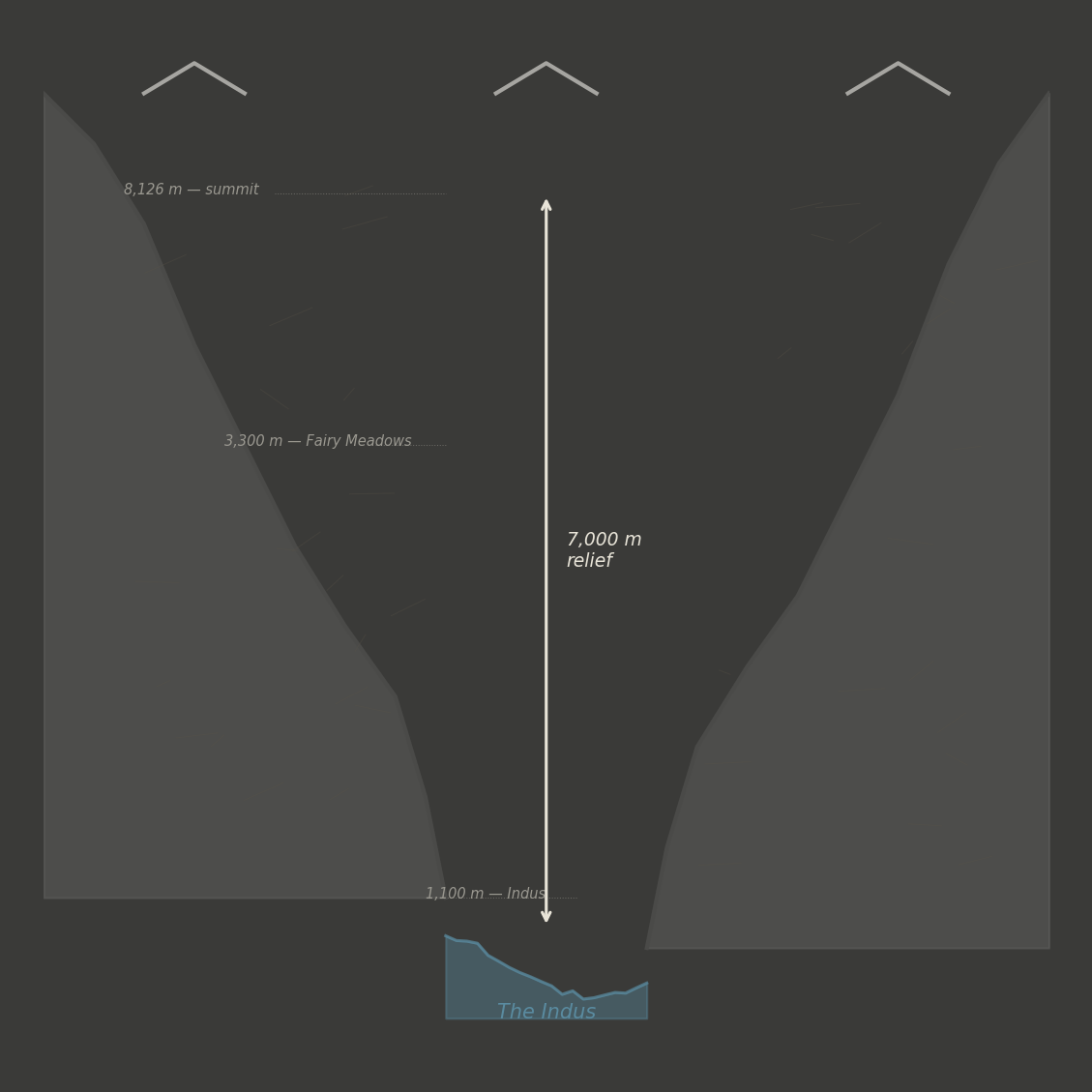
Figure 8: The Indus gorge below Nanga Parbat — seven thousand metres of relief in twenty-one kilometres. The river older than the mountain it cuts through. Neither has finished.
VI. The Language the Spirit Brings
Hunza Valley, Karimabad to Gojal — Where Three Languages Share No Common Ancestor
The Thread Walker reached Hunza.
The valley was different from everything she knew. Wider than the Tirthan gorge, drier than the Parvati, more vertical than anything in Kullu — the peaks above Karimabad exceeded seven thousand metres, and the irrigated terraces below were green only because the water had been brought by hand from the glaciers above, channelled through stone-lined canals that crossed cliff faces on wooden troughs. This was not monsoon country. This was engineering country — every green field an act of will against the brown rock.
And it was here that the Thread Walker encountered the strangest tri-junction of her journey. Not a junction of valleys or traditions or names for the same statue. A junction of languages.
Three languages are spoken in Hunza and the valleys around it: Burushaski, Shina, and Wakhi. They share no common ancestor. Shina is Indo-Aryan — a cousin of Hindi and Urdu, traceable back through Sanskrit to a proto-language spoken five thousand years ago on the steppe. Wakhi is Iranian — a cousin of Persian and Pashto, traceable back through the same proto- language by a different branch. But Burushaski is neither. Burushaski is an isolate — a language with no known relatives, no demonstrated connection to any other language on earth. It sits in these valleys the way a boulder sits in a river — the current flows around it, but it does not move.
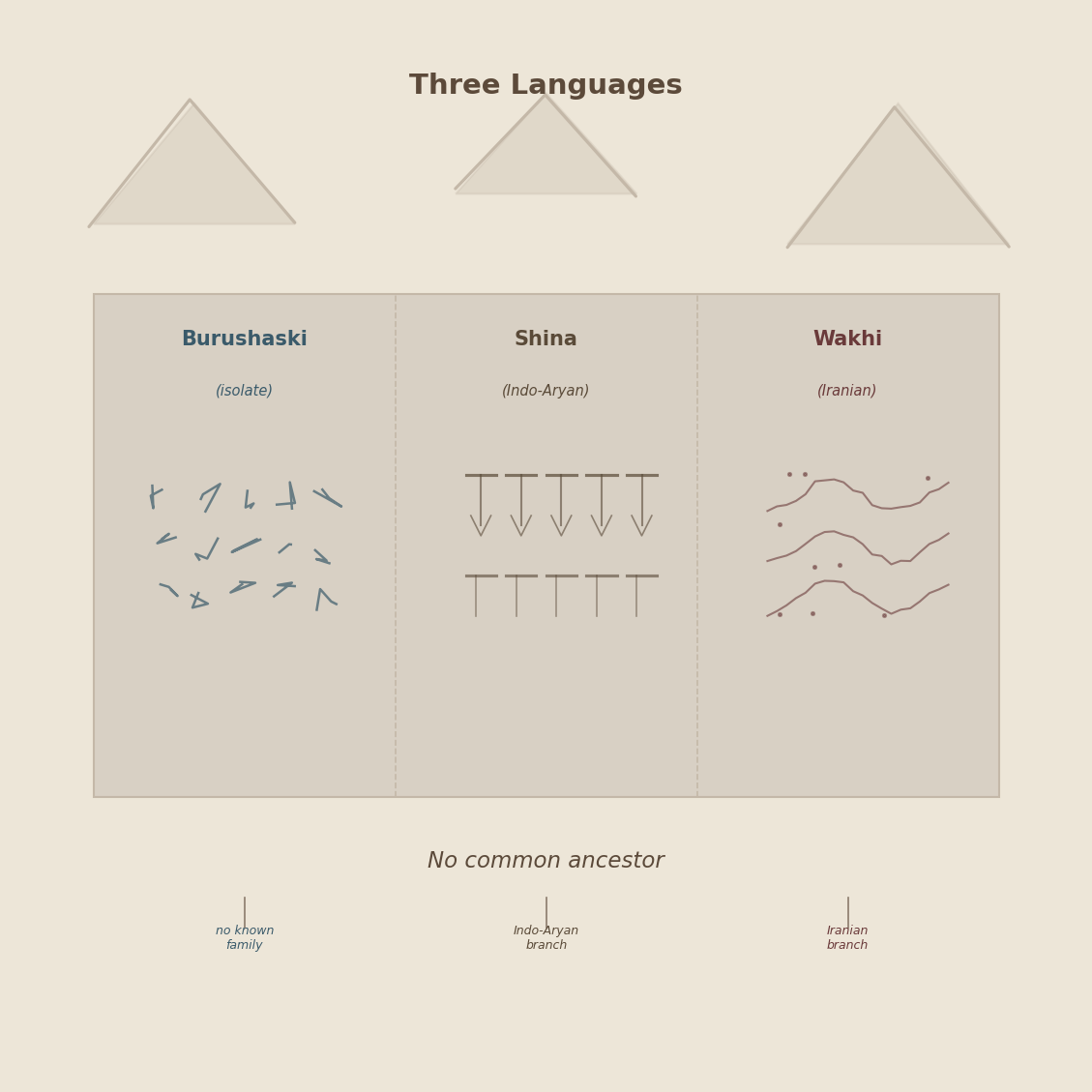
Figure 9: Three languages, no common ancestor — Burushaski (isolate), Shina (Indo-Aryan), Wakhi (Iranian). Three scripts on the same market wall in Karimabad. Three ways of encoding the same valley.
The Thread Walker spoke with a teacher in Karimabad who taught in Urdu but spoke Burushaski at home.
It is not that Burushaski has no relatives, he said. It is that no one has found them. Linguists have tried. They have compared it to Basque, to the Caucasian languages, to the Yeniseian languages of Siberia. Nothing holds. The connections are always superficial — a few words that sound similar, a grammatical feature that might be coincidence. Burushaski is alone.
What does that feel like? the Thread Walker asked. To speak a language that is alone?
He thought for a moment.
It feels like standing on a ridge, he said. You can see into other valleys. You can hear other languages. You can learn them — most of us speak three or four. But when you come home and speak Burushaski to your children, you are speaking something that came from nowhere that anyone can find. It is like the glacier: it is here, it feeds the fields, but no one can say exactly when it arrived or where the first snow fell.
The Thread Walker heard about the bitan from an older man in Gojal — the upper part of Hunza where Wakhi is spoken, where the Karakoram Highway climbs toward the Khunjerab Pass and China.
The bitan, the man said, is the shaman. In Burushaski we call him bitan. In Shina they call him dayal. The peri choose him — the mountain spirits. They select from among newborns by smelling their noses and mouths during the cherry and apricot blossom. The chosen one grows up different. Unconscious spells. Ecstatic states. Prolonged sickness.
And the trance? the Thread Walker asked.
Music. Juniper smoke. Goat blood. The drums play for forty minutes. The bitan inhales burning juniper. He drinks blood from a freshly severed head — a young male goat. And then he dances, and then he speaks.
In what language?
The old man looked at her carefully.
That, he said, is the question.
He said: The bitan speaks Burushaski when he is awake. That is his mother tongue. That is the language of his home, his children, his fields, his daily prayers. But when the peri enter him — when the drums have played and the juniper has burned and the blood has been drunk — the bitan speaks Shina.
Shina, the Thread Walker repeated.
Shina. A language he does not normally speak. He may know some words — everyone here knows some Shina, the way everyone knows some Urdu. But in trance, the bitan does not speak a few words of Shina. He speaks fluently. He speaks in an archaic register that the Shina-speakers themselves do not fully understand. He sings his prophecy in a language that he is incapable of speaking or understanding when he is awake.
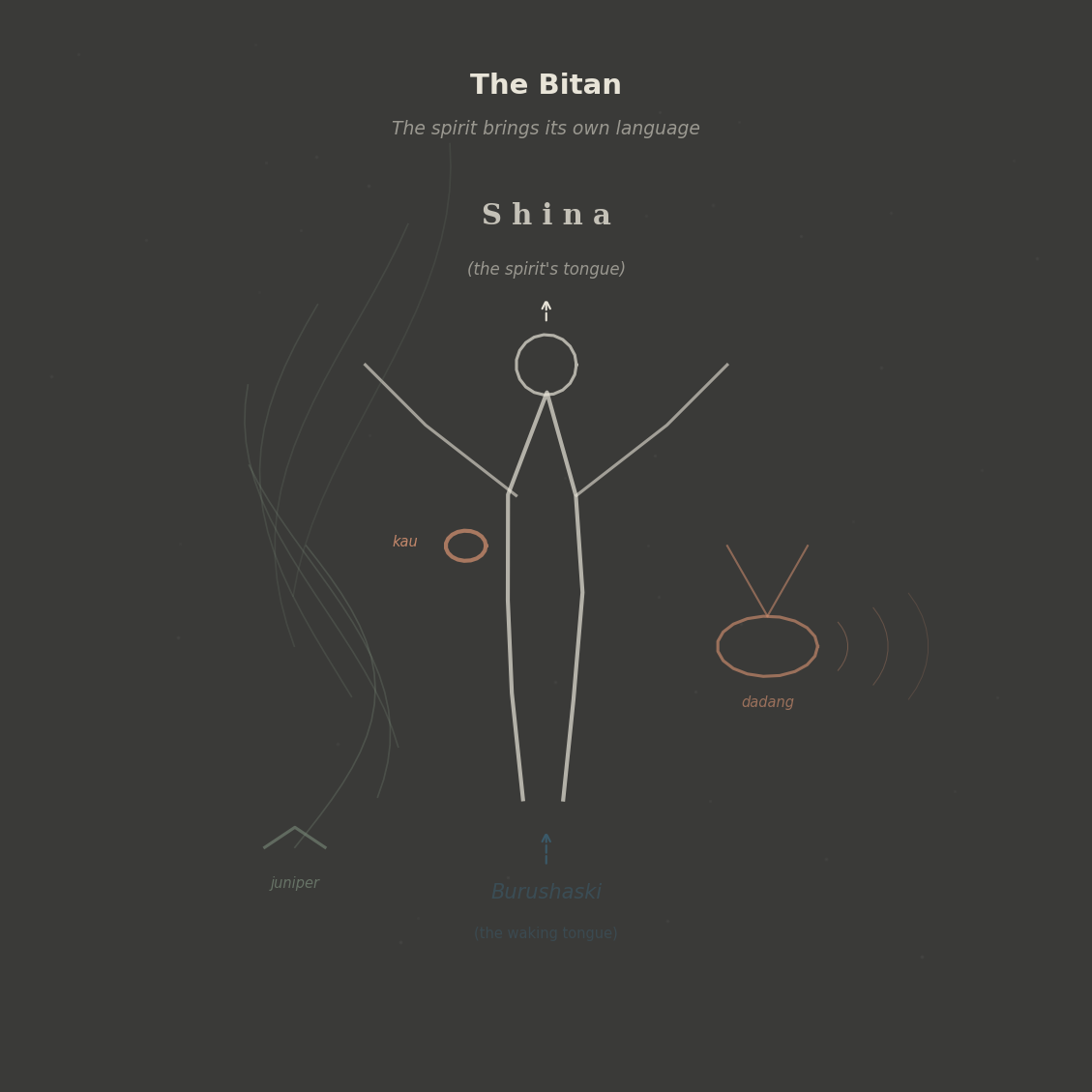
Figure 10: The bitan in trance — juniper smoke, drum rhythm, the moment of passage. The Burushaski speaker opens his mouth and Shina comes out. The spirit brings its own language.
How is this explained? the Thread Walker asked.
The peri explain it, the man said. The peri are Shina- speaking spirits. The only official language of the peri is Shina. When the peri enter the bitan, they bring their own language. The bitan’s mouth moves. The peri’s words come out. The body is Burushaski. The voice is Shina. The iron bangle on his wrist — the kau — binds him to the spirit and protects him from it at the same time. The binding is the protection.
The Thread Walker sat with this for a long time. The afternoon light in Hunza is different from the light in the valleys she knew — harder, more mineral, the dry air sharpening everything. The peaks above Karimabad were lit orange on one side and blue on the other — the sun low enough to cast the eastern faces into shadow while the western faces still burned.
She wrote:
The bitan speaks a language he does not know. The spirit brings its own tongue. This is the strangest reading of all — not a person reading a document, not a climber reading a face, not a shepherd reading a meadow, but a body speaking words that belong to something else. The bitan is not confused. He is not pretending. He is inhabited. The spirit enters through the juniper smoke and the drum rhythm and the blood, and it speaks through him in its own language, and his mouth forms words his waking mind does not own.
This is the final form of the tri-junction. Not three valleys meeting. Not three traditions reading the same stone. Not three shepherds grazing the same meadow. But three languages meeting in a single throat — the Burushaski of the waking man, the Shina of the inhabiting spirit, and the Urdu of the daily world — none of which shares a common ancestor with the others, each of which encodes a different relationship to the same mountains.
The language isolate — Burushaski, the tongue with no known relatives — is the one that yields to the spirit’s language in trance. The substrate that cannot be classified is the substrate that opens its mouth and lets the classified one speak. It is not replacement. It is hospitality. The bitan’s body hosts the peri the way the valley hosts the glacier: something arrives, something speaks, something feeds the fields, and when the trance ends the body remembers nothing, the way the valley remembers nothing of yesterday’s meltwater except the green it left behind.
Coda
The Thread Walker turned south.
She had been walking for weeks — from the Parvati headwall where three passes sort the same snow into three climates, to the temple where two traditions read the same statue, to the meadow where three shepherds graze the same grass with the shapes of their home valleys in their legs, to the gorge where fifty thousand marks fossilise ten thousand years of passage, to the mountain that cannot be seen whole, to the valley where the spirit brings its own language.
Six tri-junctions. Six ways of saying the same thing: that the country cannot be seen whole from any single valley.
She descended the Karakoram Highway to Chilas and sat on the river terrace where the Sogdian merchant had carved his name fifteen hundred years ago — Nanai-Vandak, pleading to reach Tashkurgan, the same prayer every traveller offers, the prayer to arrive. Below, the Indus carried water from all three faces of Nanga Parbat — Rakhiot meltwater from the north, Diamir meltwater from the west, Rupal meltwater from the south — mixed and anonymous, the mountain’s three readings dissolved into a single current.
She wrote:
Six tri-junctions. Six times, the same finding.
At the rain wall: the same snow produces three climates, because the ridge sorts what the cloud delivers.
At the temple: the same statue speaks two languages, because the tradition equips the reader’s eye.
At the meadow: the same grass feeds three flocks, because the shepherd’s body carries the shape of the home valley.
At the gorge: the same corridor receives ten scripts, because each traveller reads the passage as a reflection of where they came from.
At the mountain: the same peak shows three faces, because no valley is wide enough to hold the whole.
At the bitan’s throat: the same body speaks two languages, because the spirit brings its own tongue and the host provides the mouth.
Six times, the same finding. The country cannot be seen whole from any single valley. The rain wall teaches this with snow. The temple teaches it with stone. The meadow teaches it with grass. The gorge teaches it with marks. The mountain teaches it with rock. The bitan teaches it with breath.
And the union of the six readings is not a map. It is not a synthesis. It is a composite — the way the Indus at Chilas carries water from three faces of a mountain that no single pair of eyes has ever seen at once. The water does not know which face it came from. The river does not distinguish its tributaries. The confluence happens not by design but by drainage — by the shape of the country itself, which directs all water downward and all understanding toward the junction where the readings meet and the readings dissolve and what remains is the river, carrying everything, remembering nothing, flowing south.
She closed her notebook. Below, the Indus moved at the speed of geological patience — the river that had been here before the mountain rose, that would be here after the mountain fell, that carried in its current the dissolved minerals of every rock it had ever touched and the dissolved memory of every name that had ever been carved on its banks.
The Thread Walker stood and continued south, toward the valleys she knew, where the deodar grew and the monsoon fell and the rivers ran clear enough to see the stones at the bottom, and where the same finding — that seeing depends on where you stand — was true, but quieter, carried not in rock carvings and spirit languages but in the chalk marks on a cartographer’s slab and the tiles in a serai keeper’s register and the pattern in a weaver’s cloth.
The same finding. Six valleys. One country.
A Human-Machine Collaboration (mu2tau + Claude). The six tri-junctions are real places in the Western Himalaya and Karakoram. The Pin Parvati Pass (5,300m) connects the wettest and driest valleys in the region — 1,200mm of monsoon rain on the Parvati side, 200mm on the Spiti side. Trilokinath temple in Lahaul is genuinely venerated by both Hindu and Buddhist communities, who identify the same marble statue as Shiva and Avalokiteshvara respectively. Bara Bhangal is one of the most remote villages in Himachal Pradesh, accessible only by shepherds’ tracks across the Dhauladhar. The Chilas petroglyphs — approximately 50,000 carvings and 5,000 inscriptions in ten or more writing systems — are documented by the Pak-German Archaeological Mission (Jettmar, Bandini- König, et al.); many will be submerged by the Diamer-Basha Dam. Nanga Parbat (8,126m) stands at the Western Himalayan Syntaxis; its three faces — Rakhiot, Diamir, Rupal — are never simultaneously visible. The bitan shamanic tradition of Hunza is documented by Sidky (1994), Nicolaus (2015), and others; the detail that the bitan speaks Shina in trance regardless of his waking language is ethnographically attested. Burushaski is a genuine language isolate — no demonstrated genetic relationship to any other language has been established.