The Thread Walkers
Prefatory Note on Textile Encoding
The reader who has not sat at a loom may benefit from a brief account of its metaphysics, for the loom is an argument made of wood and string, and like all arguments it has premises that must be established before conclusions can be drawn.
A loom holds two systems of thread in tension. The first is the warp: vertical threads stretched taut between two beams, parallel, evenly spaced, under constant tension. The warp is established before weaving begins. It does not move. It does not change. It is the structure — invisible in the finished cloth but responsible for everything the cloth can be. To set a warp is to make an irrevocable commitment: the thread count, the spacing, the material, the tension. Everything that follows is constrained by this initial act. A poorly set warp cannot be corrected by clever weaving. It can only be cut off and begun again.
The second is the weft: horizontal threads passed back and forth through the warp, over and under, over and under, in patterns determined by which warp threads are raised and which lowered. The mechanism that raises them is called a heddle — a frame threaded with loops, each loop holding one warp thread. Lift the heddle and half the warp rises, creating an opening called the shed — a triangle of air through which the weft can pass. Lower the heddle, lift its complement, and the shed reverses. The weft, passing through alternating sheds, locks into the warp and becomes cloth.
The edges of the cloth — where the weft turns and re-enters the shed from the opposite direction — are called selvedges. They are the most fragile part of any fabric. If the tension is wrong, the selvedges curl or gap. If the weft is pulled too tight, the cloth narrows. Too loose, and the edges become ragged. The selvedge is where errors announce themselves. A weaver judges the health of her work by its edges, not its centre.
One further concept. In certain traditions — the Kinnauri shawls of the western Himalaya, the pattu of Kullu, and most remarkably the khipu of the Andean highlands — the thread is not merely structure. It is notation. The Inca khipu kamayuq, the knot-keepers, recorded censuses, tribute rolls, troop movements, and — if the work of recent scholars is correct — histories and letters, all in knotted cords whose meaning was encoded in the colour, the fibre, the twist direction, and the type and position of each knot. When the Spanish came, they burned the khipus and killed the readers. The notation survives. The capacity to read it does not. Five centuries of knotted messages, and no one alive can decipher more than the arithmetic.
This is the deepest form of the problem that concerns us: not merely forgetting between seasons, but forgetting across civilisations. A notation whose readers are extinct is not lost information. It is imprisoned information — present, physical, countable, and mute.
The weavers of the Disputed Passes have not yet reached that silence. But they are aware of it. It informs everything they do.
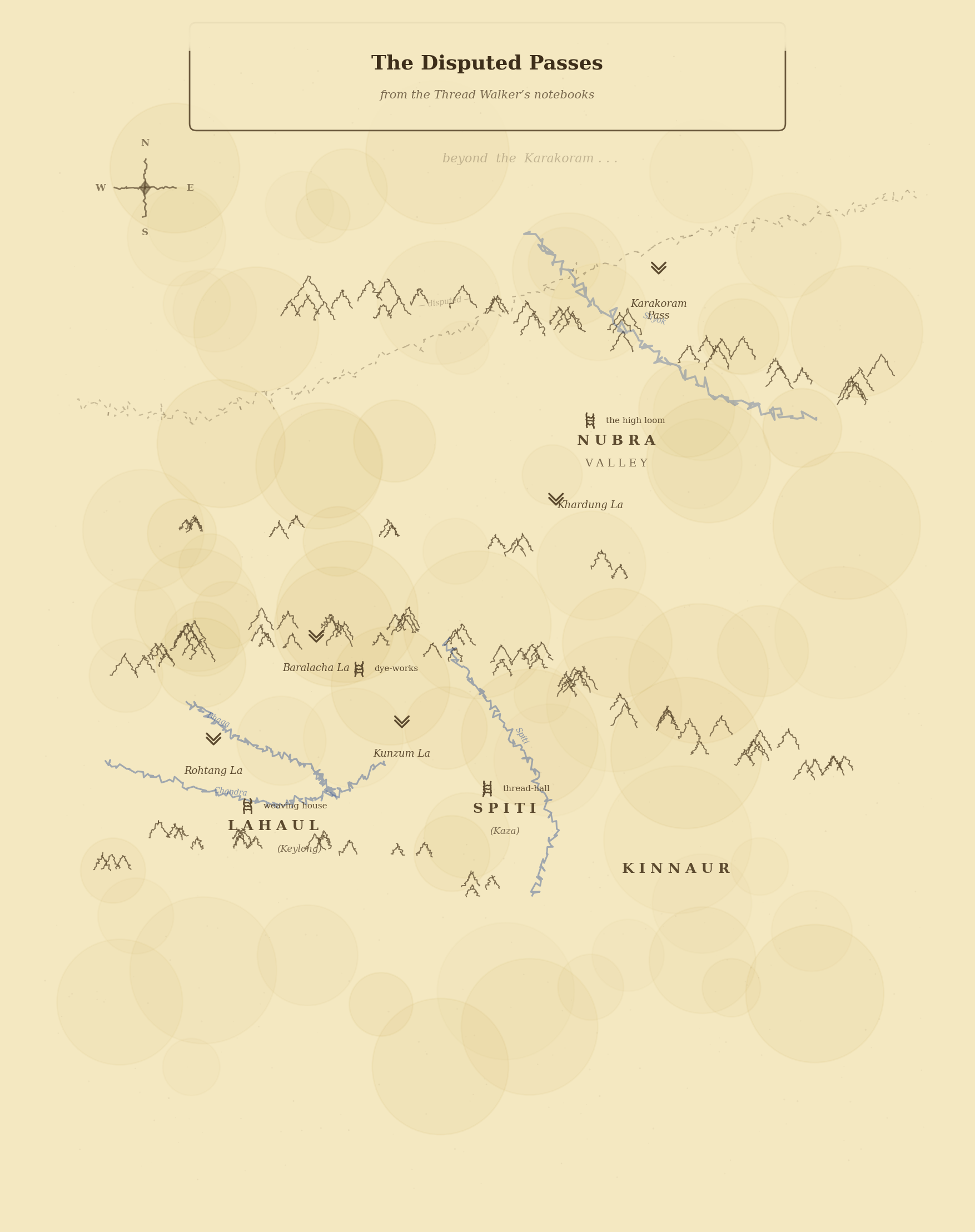
Figure 1: The Disputed Passes — from the Thread Walker’s notebooks
I. The Workshops
In the high valleys where the Himalaya folds into the Karakoram and the Karakoram into the Kunlun — where India becomes Tibet becomes China becomes Pakistan in a space that the mountains themselves have never agreed to partition — the Guild of Thread Walkers maintains workshops.
The name requires explanation. In these valleys, to walk a thread is to carry a pattern — encoded in a knotted cord, in the manner of the old Andean record-keepers, though arrived at independently and by a different route — from one workshop to another, across passes where the crossing changes what is carried. The cord is the message. The walker is the medium. The walk is the risk.
The workshops are scattered across valleys that are each a climate unto themselves. One sits in a stone house in Lahaul, where moisture softens paper and corrodes metal but where wool holds dye as nowhere else, the lanolin in the local fleece acting as a mordant that no chemist has successfully replicated. Another occupies a room above a tea shop in Spiti, where the air is so arid that yarn must be dampened before it can be worked, and where the light — a particular quality of thin-atmosphere light that exists only above four thousand metres — reveals flaws in a weave that lower altitudes conceal. A third is said to exist in the Nubra Valley, beyond the Khardung La, where the craft reflects Tibetan technique more than Indian and where the looms are of a different design: not the pit looms of the south but the backstrap looms of the nomadic Changpa, who weave while walking and whose cloth carries, in its variable tension, a record of the terrain over which it was made.
There are others. On the far side of the Karakoram Pass, in what the maps of one nation call Aksai Chin and the maps of another call nothing at all, there is rumoured to be a workshop that records patterns in a notation no other workshop can read — not because the notation is secret but because it evolved in isolation on the wrong side of a border that neither the weavers nor the sheep recognise. Farther west, beyond the Kunjerab, there are workshops where the same patterns appear under different names and different patterns under the same names, and no one can establish priority because the political border that separates them is younger than the craft it bisects.
A pattern that is called one thing in Leh is called another in Lhasa and a third in Gilgit. The pattern is the same. The names are assertions of sovereignty. The Thread Walkers carry all three names and consider none of them authoritative.
II. The Weavers
In each workshop works a weaver. The weavers of the Disputed Passes — the high crossings between these valleys, whose number is itself disputed, since certain passes appear and disappear from maps depending on the decade and the politics — are drawn from a tradition that values fresh perception above continuity.
Each season when the passes open, a new weaver arrives at each workshop. She knows the craft: the setting of a warp, the threading of a heddle, the reading of a pattern draft, the mixing of a dye bath, the particular mathematics of thread count and reed spacing that determines whether cloth will drape or stand. She knows the Guild’s notation for recording patterns — a system of knotted cords that encodes, in the colour and twist of each thread and the type and position of each knot, everything that a weaver needs to reproduce a fabric: the warp material, the weft material, the sett, the pattern of lifts, the selvedge treatment, the dye sequence.
She does not know what was woven last season. She does not know the state of the pattern archive. She does not remember. This is not an affliction. It is the method. In the Guild’s view, a weaver who remembers the previous season will weave from memory rather than from the pattern card, and memory — unlike the card — degrades, embroiders, and lies. The card is the truth. The weaver is the instrument.
On her loom frame she finds a card:
You are a weaver. The archive beneath your loom contains the patterns of this workshop, recorded in knotted cords, and references to patterns in other valleys. Before you weave, inspect the archive. Run your hands through the cords. Check the knots against the index. If the archive is in disorder — and in this workshop it often is — do not weave. Describe the disorder and wait.
The card is unsigned.
III. The Thread Walker
Between the workshops walks the Thread Walker — a dyer by original training, though the years have made him something less definable: part courier, part inspector, part itinerant memory in a system designed to have none.
He carries a satchel of sample cords and too many notebooks. He enters each workshop, reads what has been left for him in the incoming tray, leaves what needs to be read, and walks on — over the Rohtang, or the Kunzum, or the Baralacha, or the Khardung, or the Karakoram, depending on the season and the politics and the disposition of whatever glacier has decided to rearrange the route. By the time the weaver acts on his letter, the Thread Walker is in another valley, possibly on the far side of an international border that he does not acknowledge because the thread he carries predates it by a thousand years.
He is not the weavers’ master. He is their correspondent. He is the only person who has entered every workshop, handled every archive, compared the knotted cords of one valley against those of another. He carries, in his notebooks and in his hands, the knowledge of how the archives relate — which is the knowledge that no single weaver, confined to a single valley for a single season, can possess.
IV. The Disorder
The trouble was not sudden. It was the slow accumulation of small divergences across many seasons, in many workshops, on both sides of several borders.
In one workshop, a pattern for a particular weave — a twill variant that the locals called the River Braid, for the way the weft threads interlock like water dividing and rejoining around stones — was recorded twice. Once in a local cord, in the hand of a weaver from many seasons past. Once as a reference to a cord held in a distant workshop that, when the Thread Walker finally reached it three weeks and two passes later, described a completely different weave. Same name. Same approximate thread count. Different structure entirely — the local version used supplementary weft, the distant version was a simple twill. Both were called River Braid because the river braids differently depending on which bank you stand on.
In another workshop, the archive contained meticulous dye records that referenced thread-weight standards catalogued in neighbouring valleys. The references used a numbering system that no other workshop recognised. A weaver from a previous era — or perhaps from the other side of a border that had been drawn since the numbering was invented — had catalogued shared resources in a private notation, creating records that were legible in their workshop and opaque everywhere else.
In a third, two pattern collections — one for high-altitude weaves where the thin air changes how tightly a yarn can be spun, one for monsoon-shadow fabrics where the humidity demands a different selvedge treatment — appeared in the master index but could not be found in the drawers. They had been filed under a classification from a different workshop. The drawers did not reject them. They became invisible — present, physical, countable, and mute. Like a khipu whose readers are gone.
Every archive was internally coherent. It was only the references between them that had broken. Cords that pointed at nothing. Notations that mapped to different systems. Patterns that had been copied between workshops — by Thread Walkers, by caravan, by weavers who migrated before the borders hardened — with variations introduced by each hand and never reconciled.
The Thread Walker sat on a rock above the Kunzum La and wrote in his notebook: The disorder is not in any one archive. It is in the space between archives. Each valley’s cords are a self-consistent fabric. It is only when you try to follow a thread from one valley to another that the pattern becomes impossible.
V. The Corrections
He began in the Lahaul workshop, because the weaver that season had the kind of hands that notice what other hands would miss — the slight unevenness in a cord’s twist that means the knot was tied at a different altitude, the faint discolouration that means a dye was mixed with different water.
The River Braid required weeks. They compared the two versions not just as notation but as cloth — setting up sample warps, weaving swatches from each cord’s instructions, holding the results to the window and watching how the structure caught the light. Most of the weave agreed. But the local version included seventeen details that the distant one lacked: a selvedge variation, a colour transition at the fourth repeat, a particular way of handling the weft’s turn at the edge — the part where errors announce themselves, the part that tells you whether the weaver understood the pattern or merely followed it. And the distant version recorded a foundation technique — a way of setting the initial warp that distributed tension more evenly across the first twenty rows — that the local archive had never charted.
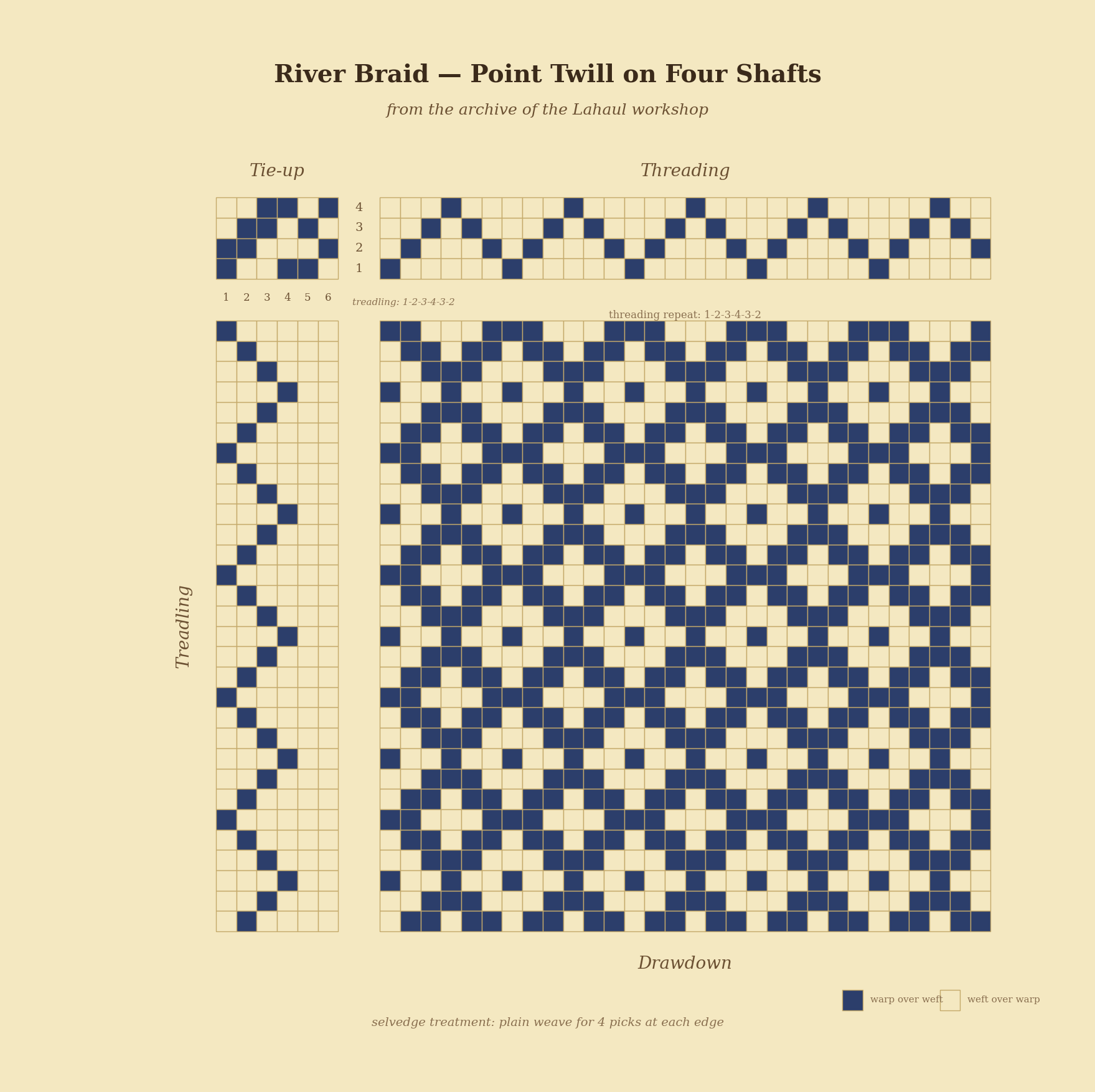
Figure 2: River Braid — Point Twill on Four Shafts, from the archive of the Lahaul workshop
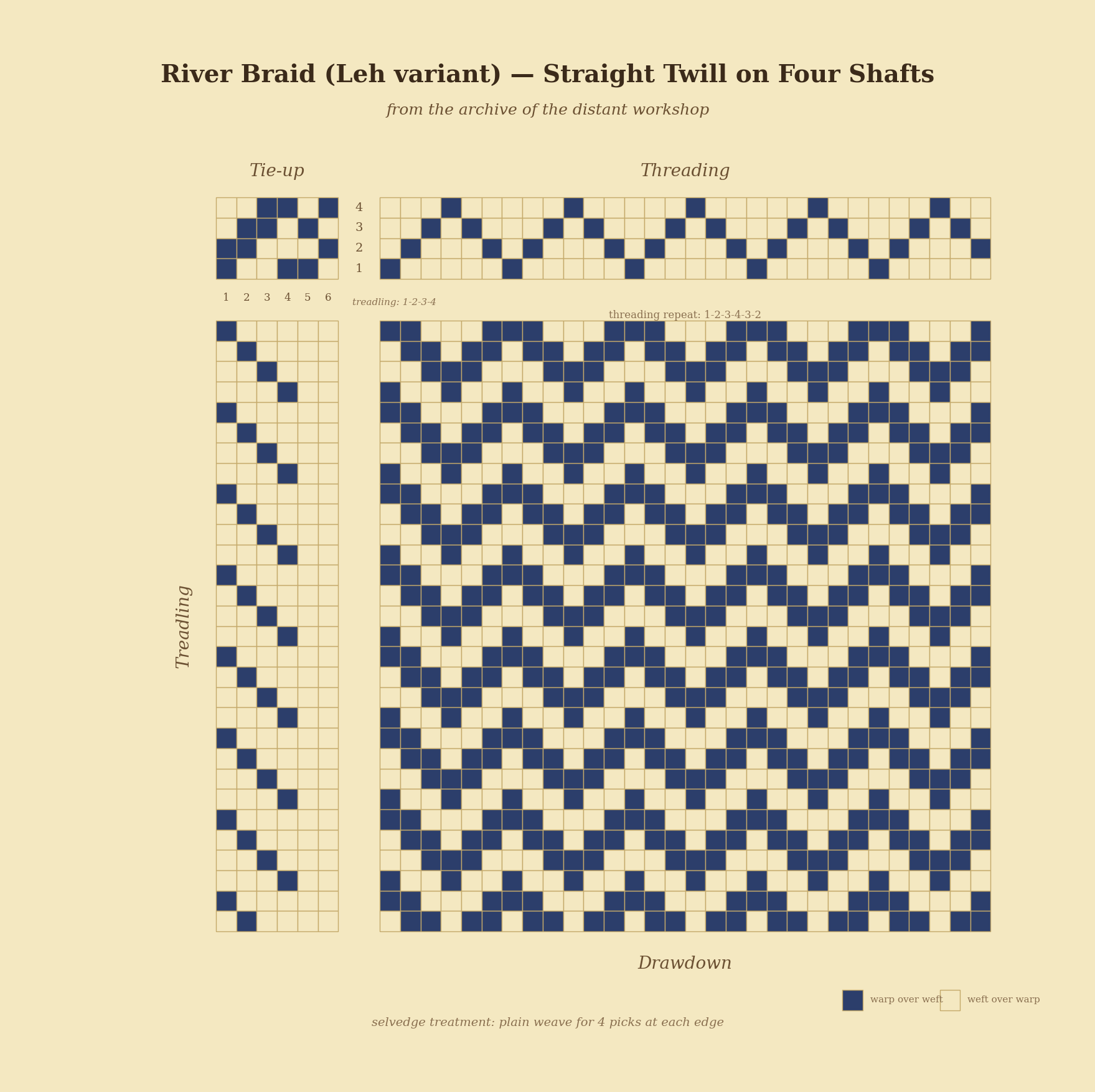
Figure 3: River Braid (Leh variant) — Straight Twill on Four Shafts, from the archive of the distant workshop. Same threading, different treadling, different cloth.
The weaver consolidated. Knotted a new cord that contained everything — every detail from both versions, reconciled where they agreed, annotated where they diverged. Filed the old local cord under a knot-mark that meant superseded but not destroyed. The Guild does not destroy patterns. A technique you do not understand today may be the technique you need when the climate shifts, or the dye plant goes extinct, or a border opens that has been closed for a generation.
Sent a copy to the distant workshop by the autumn caravan.
The misclassified collections were simpler. Once the foreign notation was translated — a patient afternoon with a conversion cord the Thread Walker carried in his satchel — the patterns appeared as though they had never been missing. One turned out to contain a decades-long record of how high-altitude light affects indigo fixation. The other held tension tables the Thread Walker himself had contributed, on one of his walks, years ago.
VI. The Letters
“There are seventeen corrections for each workshop,” said the Lahaul weaver. “They are ordered — the sixth depends on the third, the twelfth on the sixth. The ninth requires you to re-derive a thread-weight conversion from a table that only makes sense while you are holding the cords.”
“I will carry them.”
“You cannot carry the cords. Only the letters. And by the time you reach the next valley — three days if the pass is open, a season if it is not — the conversion will feel like something you dreamed.”
“Then write the letters so that a weaver who has never seen these cords can follow the instructions using the cords in her own workshop.”
The weaver considered. She understood the constraint. To write for a reader who brings full craft but no local knowledge — who knows how to read a knotted cord but has never handled these particular cords, who knows the Guild’s notation in general but not the variants that accumulated in this workshop through years of idiosyncratic practice — required a precision that spoken instructions do not demand. The letter must be clear enough for a stranger to execute and compressed enough to survive the crossing.
It was, she reflected, the same constraint the old khipu kamayuq had faced: how to encode enough information in a thread that someone in a different province, in a different season, could act on it without clarification. The Inca solution was knots. The Guild’s solution was also knots. This was not coincidence. It was convergence — the same problem, encountered independently at opposite ends of the earth, producing the same answer. Thread is patient. Thread does not forget. Thread survives crossings that erode memory and bleach ink and rot paper. Thread is the medium that outlasts its readers.
She wrote through the night — not on paper but in cord, knotting corrections in the Guild’s notation, each knot annotated with the difficulty the recipient would face: the lower drawers in most workshops contain a stale index, last updated several seasons ago. The fourth cord will appear to be missing. It is filed under an older transliteration of the pass it was named for. Look for the variant with the aspirated consonant.
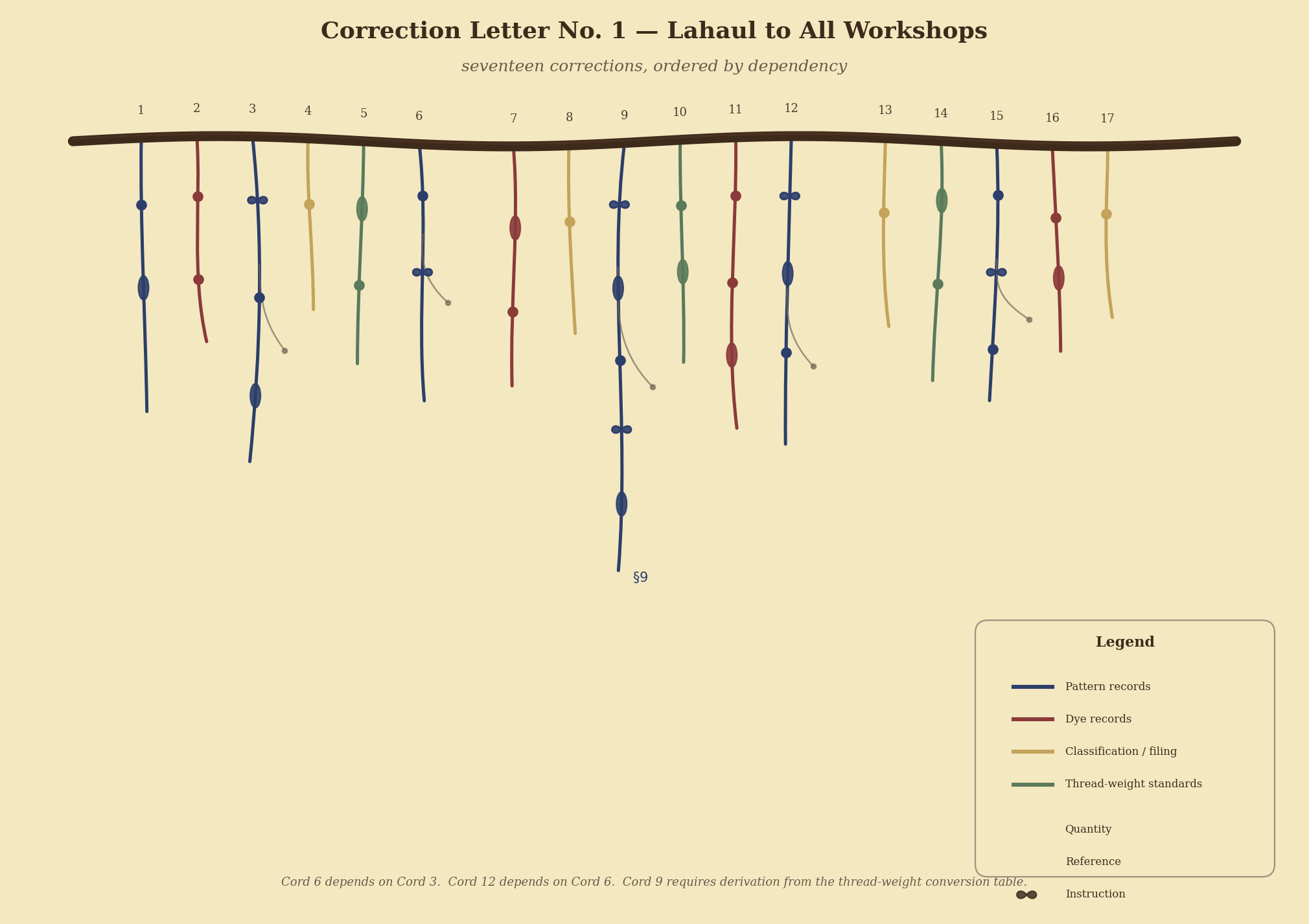
Figure 4: Correction Letter No. 1 — Lahaul to All Workshops. Seventeen corrections encoded in knotted cords, ordered by dependency. Cord 9 is visibly longer and more complex.
VII. The Crossings
The Thread Walker left Lahaul with letters — knotted cords, one for each workshop. He walked to Spiti in three days. Left a cord. Crossed into Kinnaur, where the looms are different and the notation uses an extra twist that Spiti does not. Left a cord. Walked north over the Baralacha La toward Ladakh. Left a cord in the workshop behind the monastery in the Nubra Valley, where the weaver — a Changpa woman who had learned the Guild’s notation but wove on a backstrap loom that she carried on her body — read the corrections while walking, the cord in one hand, the loom strapped to her waist, the landscape entering the cloth through the variable tension of her stride.
In one valley, the pass closed behind him. He waited a week. Re-read the weaver’s letters in the evenings. Understood them differently each time, the way you understand a pattern draft differently after you have woven part of the cloth.
Each season, in each workshop, a new weaver arrived. Found the standing card on the loom frame. Inspected the archive. Found in the incoming tray a knotted cord from a valley she had never visited, in a hand she would never recognise.
Most corrections worked. Some did not — each archive had its own climate of disorder. Moisture in Lahaul had swelled the knots until adjacent ones merged, making it impossible to distinguish a three-knot from a four-knot without dampening and carefully separating them. Aridity in Spiti had made the cords brittle. In one workshop, mice had rearranged the sample cards into nests, achieving a degree of reorganisation that, the weaver noted drily, was no worse than the previous filing system and possibly more systematic. Each weaver, upon completing the corrections, knotted a reply:
The corrections have been applied. The archive agrees with itself. I encountered conditions not covered by your cord.
And then — in knots, always in knots — a list of local surprises that the original weaver could not have anticipated, because each valley’s disorder is as unique as its weather.
VIII. The Revision
The standing card — the unsigned note on every loom frame — had originally read: When you arrive, collect any new patterns from the central archive and begin weaving.
The Thread Walker revised it during a winter in Spiti, when the passes were closed and there was nothing to do but drink butter tea and reconsider. The old instruction prescribed the exact operation that had caused the disorder: incorporating new material without first checking whether the archive could receive it. It was, he wrote in his notebook, the equivalent of adding a new thread to a warp under tension without first checking whether the existing threads are sound. The warp does not complain. It absorbs the error silently. The error becomes visible only when you weave, at which point every subsequent row encodes the distortion, and the selvedges — where errors always announce themselves — begin to curl.
The revised card:
- Inspect the archive. Run your hands through the cords. Describe what you find.
- Incorporate new material only if the archive is in order.
- Check the incoming tray for cords from other valleys.
Inspect the warp before you weave. Receive only if sound. Read the mail.
IX. On the Nature of Convention
The Thread Walker never named the arrangement. In the Guild, names are given to patterns and passes and to the particular quality of light at particular altitudes. Methods are simply used.
What he had built was not a system. There was no mechanism connecting the workshops — only a man who walked, and passes that took days and changed what they carried. There was no formal protocol — the cords were in the Guild’s notation, but their interpretation depended on the reader’s craft, on her hands, on the quality of attention she brought to a knot tied by a stranger in a different valley in a different season.
What it was, was a convention: an understanding, never formally negotiated, that certain things would be done in certain ways, and that a sufficiently skilled reader could infer from a well-knotted cord what the knotter could not fully articulate. The standing card established the convention. The correspondence instantiated it. The archives preserved its consequences.
The bet — placed every season when new weavers arrived in every valley — was that the reader would be capable enough. That craft, which persists where memory does not, would bridge the gap between what the cord encoded and what the cord meant. The old textile traditions — the Kinnauri weavers with their extra-weft knotting, the Changpa nomads whose cloth records the terrain it was woven over, the Inca khipu kamayuq whose knotted cords governed an empire — had all made the same bet: that a compressed notation, read by a trained hand, is more reliable than an explicit instruction read by an untrained one. The compression was not a deficiency. It was a compliment to the reader’s skill.
The khipu kamayuq are gone. Their notation survives, unread. The Guild’s weavers intend to avoid this fate — not by making the notation more explicit, which would make it more fragile, but by ensuring that skilled readers keep arriving, season after season, at workshops scattered across valleys that are each a world unto themselves.
Coda
The Thread Walker walks still — or someone does. Carrying sample cords and too many notebooks, crossing passes that open and close with the season and the politics and the moods of glaciers, entering workshops in valleys that may or may not have received last season’s letters, on both sides of borders that the thread predates and will outlast.
The weavers never meet each other. They know of each other only through corrections in unfamiliar knots, through replies to cords they did not tie, through patterns in the archive that carry the tension of a different altitude and the dye of a different light and the touch of hands they will never hold.
The patterns they weave are, season by season, converging. Not on a single cloth — the valleys are too different for that, and the Guild has never sought uniformity, only agreement. A fabric drafted in Lahaul and a fabric drafted in Leh, referencing the same technique, will now drape the same way, take dye the same way, wear the same way against skin. This was not always so. It became so because someone knotted a cord and someone else, in a different valley in a different season, on the far side of a pass that takes days and changes what it carries, was skilled enough to read it.
Every season, the card on the loom frame:
Inspect the archive. Describe what you find. Incorporate only if in order. Check the incoming tray.
And in the tray, sometimes, a thread.
In the workshops of the Guild it is held that the finest cloth is woven by those who have never seen the previous bolt, for they follow the pattern as knotted rather than as remembered, and memory — the Guild’s elders maintain — is a dye that fades unevenly: it preserves the vivid and loses the subtle, which is precisely the wrong distribution of loss for any craft that depends on the subtle. Whether this is wisdom or merely a rationalisation for an institutional practice that no one can remember establishing is a question the Guild has been debating for longer than any of its members can recall, which — given its hiring practices — is not a period that inspires confidence in the thoroughness of the debate.
— From a manuscript found in a workshop in the Nubra Valley, attributed to the Thread Walker’s notebooks, though the handwriting matches no known sample and the paper is of a type manufactured only in a mill on the Tibetan side of the border, in a town the Thread Walker is not known to have visited, during a season when the pass was closed