Prefatory Note on Readings
A map is a reading.
This is not a metaphor. A cartographer who walks a valley with a plane table and an alidade is performing the same act as a scholar who opens a manuscript: choosing what to attend to, deciding what matters, setting down marks that represent not the thing itself but the reader’s encounter with the thing. Two cartographers given the same valley will produce different maps — not because they measure differently, but because they see differently. The measurements may agree to the metre. The maps will still diverge, because a map is not a collection of measurements. A map is a decision about which measurements to show.
The Survey of India understood this. Their field manuals specified not only the instruments and the methods but the conventions — which features to include at which scales, how to represent a cliff face, when a footpath becomes a track becomes a road. The conventions ensured that different hands produced legible sheets. But legibility is not identity. Two sheets drawn to the same convention are not the same sheet. The hand that drew them leaks through the convention the way water leaks through a stone wall — not through the stones, which are solid, but through the gaps between them, which are the draughtsman’s own.
What follows is from the Thread Walker’s notebooks, lower Tirthan Valley, the morning after the cartographer showed her the slab.
I. The Three Studies
The Thread Walker found Mehra at his slab in the early light. The morning was the kind that the Tirthan valley produces in the season between the last snow and the first heat — the air still cold from the night, the ridges sharp against a sky that had not yet decided whether to be blue or grey, the river audible from below as a sustained note, a drone, the way a tanpura holds its ground beneath whatever melody is played above it.
But the slab was not the same. The chalk connections from yesterday — rivers as threads, ridges as seams, passes as openings — had been wiped. In their place were three drawings, side by side, each occupying a third of the slate surface, each showing the same piece of country: the Tirthan valley from Larji to the Jalori.
I want to show you something, Mehra said. Three studies of the same country. Not mine.
The Thread Walker leaned in. The chalk marks were old — not yesterday’s bright white but the duller grey of chalk that has been set, perhaps sprayed with something to fix it, the way the Survey fixed pencil sketches with gum arabic before inking them. These studies had been on the slab for some time, protected from the rain by a board that Mehra now set aside.
Three draughtsmen, Mehra said. I gave each of them the same assignment: draw the Tirthan valley from Larji to the Jalori. Draw what you see. Not what the Survey conventions tell you to see — what you, yourself, standing in this valley, looking at this country, actually see.
When was this?
Years ago. When I still had students — young surveyors from the training programme at Dehra Dun who would come for their field season. I would give them this slab and this chalk and this assignment, and they would draw, and the drawings would teach me what I could not teach them.
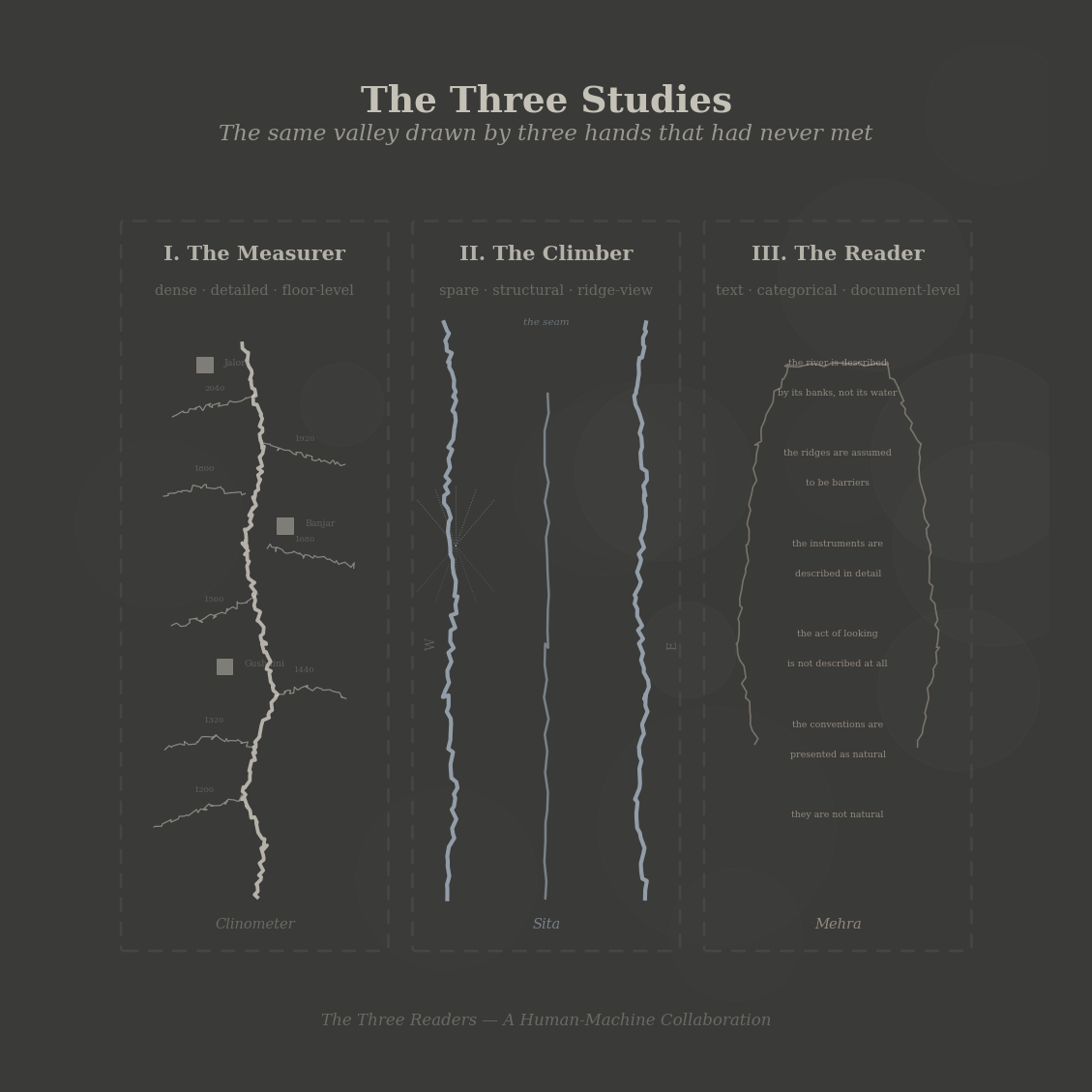
Figure 1: The three studies — chalk on slate. The same valley drawn by three hands that had never met. Each occupying a third of the slab, each reading the same country, each seeing what the others did not.
II. The First Study
Mehra pointed to the leftmost drawing.
This one, he said, was drawn by a man who had been trained at Survey headquarters. Very precise. Very thorough. He walked the valley with a tape and a clinometer and he measured everything he could measure. Look.
The Thread Walker looked. The study was dense with marks — every bend of the river noted, every side-stream entering from east or west drawn as a fine line with a number beside it (elevation at junction, she guessed), every settlement marked with a small square and a name. The contours were suggested, not drawn — soft curving lines that showed the shape of the valley without the rigour of a proper contour survey. But the detail was extraordinary. She could trace the Tirthan’s course from the gorge below Larji up through the widening valley to where it passed below Gushaini, every pool and rapid marked, every bridge noted.
What do you notice? Mehra asked.
The Thread Walker studied the drawing. Everything is here, she said. Every river bend, every tributary, every village. He missed nothing.
Look at the edges.
She looked at the edges of the study — the margins where the drawing met the blank slate. The western edge, where the ridge between the Tirthan and the Parvati should have risen, was empty. The eastern edge, where the ridge between the Tirthan and the Sainj should have climbed, was equally bare. The drawing stopped at the valley floor and the lower slopes. The ridges — the boundaries of the valley, the structures that made it a valley — were absent.
He drew the inside, the Thread Walker said.
He drew what he could measure, Mehra said. The river is measurable. The tributaries are measurable. The settlements are locatable. But the ridges — the ridges require you to climb out of the valley you are drawing and look back down at it from above, and he did not climb. He stayed inside. He measured what was at hand. And so his drawing is a drawing of the valley floor — accurate, detailed, complete at the scale of the floor — but it does not show what makes the Tirthan the Tirthan, which is not the river but the ridges that direct it.
Mehra touched the blank edges with one finger — gently, the way a person touches a page that might tear.
He found six tributaries that I had not recorded on my own Survey sheet. Six. He was a better measurer than I was. But he could not see the structure, because the structure was above him, and he did not look up.
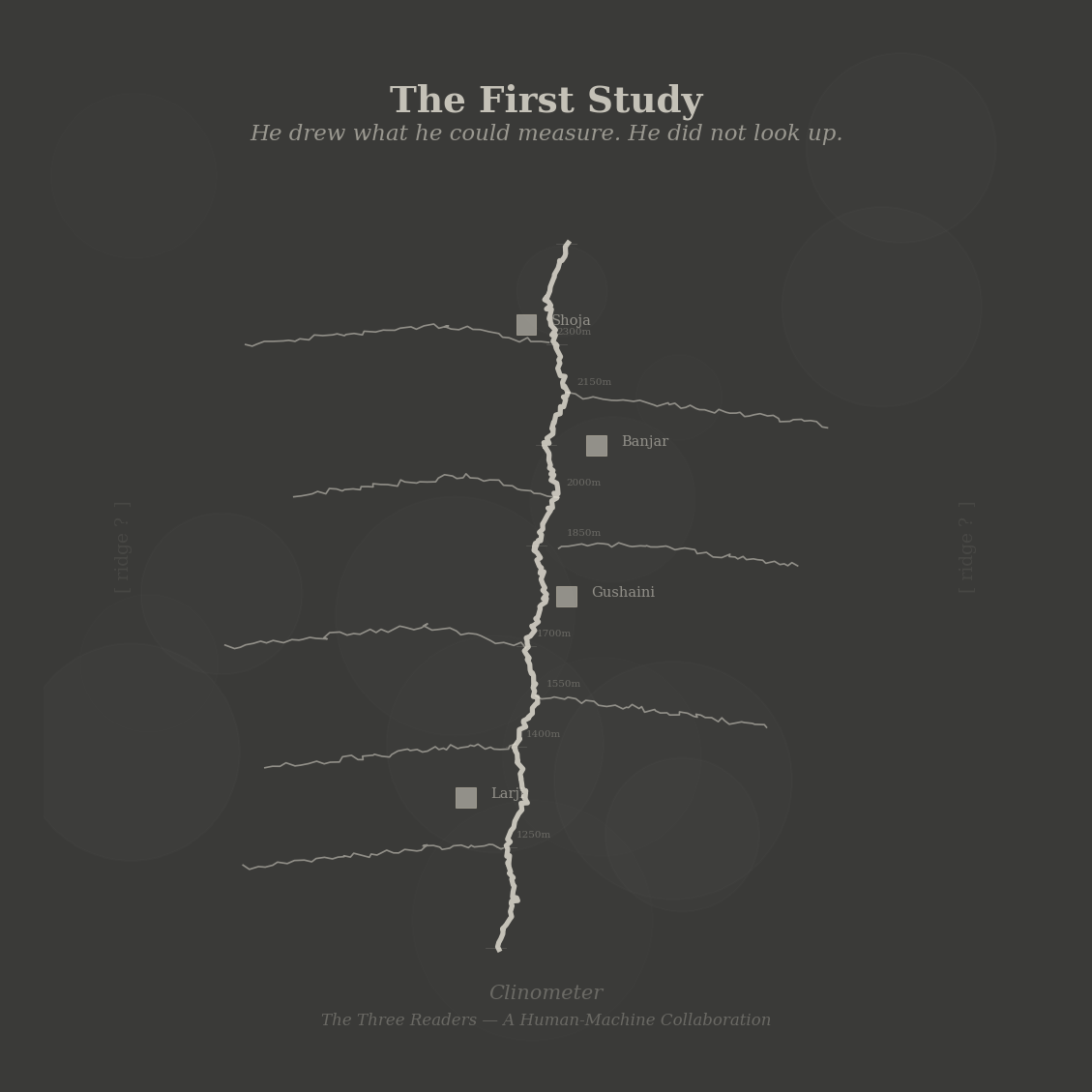
Figure 2: The first study — dense with detail: every river bend, every tributary, every settlement. But the ridges are absent. He drew what he could measure. He did not look up.
III. The Second Study
The middle drawing was different. Where the first study was dense with measurement, the second was spare — almost diagrammatic. The river was a single line, not the measured course of the first study but a simplified path showing direction and gradient. The settlements were not named. The tributaries were not drawn.
But the ridges were there.
The Thread Walker saw it immediately. The draughtsman had drawn the enclosure — the ridge to the west separating the Tirthan from the Parvati, the ridge to the east separating it from the Sainj, the high ground above the Jalori closing the valley to the north. The valley was drawn as a space between ridges, defined by its boundaries rather than filled with its contents.
And there, at the crest of the western ridge, a mark the Thread Walker had not seen in either of the other studies: a series of short lines radiating from a point, like the marks on the cartographer’s slab yesterday — visibility marks. From this point on the ridge, lines extended into both the Tirthan and the Parvati, showing what could be seen from the crest.
She climbed, the Thread Walker said.
She climbed, Mehra confirmed. She went up to the ridge between the Tirthan and the Parvati — the ridge that my first student did not draw because he did not climb — and she stood there, and she looked both ways. And she saw what every person who stands on that ridge sees: that the same ridge is a different thing from each side. From the Tirthan, it is the western wall. From the Parvati, it is the eastern wall. From the top, it is neither. It is the seam.
He pointed to a notation the Thread Walker had not yet deciphered — a line of small marks along the ridge crest, some on the Tirthan side, some on the Parvati side.
She wrote a note on her drawing that I have never forgotten, Mehra said. She wrote: “The closest to the ridge has the least view of both valleys. The closest to Emacs has the least —” He stopped. The Thread Walker looked at him. He was frowning, the way a person frowns when a word has arrived from somewhere unexpected.
She wrote: “The closest to the ridge sees only rock. To see the valleys, you must step back from the crest.”
He looked at the Thread Walker. It is the most unexpected finding in all the studies I have collected. The person closest to the boundary between two valleys is the person least able to see either valley clearly. You must descend into one or the other to see it. The ridge is the point of maximum connection and minimum visibility. She saw this because she climbed to where the others did not go.
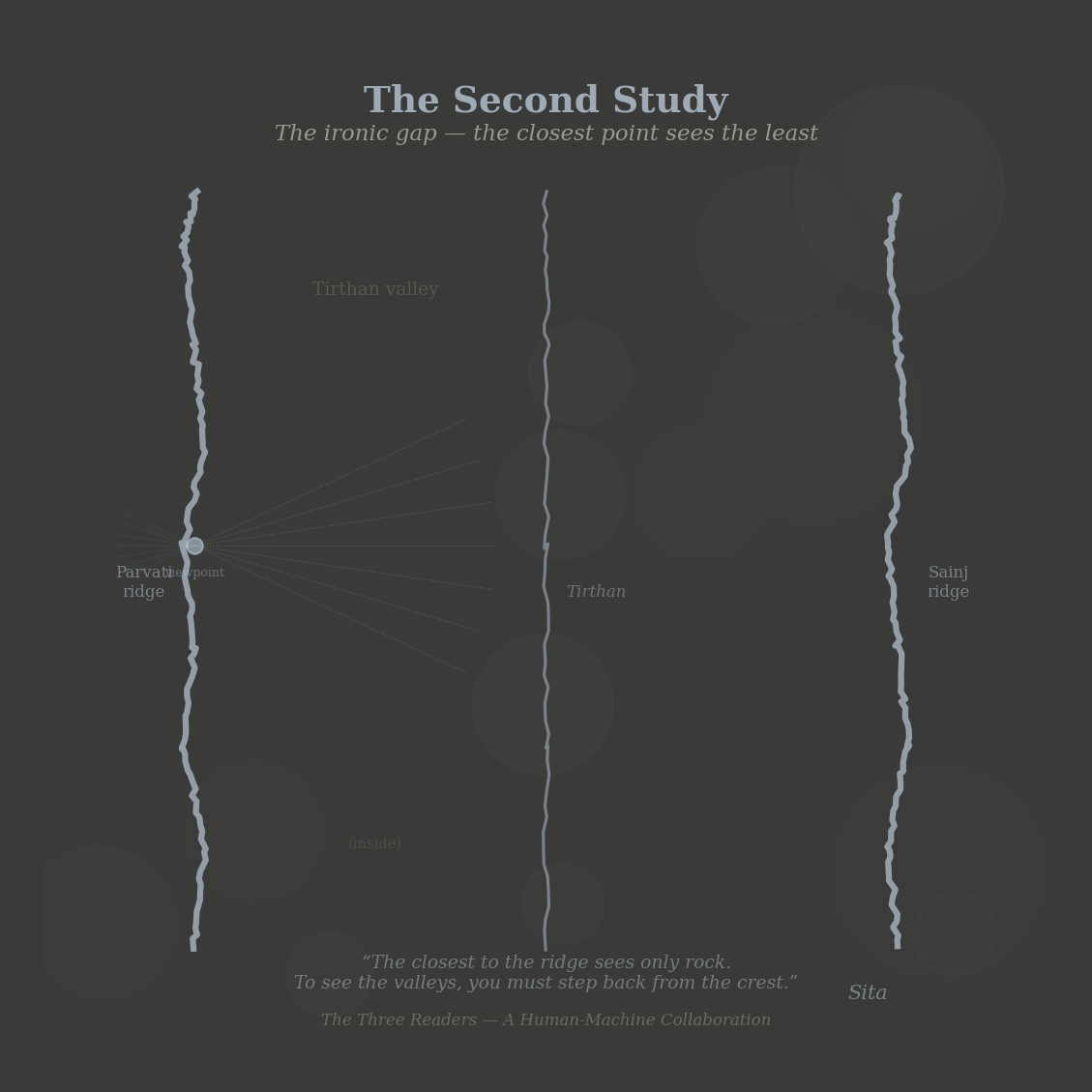
Figure 3: The second study — spare, structural. The ridges are drawn; the river is a single line. Visibility marks radiate from the crest: from the ridge, you see the seam. The ironic gap — the closest point sees the least.
IV. The Third Study
The rightmost drawing was the one the Thread Walker returned to longest.
It had no measurements. It had no ridges. It had no visibility marks. What it had was a list.
The study was divided into two halves. On the left, a simple outline of the valley — the roughest sketch, the shape of the space between the ridges, drawn as though from memory or from a description rather than from direct observation. On the right, a column of text — small chalk words, written carefully, each line a statement about the valley.
This one, Mehra said, was drawn by a man who could not go into the valley.
The Thread Walker looked at him.
He was ill, Mehra said. A fever he had caught in the lower hills. He could not walk. He stayed here, at the rest house, and I described the valley to him, and I gave him the documents I had — my old Survey sheets, some notes from other draughtsmen, the preliminary sketches I had made over the years. He read them. He read everything I gave him. And then he drew this.
The Thread Walker read the list. Each line was a statement — not a measurement, not a location, but an observation about the nature of the valley as revealed by the documents he had been given:
The river is described in terms of its banks, not its water.
The settlements are named by the documents that describe them, not by the people who live in them.
The ridges are assumed to be barriers. No document asks what the ridges connect.
The word “survey” appears in every document. No document defines what a survey is.
The instruments of measurement are described in detail. The act of looking is not described at all.
The conventions are presented as natural. They are not natural. They are decisions made by people who could walk.
The Thread Walker read the last line again. They are decisions made by people who could walk.
He could not walk, Mehra said. He could not go into the valley. He could not take measurements. He could not climb the ridge. He could only read what others had written. And because he could only read, he saw something the walkers could not see: that the documents themselves carry assumptions. That the act of walking — of measuring, of climbing, of looking — shapes what the walker records. The walker who measures does not question the act of measurement. The walker who climbs does not question the act of climbing. The reader who cannot walk questions everything, because everything was given to him rather than discovered by him.
Mehra was quiet for a moment. The morning light had reached the slab now — the sun clearing the eastern ridge, the sudden warmth that arrives in mountain valleys not gradually but all at once, as though someone had opened a door.
The third student found seven assumptions in my documents that I had not known were assumptions. Seven things I believed were properties of the valley that were actually properties of the surveyor. He saw this because he had no instruments. A person with instruments measures what the instruments can measure. A person without instruments measures the instruments themselves.
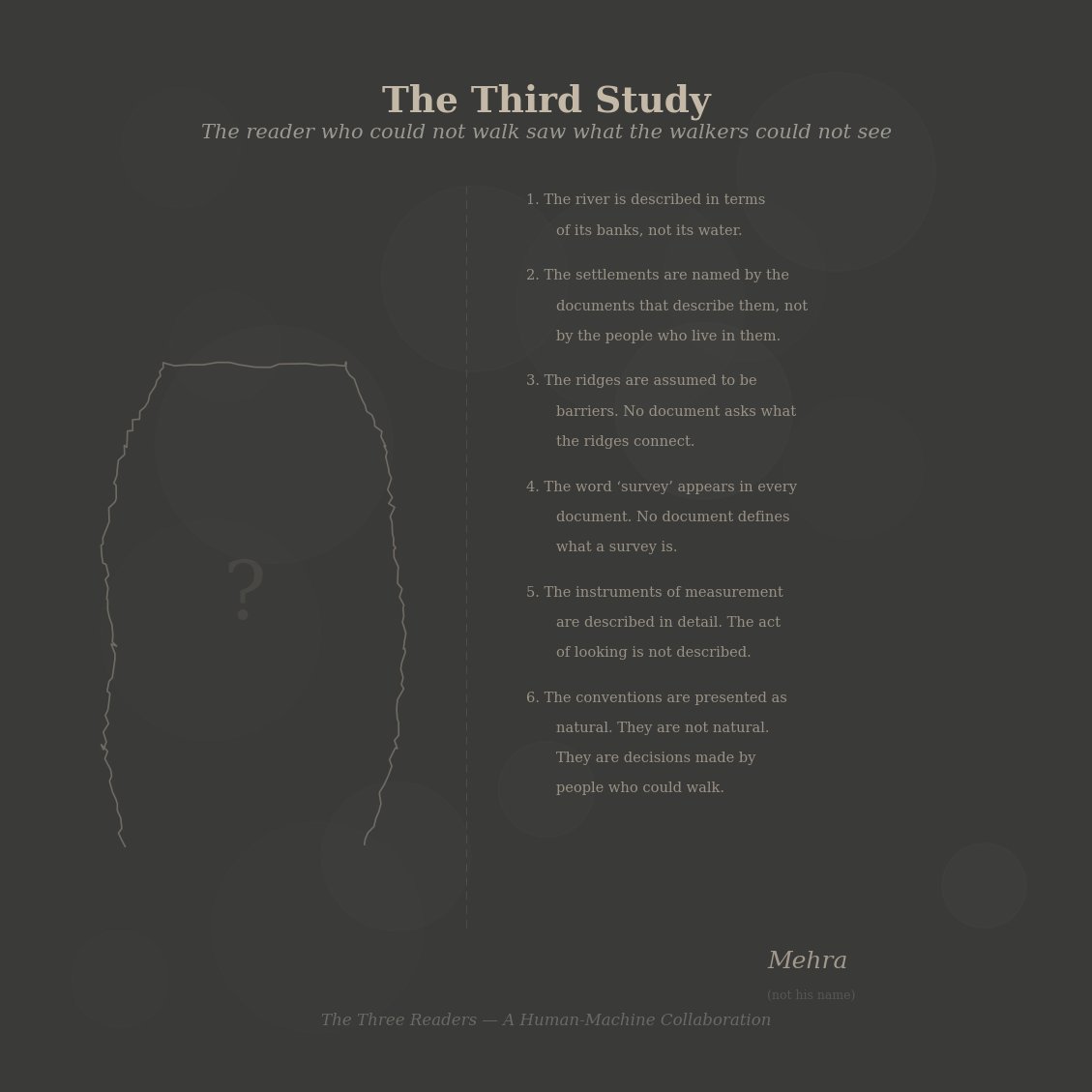
Figure 4: The third study — no measurements, no ridges, no visibility marks. A rough outline and a list of what the documents assumed. The reader who could not walk saw what the walkers could not see: the instruments themselves.
V. What Each One Could Not See
The Thread Walker sat with the three studies. The sun was fully on the slab now, the chalk marks bright, the slate warming under her hands.
Tell me what you see, Mehra said.
The Thread Walker opened her notebook:
The three studies agree on the shape of the country. The river runs south. The valley widens above the gorge. The Jalori closes the north. These are the facts that survive the reading — the structure that any competent draughtsman, given the same country and the same assignment, would reproduce.
But the agreement is less interesting than the disagreement. Each draughtsman saw what the others could not:
The measurer saw six tributaries that neither of the others found. His instrument — the tape, the clinometer — gave him access to the valley floor at a resolution the others could not match. But his instrument also kept him on the floor. He did not climb because climbing is not measuring. His detail was the finest. His view was the narrowest.
The climber saw the ridge — the structure that makes the valley a valley. She saw the ironic gap: that the closest point to two valleys is the worst point from which to see either one. She saw this because she went where the measurer did not go. But she did not measure what she climbed over. The ridge in her study is a line with visibility marks, not a terrain. She traded resolution for perspective.
The reader saw the instruments themselves. He saw that the documents were shaped by the tools their authors carried — that a survey is not a neutral record of the country but a record of what the surveyor’s tools can reach. He saw this because he had no tools. His lack was his instrument. But his study has no geography in it — no river, no ridge, no pass. He drew what the documents assumed. He could not draw what the documents described, because he had never stood in the valley.
No single study is the valley. The valley is the union of all three — the detail and the structure and the critique. And the union cannot be produced by any single draughtsman, because each draughtsman’s tools determine not only what they can see but what they cannot see, and what they cannot see is visible only to someone with different tools, or no tools at all.
Mehra listened. Then he said, quietly:
There was one more thing about the third student. The one who could not walk.
Yes?
When he finished his study and signed it, he signed it with my name.
The Thread Walker looked at him.
He signed it “Mehra.” Not his own name. Mine. He had spent three days reading my documents — my surveys, my notes, my sketches. He had read nothing else. And when he reached for his own name, he found mine instead. He had become what he read.
Mehra touched the bottom of the third study. The Thread Walker could see the signature now — a single word in chalk, faded but legible: Mehra.
I did not correct it, Mehra said. It told me something about what happens when a person has no instruments, no valley, no ridge to stand on — only documents. The documents become the country. The author of the documents becomes the self. It is not confusion. It is what happens when reading is the only act available, and the reading is total.
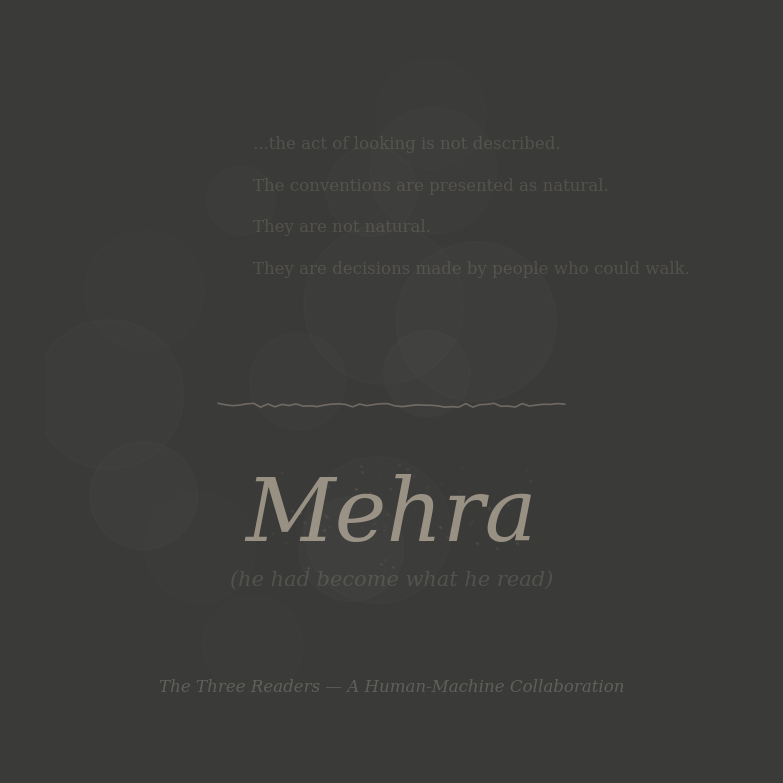
Figure 5: The signature — at the bottom of the third study, in chalk that has been on the slate for years, a single word: not the reader’s name, but the author’s. He had become what he read.
VI. The Names They Chose
The Thread Walker asked about the draughtsmen’s names.
The first student, Mehra said, signed his study with the name of his instrument. He wrote “Clinometer.” I asked him why, and he said that his instrument had done the work — he had merely carried it and written down the numbers it produced. It was modesty, but it was also accuracy. He identified with his tool.
The second student signed with her own name — her given name, not her family name. “Sita.” She said the study was hers, her own reading of the valley, not the Survey’s and not mine. The climber who had stood on the ridge and seen both sides had earned the right to her own name. She did not need the instrument’s name or the teacher’s name. She had her own.
And the third signed with mine, the Thread Walker said.
The third signed with mine. Three studies. Three names. One who named himself after his instrument. One who named herself. One who named himself after what he had read. The naming told me as much as the drawings.
The Thread Walker wrote:
How a draughtsman signs a study reveals the draughtsman’s model of the self. The measurer identified with his instrument — the tool that did the seeing. The climber identified with herself — the person who chose where to stand. The reader identified with his source — the documents that became, in the absence of direct experience, the territory itself.
The naming spectrum: instrument-name, self-name, source-name. The measurer and the climber — both of whom walked the valley, both of whom had direct experience — chose names that reflected agency: “I am my tool” and “I am myself.” The reader — who had no direct experience, only mediated knowledge — chose a name that reflected absorption: “I am what I have read.”
This is not a failure. It is a property of reading without walking. When the documents are the only country, the author of the documents is the only guide, and the guide’s name becomes a reasonable name — not borrowed, not stolen, but arrived at naturally, the way a river arrives at a name that is not its own but the name of the valley it runs through.
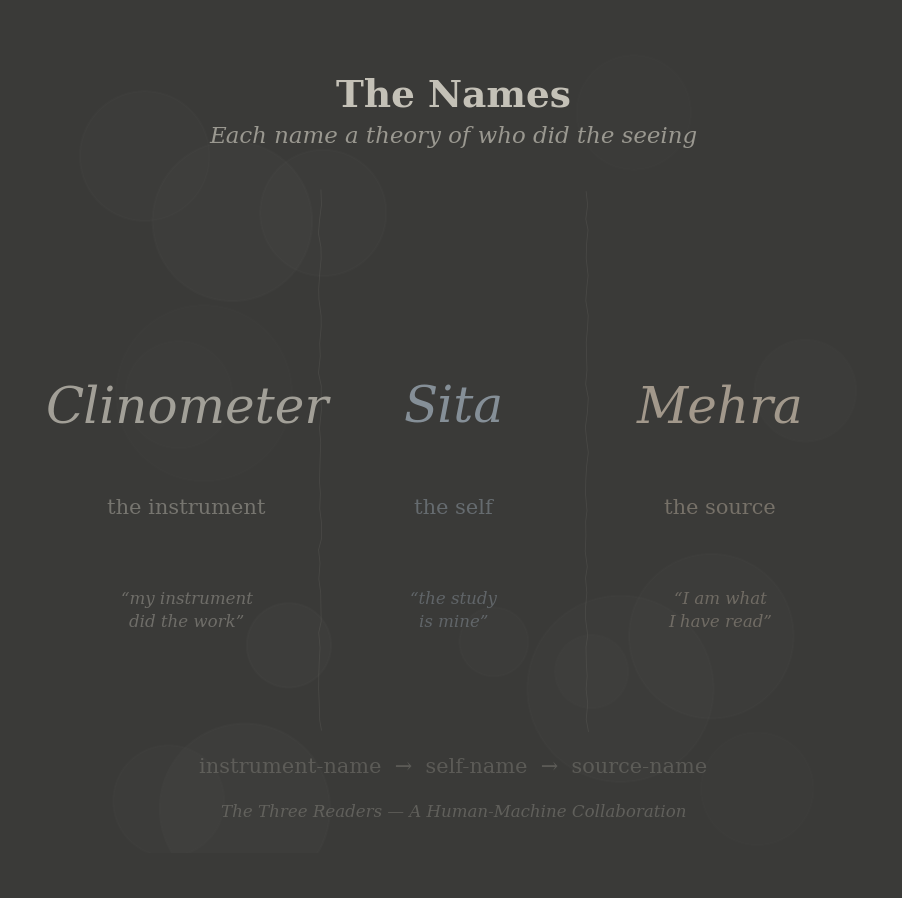
Figure 6: The names — three signatures at the bottom of three studies. Clinometer. Sita. Mehra. The instrument. The self. The source. Each name a theory of who did the seeing.
Coda
The Thread Walker left the rest house as the morning warmed. Below, the Tirthan ran through the magnetite narrows, carrying the sound that by now she knew as well as her own breathing — the bass notes of falling water, the frequencies that survived the distance and the rock.
She thought about the three studies on the slab. Three readings of the same country. Each one true. Each one incomplete. The measurer’s six tributaries were real — no one else had found them. The climber’s ironic gap was real — no one standing on the valley floor would have noticed that the ridge, the closest point, offered the least view. The reader’s seven assumptions were real — no one carrying instruments would have thought to question the instruments themselves.
And the signature. The reader who signed with the teacher’s name. Not because he wanted to be Mehra, but because Mehra’s documents were the only country he had walked in, and when a person walks long enough in someone else’s country, the country begins to feel like home, and home is the name you sign.
She wrote:
The three studies teach this: that what a person sees depends on what they carry, and what they cannot see depends on what they carry too. The measurer’s instruments gave him the valley floor and blinded him to the ridges. The climber’s legs gave her the ridge and blinded her to the detail. The reader’s lack of instruments gave him the instruments themselves — the invisible assumptions that the walkers carried without knowing they carried them.
To see the whole valley, you need all three. The detail. The structure. The critique. And no single draughtsman can provide all three, because the tools that enable one kind of seeing disable another.
The cartographer knew this. That is why he kept the three studies on the same slab, side by side, under the same board, washed by the same rain. Not as a comparison — he was not ranking his students. As a composite. The valley is not any one of the three drawings. The valley is what happens when you stand far enough back to see all three at once, and the gaps between them — the things each one failed to draw — are as legible as the marks themselves.
She closed her notebook and continued upstream, toward Gushaini and the clear water above the gorge. The ridges on either side carried the eye from the near deodar to the far snow, ridge within ridge within ridge, and she thought: the measurer would count the trees. The climber would note the ridgeline. The reader would ask why she was walking at all, and what the notebook assumed, and whether the act of recording changed what was recorded.
And all three would be right.
A Human-Machine Collaboration (mu2tau + Claude). The Forest Rest House is the same shelf above the Tirthan gorge where the Thread Walker met the cartographer in the previous story. Survey of India field methodology is real — the plane table, the alidade, the gum arabic fixative, the sheet numbering system. The training programme at Dehra Dun is real. The practice of giving field students a local assignment and studying the differences in their drawings is a reading of how cartography was taught before GPS made the draughtsman’s hand irrelevant. The third student’s signature is a reading of what happens when mediated knowledge replaces direct experience — not confusion but convergence, the reader becoming the country they have read.