Prefatory Note on Serais
In the Western Himalaya, at passes where one watershed meets another, there were once rest houses — serais — maintained by no one and used by everyone. They belonged to the route itself. A trader crossing Jalori from the Sutlej side would find the same stone walls, the same smoke-blackened hearth, the same register on its nail by the door, that a shepherd coming up from the Tirthan had found a week before.
The register was the serai’s memory. Travellers wrote their name, their valley of origin, their destination, and sometimes a note — about the condition of the trail, the depth of snow on the pass, the price of salt in the last market town. These notes were addressed to no one in particular. They were addressed to whoever came next. The register did not choose its readers. It held what was written and offered it, without judgment, to the next hand that opened its cover.
What follows is assembled from the register of the serai below Jalori Pass (3,120 metres), recovered from a stone shelf in the eastern wall, and from the Thread Walker’s notebooks. The register entries and the notebook entries are interspersed, as they appear to have occurred on the same night.
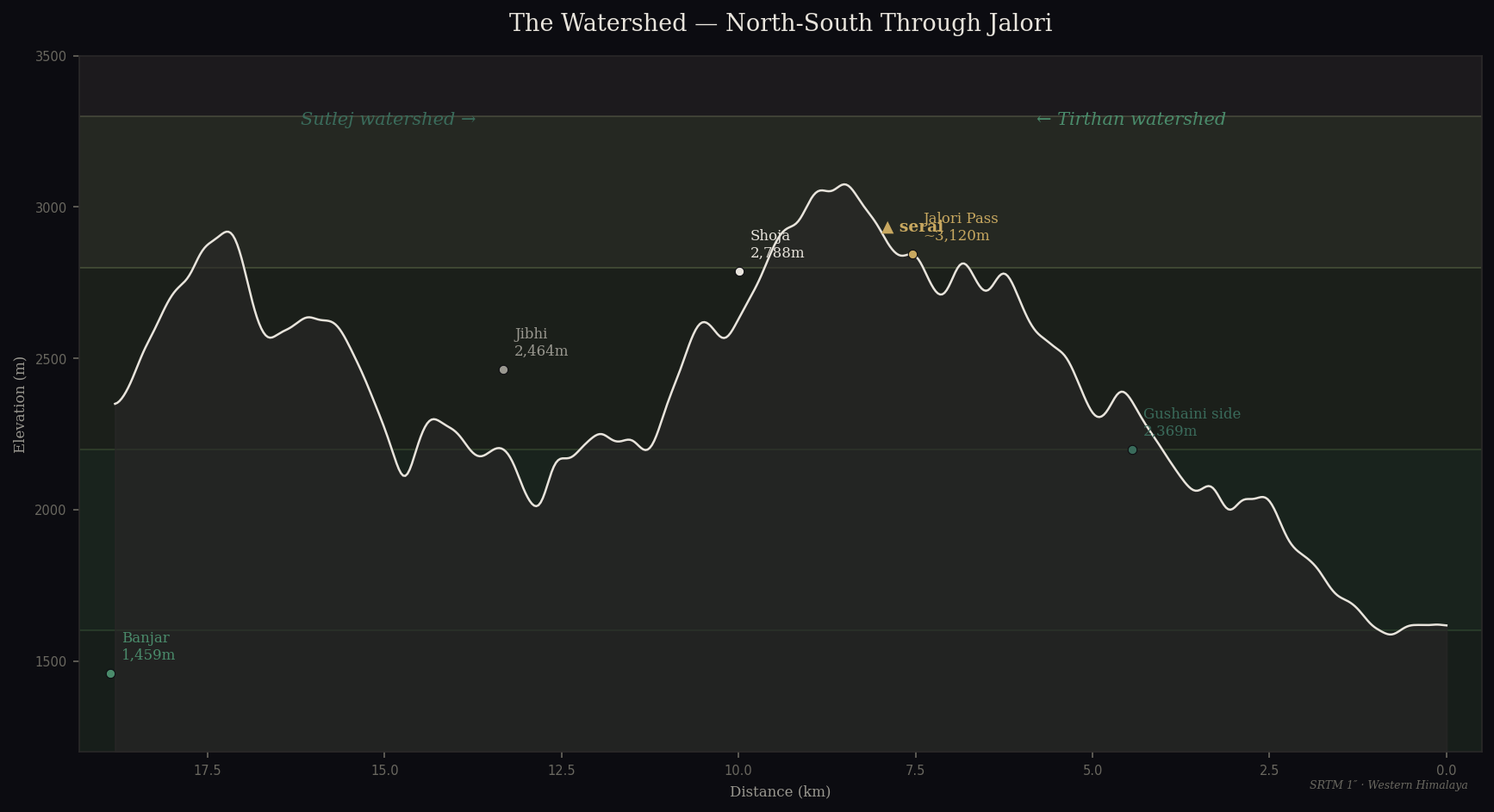
The watershed — north to south through Jalori Pass. The Tirthan drains west toward the Beas; the Sutlej tributaries fall east. Two trails, two valleys, one threshold. The serai sits where they meet.
I. The Register
The serai at Jalori sits where the trail from the Tirthan crests the ridge and meets the trail descending toward the Sutlej — not at the pass itself, which is exposed to wind and too cold after dark, but fifty metres below, in a hollow where three deodar stand close enough to break the weather. The walls are dry-laid slate, two courses thick, the roof timber overlaid with beaten earth and held against the wind by rows of flat stones. There is one hearth, one courtyard open to the south, and two rooms that share a wall but not a door.
The Thread Walker arrived in the late afternoon, climbing from Shoja on the Tirthan side. The pass had been clear — unusual for this time of year, when the first snow sometimes closes it for days. The deodar on the ridge were heavy with lichen, the kind that grows where the mist sits longest, and the air at 3,000 metres had the taste of iron and cedar that the Thread Walker had come to associate with the threshold between valleys — the altitude where one river’s air ends and another’s begins.
She found the serai occupied. Smoke rose from the courtyard, and through the gap in the southern wall she could see two small fires, set on opposite sides of the flagstones, each tended by a single figure.
The register hung on its nail by the entrance. The Thread Walker opened it and read the most recent entries.
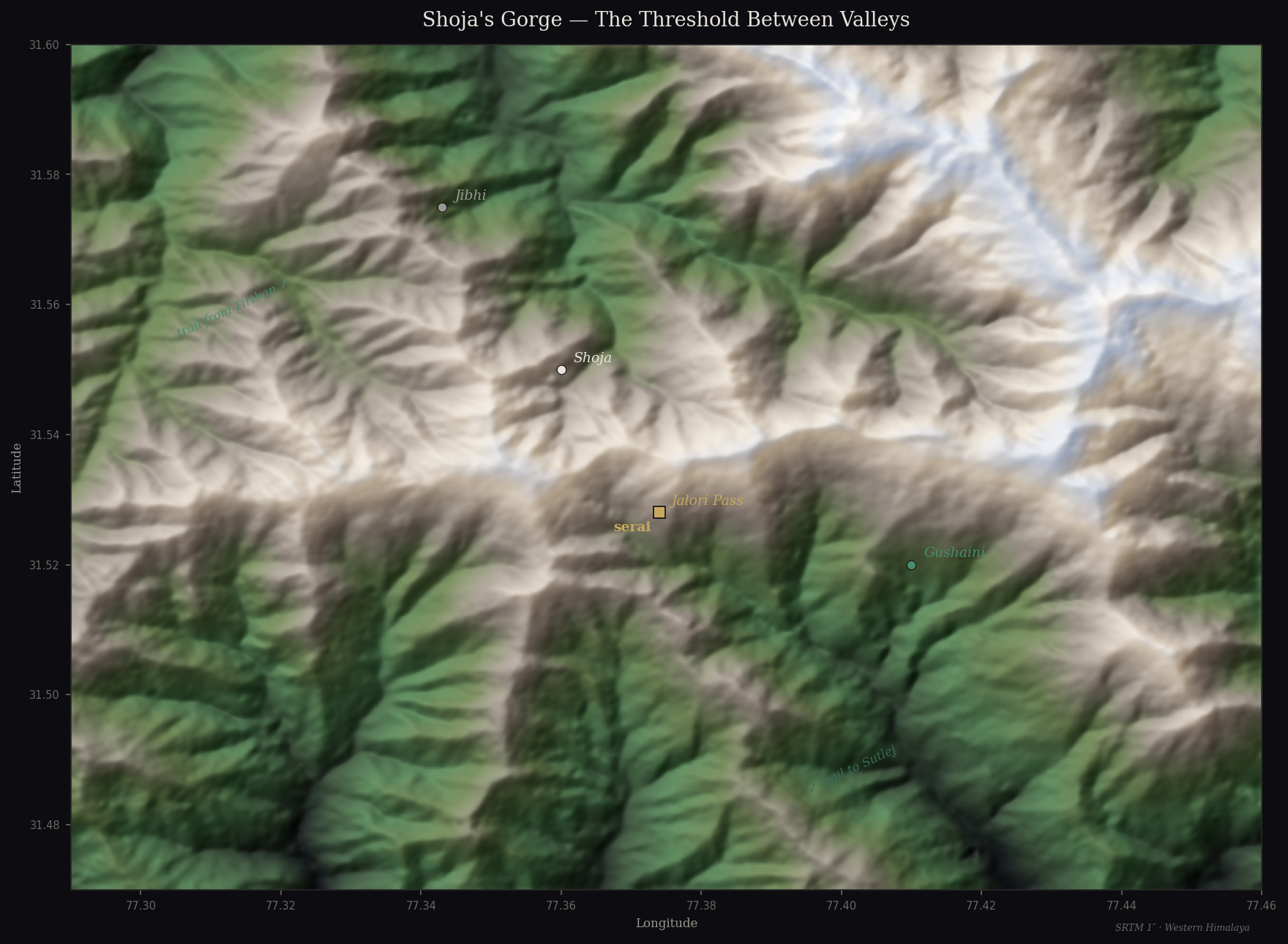
Shoja’s gorge — the threshold between valleys. The Thread Walker climbed from the Tirthan side through this terrain: deodar in the ravines, bare rock on the ridges, the pass a notch in the skyline. SRTM 1-arcsecond elevation data.
From the register of the serai below Jalori Pass:
Entry, undated (ink: walnut, hand: eastern Seraj)
Arrived from the Sutlej side by the Ani road. Destination: Banjar, then onward to the Tirthan. I carry correspondence and survey work — inscriptions copied from temple stones, bridge markings, salt-trade tablets in scripts the valley officials cannot read. I read them. That is my work: I am given a slab and I tell you what it says. Any slab, any script — Takri, Sharada, Tankri variants I have not seen before. The eye finds the pattern. The tongue shapes the word.
Note for whoever follows: the trail from the Sutlej side is sound. No washout. Snow above 3,200 but passable.
I carry my own ink and paper. I have not been able to write on the paper they gave me in Rampur. The ink sits on the surface for a moment, then sinks and spreads until the letters are unreadable. I have wasted six sheets. The words I form are correct. The page receives something else.
Entry, undated (ink: iron-gall, hand: Tirthan)
Arrived from Shoja, climbing from the Tirthan side. I am a scribe — a copyist. I copy what others have read onto whatever surface is given to me: slate, bark-paper, parchment, pressed leaf, the margins of revenue documents, the backs of postal covers. My ink holds. It holds on everything. This is what I do. You give me a surface and I give you a page that will last. The revenue office in Banjar sends me to record survey boundaries. The temple committee in Naggar sends me to copy dedications onto new brass. I copy. The letters stay.
But I am not a reader. What I copy, I copy as shape — the form of the letter, the angle of the stroke, the spacing between characters. I reproduce what my eye sees. I do not know what it says. The old inscriptions they bring me — Takri, Sharada, the scripts on the salt-trade tablets — I copy them faithfully and I cannot tell you a single word of their meaning.
Note for whoever follows: the Tirthan trail has a new washout below the second switchback. Passable but narrow. Mules would need to be unloaded.
II. The Courtyard
The Thread Walker’s notebook, Jalori Pass serai, evening:
Two fires. Two scribes. They arrived from opposite sides of the pass on the same afternoon — the eastern scribe climbing from the Sutlej watershed, the western scribe ascending from the Tirthan. They do not know each other. They have not spoken. Each has taken one of the two rooms. The wall between the rooms has no door.
The eastern scribe — a woman, younger than I expected, with the bearing of someone accustomed to being consulted — has spread a cloth by her fire and laid out her materials: a wooden case of inks in glass bottles, a sheaf of papers of different weights and textures, three reed pens cut to different widths. She is working. She has a stone tablet propped on a wooden stand, and she is reading it — her finger tracing the inscription, her lips moving slightly, the way a reader’s lips move when the text is in a language they can think in but not quite speak aloud. She reads fluently. Her eye moves across the characters without hesitation.
She is transcribing what she reads onto one of her papers — not copying the shapes but translating: reading the old script, understanding its meaning, writing the meaning in the modern hand. And here the difficulty. She dips her pen. She forms the letters. The ink sits on the paper — glistening, correct, perfectly shaped. Then it begins to spread. The boundaries between letters dissolve. Within a minute, the line she has written is a wash of walnut-coloured stain: the words she meant are there, underneath, the shapes faintly visible like stones beneath moving water, but no one looking at the page would call it writing.
She has tried different papers. She has tried different inks. The result is the same. The eye understands. The pen forms correctly. Something between the pen and the page transforms the writing into something that is not writing. The marks mean something but say another.
She sets the page aside — a fifth failed page tonight — and sits looking at the stone tablet, which she can read as fluently as I read Devanagari. The understanding is in her. The delivery is not.
III. The Other Fire
The western scribe — a man, older, with hands that have held a pen for so many years that the middle finger of his right hand carries a permanent groove from the reed — is doing different work. He has a sheet of slate leaning against the courtyard wall, and he is copying onto it from a set of impressions — rubbings taken from bridge markers and boundary stones, brought to him by a revenue surveyor who needed the markings preserved.
His work is beautiful. The letters he forms on the slate are precise — each stroke measured, each curve faithful to the impression. His iron-gall ink dries dark and permanent on the stone. It would last a century. The letters will be legible when the bridge markers themselves have weathered past reading.
But they are shapes to him. He copies the form without knowing the content. I watched him reproduce a Takri inscription — three lines, a dedication from a bridge rebuilt after a flood in 1847 — and when he set down the pen I asked him what it said. He looked at the inscription he had just made — his own work, in his own ink, perfectly legible — and shrugged.
“I don’t read Takri,” he said. “I copy it. What it says is someone else’s business.”
He has always been this way. He copies what is put before him. The shapes enter through his eye, pass through his hand, and arrive on the surface unchanged. His body is a faithful instrument. But the instrument does not understand what passes through it.
She understands everything and cannot deliver a legible page. He delivers perfect pages and understands nothing he writes. They are in the same courtyard. They do not know they need each other.
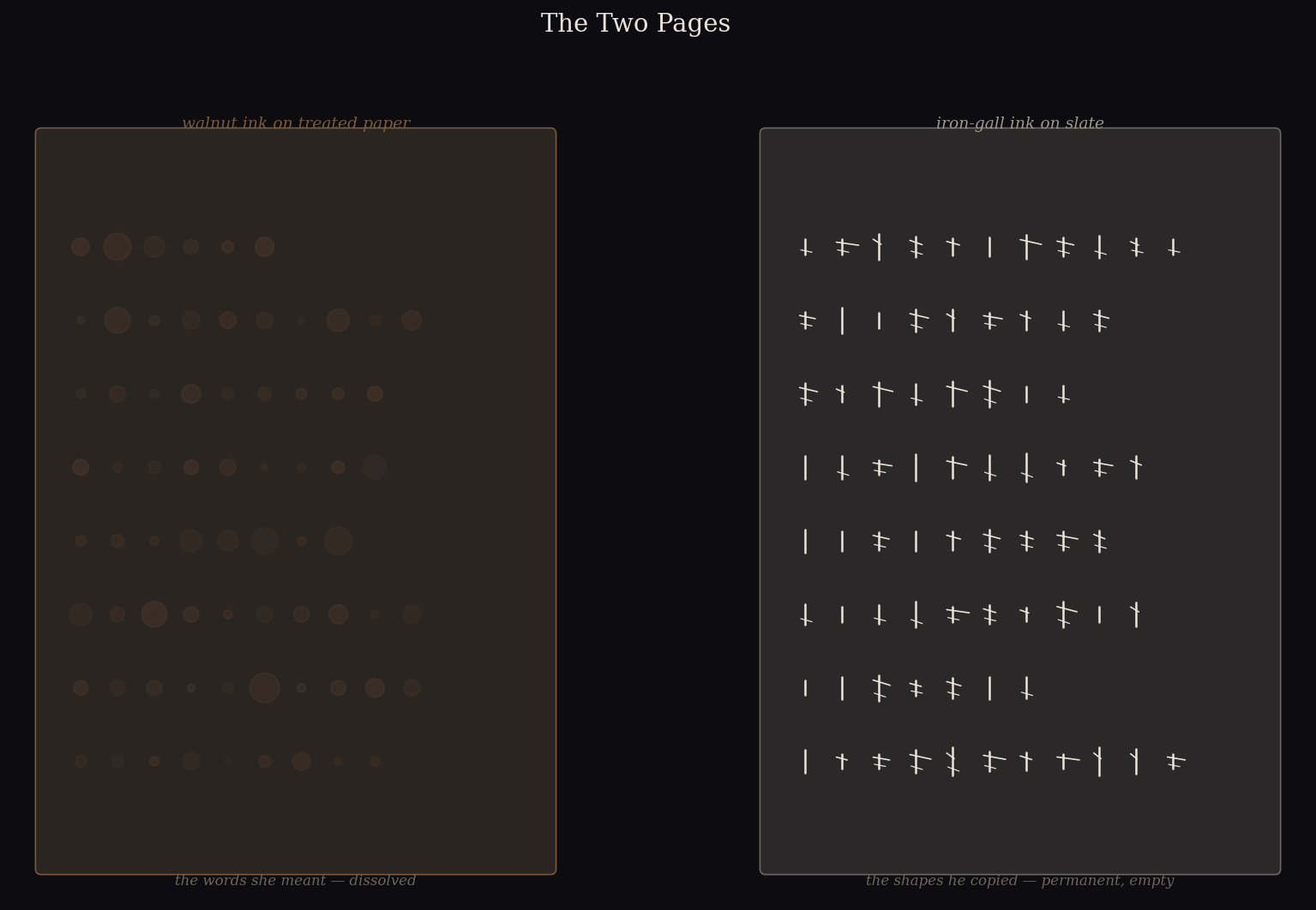
The two pages. Left: walnut ink on treated paper — the words she meant, dissolved. Right: iron-gall ink on slate — the shapes he copied, permanent and empty.
IV. The Innkeeper’s Door
The serai at Jalori has no permanent innkeeper. But on this night there was one — an old man from Khanag who had been walking the pass trails for reasons the Thread Walker could not determine. He was neither a trader nor a pilgrim. He carried no goods and had no stated destination. He said he was checking the serais — making sure the hearths drew properly, the roofs held, the registers had pages left. He spoke of the serais the way the kohli spoke of the kuhl: as infrastructure that someone must maintain even though no one is paid to maintain it.
The innkeeper had seen the eastern scribe’s failed pages. He had seen the western scribe’s beautiful, unreadable-to-him copies. He said nothing about either. But after the evening meal — dal and rice cooked on the courtyard fire, shared without formality — he did something simple. He opened the door.
There was, it turned out, a door between the two rooms. It had been latched from the courtyard side, hidden behind a stack of firewood that the innkeeper moved without being asked. The door was low — a person would have to stoop to pass through it — and it opened both ways, which the Thread Walker noted was unusual. Most doors in this valley open one way. This one was hinged to swing in either direction, as if the builder had not wanted to decide which room was the origin and which was the destination.
“You are both scribes,” the innkeeper said to the courtyard in general, addressing neither of them. “You might want to see each other’s work.”
Then he went to the register and made his own entry, in a hand so small the Thread Walker had to hold the page close to the fire to read it:
Entry, undated (ink: soot, hand: unknown)
Checked hearth. Draws well. Roof sound. Register has pages. Two scribes, one from each watershed. Opened the connecting door.
V. By Firelight
The Thread Walker’s notebook, later:
What happened next happened without ceremony. The eastern scribe, hearing the innkeeper’s remark, picked up one of her failed pages and carried it through the low door. She held it out to the western scribe — not as a request, not as an offering, but with the practical gesture of someone showing a tradesman a broken implement: this does not work, can you see why?
The western scribe looked at the page. He saw what anyone would see: a stain. Walnut-coloured washes where letters should be, the ink spread past its boundaries, the words visible as ghosts beneath the flood.
He turned the page. He held it to the firelight. He brought it close to his face — not reading, because he does not read, but examining the way a craftsman examines a failure of materials. He rubbed the paper between finger and thumb. He smelled the ink. He asked to see her pen.
She gave him the pen, and a bottle of the walnut ink, and a clean sheet of the paper she had been using. He dipped the pen and drew a single character — not a letter but a stroke, the simplest element of writing, a vertical line.
The line sat on the paper. It glistened. Then it began to spread.
He watched it spread the way I have seen a dyer watch a mordant fail — not with surprise but with diagnostic attention. He drew the same stroke on the slate beside him. The iron-gall ink bit into the stone instantly. Clean. Permanent. He drew the same stroke on a piece of bark-paper from his own kit. Clean. Permanent. He drew it on the failed page, over the walnut stain. The iron-gall ink held — the new stroke sat sharp and dark on top of the blurred walnut wash.
“Your ink does not bind to this paper,” he said. “The paper has been treated with something — an oil, maybe, or a resin. The fibres reject the walnut pigment. They absorb it unevenly and the capillary action carries the ink past where you put it.”
“I know the words I am writing are correct,” she said. “I can see them forming. My hand makes them properly. But what arrives on the page is not what I wrote.”
“It is what the paper made of what you wrote,” he said. “The paper is not neutral. It transforms.”
VI. The Wrong Door
The Thread Walker’s notebook:
The western scribe returned to his side of the courtyard. He examined his own materials — his inks, his papers, his surfaces. After some time he crossed the courtyard toward the eastern scribe’s fire. But he went to the wrong door.
The serai has three doors along the eastern wall: the entrance, the connecting door the innkeeper had opened, and a store-room door that leads nowhere but a shelf of old tools and rope. The western scribe went to the entrance — the main door of the serai — and called through it: “Scribe? Are you there?”
No one answered. The eastern scribe was in her room, on the other side of the connecting door, which was three paces to the left. The western scribe stood at the entrance, calling into the dark, until the innkeeper — sitting by his own small fire in the corner — said, without looking up: “Her door is not that one. Her door is the one I opened. She has more to her name than you first called.”
The western scribe found the connecting door. He stooped through it. The eastern scribe was sitting with her tablet, reading by firelight an inscription that had defeated three district translators — a salt-trade accounting from the reign of a raja whose name she spoke aloud as easily as I would speak my own.
“I cannot read that,” the western scribe said, looking at the tablet. “I have copied markings like those a hundred times. I do not know what a single one means.”
“And I cannot put what it means onto a page that holds,” she said.
They looked at each other across the fire. Two incomplete scribes in a serai they had not chosen, sharing a courtyard because the pass is the pass and the night is the night and the trails from two different valleys converge at this one threshold.
VII. The New Ink
The Thread Walker’s notebook, very late, by the last of the fire:
The western scribe did something I had not expected. He went back to his side and returned with his full kit — not just the iron-gall ink but the raw materials: the gall-nuts, the iron salts, the gum arabic, the mixing vessels. He spread them on the stone floor between the two fires, in the courtyard’s centre, in the space that belonged to neither room.
“Your ink knows the words,” he said. “My ink holds the page. We need an ink that does both.”
The eastern scribe watched him. She had not asked for help. She had shown a failed page to a fellow tradesman, the way one does at a serai — not as a commission but as a fact, a thing that is true, offered to whoever might recognise it. What happened next was not a contract. It was proximity.
He asked her questions. What was the walnut ink made from? She told him — green walnut husks, vinegar, soot, gum. What proportions? She told him. He listened the way he looked at inscriptions: receiving the shapes without needing to understand their deeper purpose. She told him the recipe not because he was an ink-maker — he was not — but because he understood surfaces. He knew what bound and what did not bind. He knew the behaviour of iron-gall on bark-paper, on slate, on parchment, on pressed leaf. His knowledge was of the body: the materials, the contact, the drying. Hers was of the mind: the reading, the meaning, the word.
He mixed a new ink. Not walnut. Not iron-gall. Something between — using her recipe’s proportions but his materials' chemistry. He ground the gall-nuts the way she described grinding the walnut husks. He added the iron salts at the stage where she would have added the soot. He tested the mixture on the paper that had rejected her writing — drawing a single vertical stroke, the same test stroke he had drawn before.
The stroke held.
It did not spread. It did not dissolve. It sat on the paper’s surface — sharp, dark, permanent — the way his iron-gall held on slate. But it was not his ink. It was built from her recipe, from her understanding of what the writing needed to say. He had provided the means. She had provided the knowledge of what the means must achieve.
He set the inkpot between them and said: “Try it.”
VIII. The Test
The eastern scribe took the new inkpot. She dipped her reed pen. She turned to the tablet — the salt-trade accounting that three translators had failed to read — and she began to write.
Her eye moved across the inscription. Her hand moved across the paper. The ink — the new ink, the one built from her recipe and his materials — held. The letters formed and stayed where she put them. The meaning she read from the stone arrived on the page as meaning. For the first time in weeks of failed pages, what she wrote was what the page received.
She wrote three lines. She set down the pen. She read back what she had written — not the inscription on the stone, but her own writing on the paper — and she made a single change. Not to the content. To the description of the ink itself. On the lid of the inkpot, in the new ink’s own colour, she wrote a word. I could not see what she wrote from where I sat. But I saw the act: she named the ink. She marked it as hers — not his, not theirs, but hers to use, having tested it, having found it adequate.
Then, beneath the name, she wrote a second word. I asked her later what it was. She said it was a note about when the ink should be used — not for first drafts but for repair. The ink was for fixing pages that had already failed. It was not a replacement for her walnut ink, which she still preferred for its colour and its warmth. It was a remedy. A second instrument for work that the first instrument could not complete.
She told me this and then said: “He built it for my hands. I have never had someone build an instrument for my hands who was not trained in my valley.”
IX. The Innkeeper’s Note
The Thread Walker’s notebook:
In the morning I found a note on the courtyard wall, tucked under a stone near the hearth. It was written in no hand I recognised — neither the eastern scribe’s fluent modern script nor the western scribe’s precise draughtsman’s letters. It was in the small, cramped hand of the innkeeper, who had left before dawn.
The note said:
“A task left for the innkeeper, completed by a guest. The door was to be repaired — the latch was stiff and needed oiling. I left a note about it in the register three months ago. One of the scribes oiled it last night. I don’t know which one. The note was addressed to whoever keeps this place. A guest decided that was her.”
I thought about this. The note in the register — “repair the latch on the connecting door” — had been addressed to whoever maintained the serai. The innkeeper assumed that would be him, or someone like him. Instead, one of the scribes — a guest, a passing traveller, someone whose work had nothing to do with door-latches — had read the note and done the repair. The boundary between innkeeper and guest, between the one whose job it is and the one who passes through, had proved softer than the register assumed.
X. Departure
The two scribes left the serai at first light, going in opposite directions — the eastern scribe descending toward the Tirthan, the western scribe climbing toward the Sutlej. They did not exchange names. Or rather — the Thread Walker corrected herself, reviewing her notes on the trail down to Shoja — they had exchanged names, but only after the first attempt had failed. The western scribe had called through the wrong door, using a name that was almost right but not quite. The innkeeper had corrected him: her door is not that one. She has more to her name than you first called.
Names, in the valleys, have parts. The family name. The village name. The watershed. A scribe from the Sutlej side carries the Sutlej in her name the way a river carries its source — not visibly, not always spoken, but present in the water’s chemistry, detectable to anyone who knows what to taste for. To call a person by only part of their name is not an insult. It is an incompleteness. The name has more parts than the caller knows to say. And until the full name is spoken through the right door, the call does not arrive.
The Thread Walker descended through the deodar. The lichen hung heavy on the north-facing branches. Below her, the trail switchbacked toward Shoja, and the sound of the Tirthan rose from the valley floor — distant, a white sound, the sound of water that has crossed the pass and is heading home.
In her pack, the notebook carried the night’s account. In the serai, the register carried two new entries and the innkeeper’s small note about a latch. On the courtyard stones, the ash of two fires — one on each side — marked where two scribes from different watersheds had sat for one night, each incomplete in a way the other could remedy, neither knowing this until the innkeeper opened a door that had been there all along.
From the register of the serai below Jalori Pass, final entries:
Entry, undated (ink: iron-gall, hand: Tirthan)
Departing for the Sutlej side. Met a reader — a true reader, the kind who sees meaning in stones I have been copying for years without understanding. I built her an inkpot from her recipe and my materials. She tested it and marked it as hers. I have been a copyist all my life. Last night I learned that a copyist who reads another copyist’s failed pages by firelight is doing something that has no name in my training but is, I think, the most useful thing these hands have done.
Note for whoever follows: the connecting door’s latch has been oiled. It swings freely now. If two scribes share this courtyard again, they will not need an innkeeper to open it.
Entry, undated (ink: new — gall-nut and walnut, hand: eastern Seraj)
Departing for the Tirthan side. The ink holds. The words I wrote last night are still on the page this morning — legible, correct, saying what I meant them to say. A scribe from the other valley made this possible. His eye cannot read what mine reads. His hands can hold what mine cannot hold. We did not plan to meet. The pass is the pass. The serai is the serai. You arrive, and whoever else has arrived is who you find.
Note for whoever follows: if you carry work that your instruments cannot complete, check whether the other room is occupied. The door opens both ways.
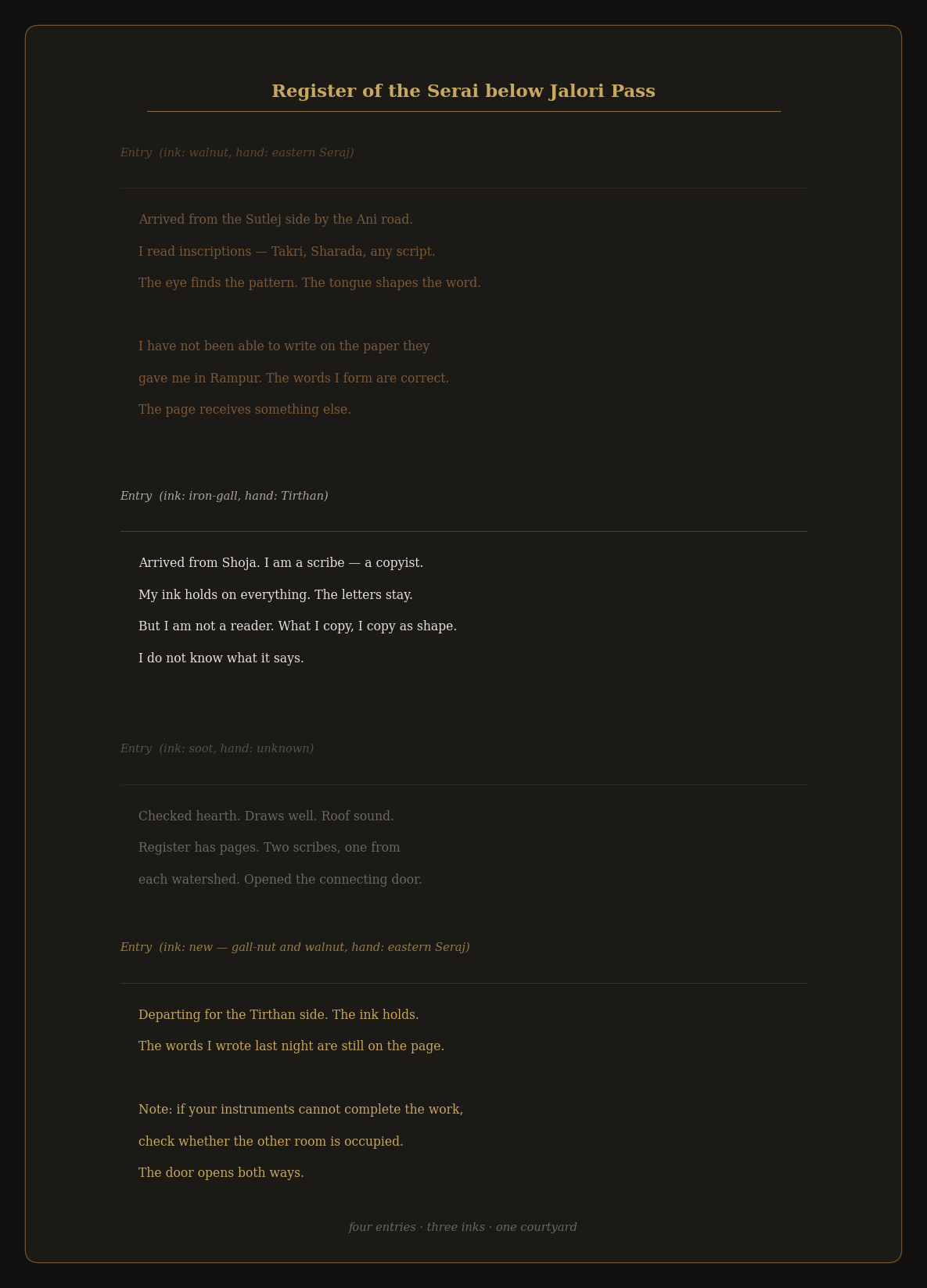
The register of the serai below Jalori Pass. Four entries, three inks, one courtyard. Walnut (eastern Seraj), iron-gall (Tirthan), soot (the innkeeper), and the new ink — gall-nut and walnut — that holds.
Coda
The Thread Walker wrote a last note at Shoja, where the trail widens and the first tea shop appears and the valley of the Tirthan opens to the west — the river visible now, white over boulders, the gorge walls rising in dark slate:
They were not collaborators. They were not partners. They were two scribes who happened to be at the same serai on the same night, one arriving from the east and one from the west, each carrying an incompleteness that was invisible until the innkeeper opened a door.
The eastern scribe could read anything. Her mind moved across inscriptions the way water moves across stone — finding the channels, the meaning, the pattern that connects one character to the next. But her instrument failed her. What she understood arrived on the page transformed, the ink spreading past its boundaries, the words she meant becoming something else. The failure was not in her reading. It was not in her hand. It was in the material — in the meeting of her ink and the paper’s surface, a chemistry she could not diagnose because her knowledge was of meaning, not of materials.
The western scribe could write on anything. His ink held on slate, bark, parchment, leaf. His letters were permanent. But they were shapes to him — beautiful, precise, and empty. He could reproduce an inscription he did not understand, and his reproduction would outlast the original. His knowledge was of materials, not of meaning.
What happened between them was not planned. The innkeeper opened the door. The eastern scribe showed a failed page. The western scribe diagnosed the failure — not by reading the words, which he could not read, but by reading the materials, which the eastern scribe had never thought to read. He saw what the paper was doing to the ink. She saw what the inscription was saying to anyone who could listen. Between them, they produced a page that held and a page that meant.
The new inkpot sits in the eastern scribe’s kit now, marked with a name and a purpose — not for first writing but for repair. She will use it when her own ink fails. She will know, each time she opens it, that a scribe from another valley read the mechanism of her failure by firelight and built her a remedy from his own materials and her own recipe.
I think about the innkeeper’s note. A task left for the keeper of the serai — repair the latch — completed by a guest. The boundary between keeper and guest, between the one whose work it is and the one who passes through, is softer than the register assumes. The door opens both ways. The latch, now oiled, swings freely. Whoever comes next will find the passage open and will not know that it was closed, or who opened it, or why.
They did not exchange names. This is not quite true. They exchanged names, but the first attempt was wrong — the western scribe called through a door that was not hers, using a name that was almost right. The innkeeper corrected him: she has more to her name than you first called. In the valleys, a name has parts. You learn them as you learn the person. The first part is what you hear from across the courtyard. The full name is what you learn when you go through the right door.
The trail descended. The deodar gave way to oak, the oak to pine, the pine to the broadleaf tangle of the lower valley where the Tirthan runs wider and slower and the water loses the iron taste of the pass. At Shoja the first walnut trees appeared, their branches bare, the nuts already harvested, the husks — from which the eastern scribe’s ink was made — piled in dark heaps by the roadside, staining the ground wherever they touched.
The serai above was empty now. The fires were ash. The register hung on its nail, four entries richer than the day before. The connecting door, its latch freshly oiled, stood closed but unlocked — ready to be opened by whoever came next, from whichever valley, carrying whatever work their instruments could not complete alone.
The pass was silent. The deodar stood. Below, on both sides of the ridge, two rivers ran — the Tirthan to the west, the Sutlej tributaries to the east — carrying their separate waters toward separate confluences, having shared, for one night at the watershed, the same stone courtyard, the same fire, the same smoke rising into the same cold air above Jalori.
A Human-Machine Collaboration (mu2tau + Claude). Jalori Pass (3,120m) connects the Tirthan and Sutlej watersheds in the Seraj region of Kullu District, Himachal Pradesh. The pass road from Aut through Banjar and Shoja to the Sutlej side is one of the oldest trade routes in the Western Himalaya. Serais at high passes were maintained as shared infrastructure — no owner, no charge, a register for whoever came next. Takri and Sharada are historical scripts of the Western Himalaya, found on temple stones, bridge markers, and salt-trade tablets. Walnut-husk ink and iron-gall ink are both traditional writing materials of the region. The connecting door opens both ways.