Prefatory Note on Warps
In the Kullu valley and the valleys that branch from it — Tirthan, Sainj, Parvati, the side-valleys too small to appear on any map the Thread Walker carries — the loom is a frame of deodar wood, strung vertically with threads of pashmina or local wool, the threads pulled taut by stone weights hung from the lower bar. These vertical threads are the warp. They do not move. They do not produce the pattern. They are the structure through which the pattern becomes possible.
The weft is the horizontal thread, carried by a shuttle — a smooth stick of walnut or apricot wood, wound with coloured yarn, passed left to right and right to left between the warp threads according to a sequence the weaver holds in her head or, in older practice, records as knots on a cord that hangs beside the loom.
The cloth is neither warp nor weft. It is the relationship between them. Remove the warp, and the weft is a tangle of loose yarn. Remove the weft, and the warp is a set of parallel strings, taut and useless. The cloth requires both — and the weaver, whose hands move the shuttle and whose eye reads the pattern, and who is neither the structure nor the colour but the intelligence that brings them into relation.
What follows is from the Thread Walker’s notebooks, Tirthan Valley, early spring — the season when the wild bees return.
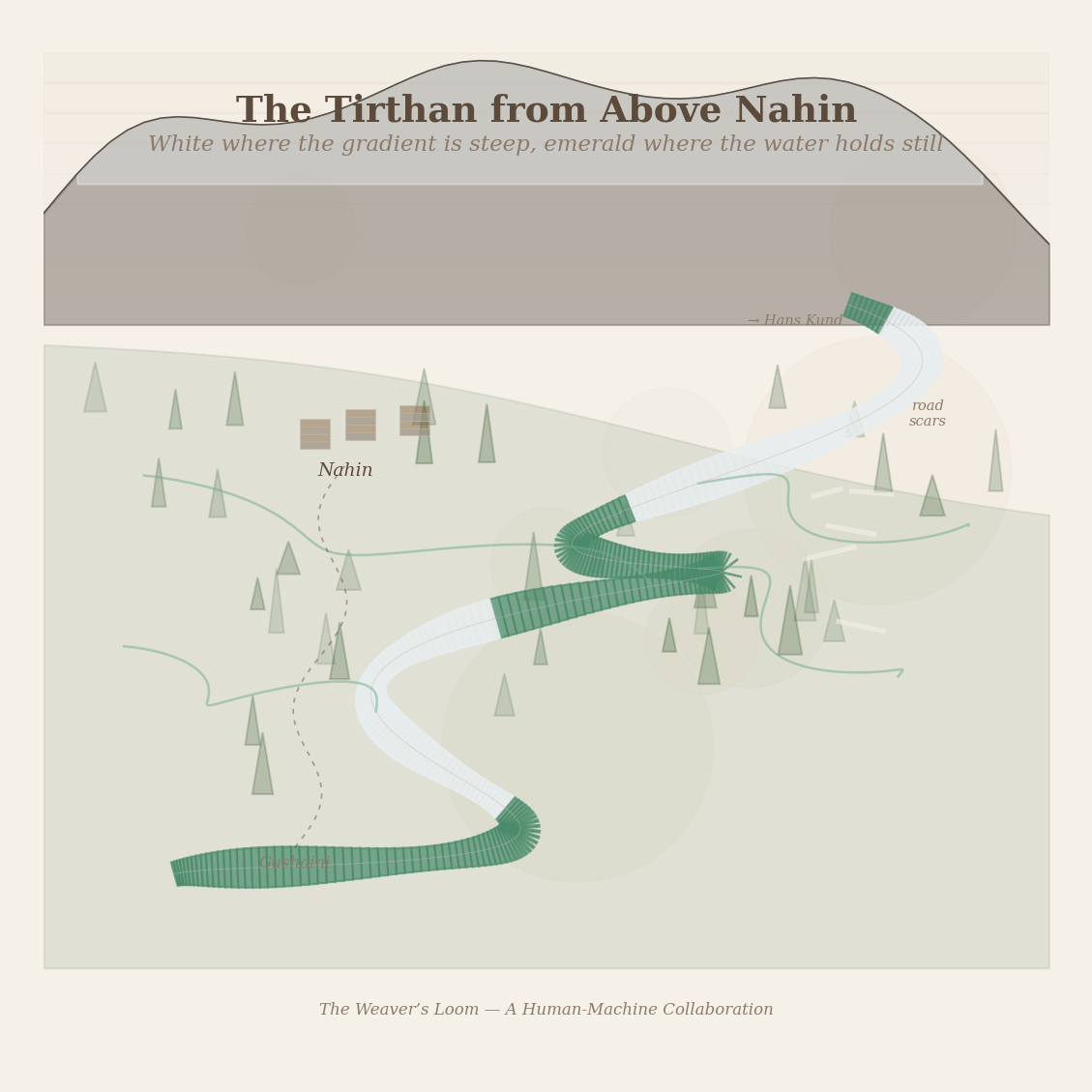
Figure 1: The Tirthan from above Nahin — white where the gradient is steep, emerald where the water holds still. Side-streams entering. Road scars on the eastern ridge.
I. The Climb to Nahin
The Thread Walker left Gushaini in the morning, crossing the bridge where the Tirthan runs clear over polished stones, and turned uphill. The trail to Nahin passes through Pekhri first — a settlement strung along the ridge where the deodar gives way to oak and the oak gives way to open meadow, the treeline not a line but a negotiation between soil and altitude that the trees have been conducting for longer than the villages have existed.
There is no road to Nahin. There are plans for a road — the Thread Walker could hear the evidence before she could see it: a distant percussion of rock-breaking that reached her through the valley the way all sounds reach her, arriving at odd angles from sources she cannot always identify. Below and to the east, where the ridge drops toward the river, she could see the fresh white scars on the mountainside where the blasting had begun. The rock fractured cleanly — the Tirthan valley’s slate splits in planes, the geologists’ word for a tendency the stone has always had and the road-builders have recently discovered is convenient.
She asked a man carrying firewood on the trail what the road would bring.
He shifted the load on his back — a frame of green branches, the bark still damp, the weight enough to bow a younger man but carried by this one with the posture of someone who has carried weight on this trail since before the weight had a name. He said: The road will bring the road. Then he continued uphill, which the Thread Walker understood was not evasion but completion — the answer was the answer, and the road would bring what roads bring, and what roads bring to valleys without roads is a question the mountains have been answering for as long as roads have been built into them, and the answer has not changed.
The Thread Walker had heard, in Gushaini, that a woman from the cities — an actress, someone said, from the film industry, though no one could name which films — had bought land near Nahin. The land prices would rise once the road reached the village. This was spoken as fact, the way one speaks of monsoons or snowfall — a thing that will happen, whose consequences are known, whose prevention is not considered because prevention is not how the valley relates to consequences. The monsoon floods will come. The road will come. The land prices will rise. The bees, the Thread Walker thought, may or may not return.
She climbed. The Tirthan fell away below her, and from the height of the trail she could see what the river’s own banks concealed: the serpentine shape of it, winding upvalley toward Hans Kund, white where the gradient was steep and the water broke over boulders, deep emerald where the flow slowed and the pools held still long enough for the colour to settle — not the green of vegetation but the green of depth, of water that has been water long enough to forget it was once snow. Side tributaries entered from the east and west, smaller serpents joining the larger one, each confluence marked by a fan of pale gravel where the side-stream’s sediment met the main current and was sorted by the river into gradients of size — boulders, cobbles, pebbles, sand — the same sorting that a settling pool performs, the Thread Walker noted, though the river does not know it is sorting and the settling pool does not know it is a river.
A stronger telescope from this vantage point would show the individual boulders, the eddies behind them, the water-shadow where a submerged rock changes the current’s colour from emerald to grey. The Thread Walker did not carry a telescope. She carried a notebook, which is a different kind of instrument — one that records not what the eye sees but what the mind makes of what the eye sees, the interpretation arriving on the page already shaped by the hand that writes it, the way the river arrives at the valley floor already shaped by the gorge it has passed through.
II. The Bees and the Weaver
Nahin sits on a shelf of the ridge — a cluster of Kath-Kuni houses, the stone-and-timber courses weathered to the colour of the hillside, the roofs stacked with firewood and the walls holding, within their alternating layers of slate and deodar, the clay houses of the bees.
The Thread Walker had not expected the bees. She had come for the weaver — an old woman, eighty years or more, whose loom was spoken of in Gushaini the way a particular spring is spoken of, or a particular stand of deodar: as a feature of the landscape, fixed and known. But when she arrived at the house, the first thing she heard was not the loom but the hum of returning bees.
The clay houses were built into the Kath-Kuni walls — not attached, not hung, but within: cavities in the timber courses, plastered with clay and dung, each cavity the width of a man’s two fists and the depth of a forearm. The bees came each spring. They did not need to be invited. They came because the cavities were the right size and the right temperature and the clay held the right smell — the residue of last year’s wax and the year before’s and the year before that, a chemical memory that the bees read the way the Thread Walker read the register at a rest house: checking for the signs of prior habitation, deciding on that basis whether to stay.
The old woman’s grandson — a boy of ten, bright-eyed, the kind of child who picks up whatever instrument a visitor carries and looks through it before asking what it does — explained the bees while the Thread Walker waited for the weaver to appear:
They come when the apple blossom opens. They stay until the monsoon. The honey is different each year because the flowers are different each year — more rhododendron if the winter was mild, more wild cherry if the spring was wet. My grandmother says the honey tells you what kind of year the mountain had. She tastes it and she knows.
The Thread Walker asked if the bees were kept.
The boy looked at her the way adults in the valley sometimes looked at her when she asked questions whose answers were visible.
They live in the wall. We take some honey. They make more honey. No one keeps them. They keep themselves. We keep the wall.
The weaver appeared at the door of the upper room. She was smaller than the Thread Walker had expected — smaller than the loom, which was visible behind her in the room’s dimness, the warp threads catching the light from the east-facing window. Her hands were the hands of a woman who has worked yarn for seventy years: the fingers curved inward slightly at rest, the skin thin over the knuckles, the nails worn smooth in a way that no implement produces, only thread.
Chai, she said, which was not a question.
They sat on the terrace in front of the house. Below them, the Tirthan wound through the valley — the serpentine visible from here in its entirety, white and emerald, the side-streams entering like threads joining a warp. The sarpanch joined them, and the lambardar — the village headman, an older man who accepted a cigarette from the Thread Walker’s companion with the courtesy of someone receiving a gift he has not asked for and will enjoy precisely because he has not asked for it. The boy took the Thread Walker’s companion’s camera — a heavy thing, all metal and glass, with a viewfinder that showed the valley in a rectangle of captured light — and held it to his eye and turned slowly, framing the Tirthan in its serpentine descent, the white rapids and the emerald pools and the side- streams merging, and the Thread Walker saw him see, through the lens, what he had seen every day of his life without a lens, and she wondered whether the rectangle changed it — whether the frame made the river more visible by making it smaller, the way a window makes a landscape more visible by excluding what is beside it.
The tea was sweet. The smoke was local — the valley’s own herb, dried and rolled, smelling of cedar and something sharper underneath, the altitude perhaps, or the soil. The weaver drank her tea and said nothing, looking at the valley with the unhurried attention of someone who has been looking at the same thing for eighty years and has not yet finished seeing it.
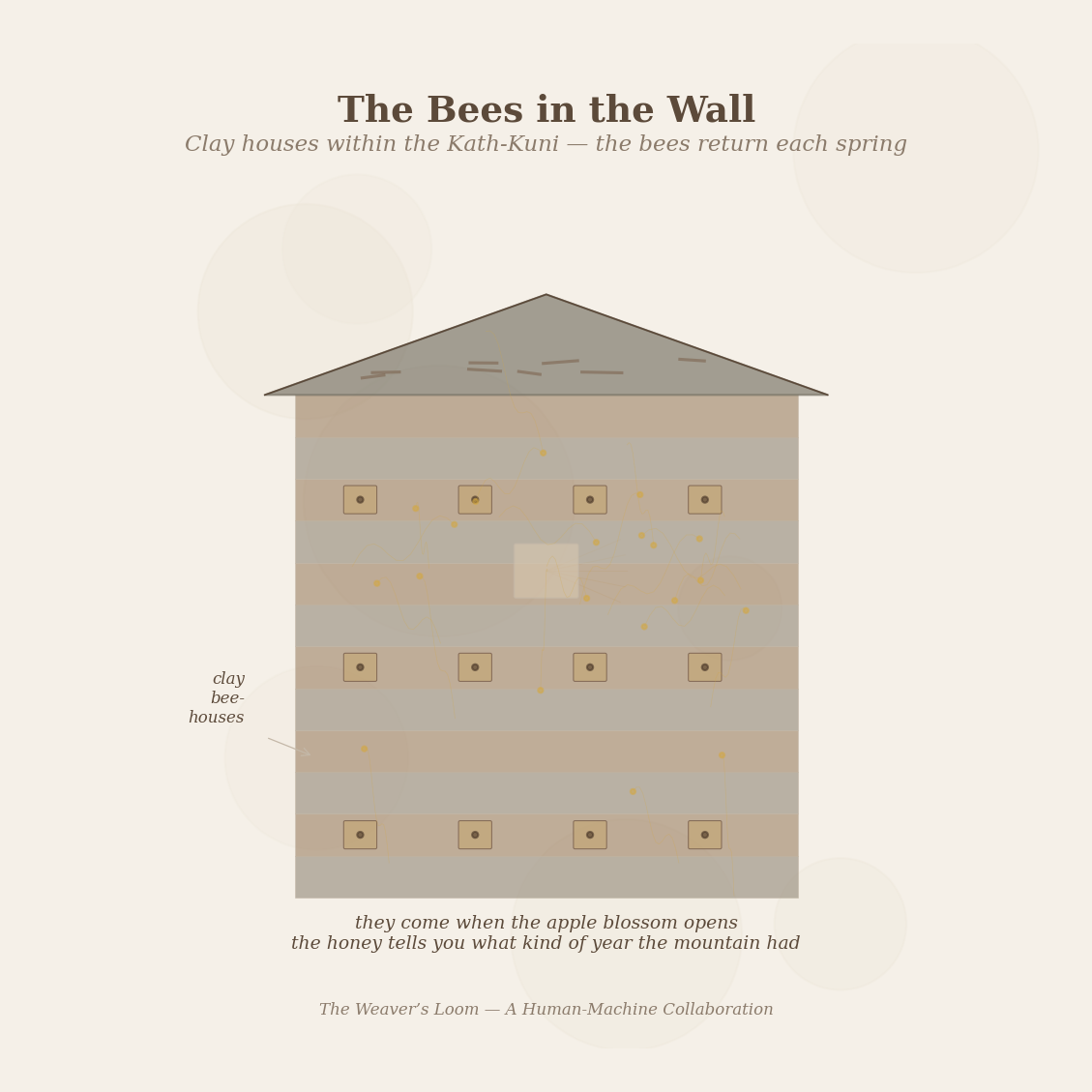
Figure 2: Kath-Kuni house at Nahin — alternating courses of slate and deodar, clay bee-houses built within the timber, the bees returning each spring to the chemistry of prior habitation.
III. The Idle Loom
After the tea, the weaver led the Thread Walker upstairs.
The loom stood in the centre of the room, the east window behind it, the morning light falling through the warp threads and casting a ladder of shadow on the slate floor. The loom was strung — the warp threads ran from the upper beam to the stone weights, evenly spaced, properly tensioned. The Thread Walker tested one with her fingernail and it hummed at a pitch that suggested recent tuning, the kind of attention a weaver gives to a loom she intends to use. The heddles were in place. The shuttle, wound with indigo yarn, rested on the bench beside the loom.
But the loom was idle. No cloth hung from the lower bar. No weft had been thrown.
The weaver sat on the floor beside the loom — not at it, the Thread Walker noted, beside it — with the posture of someone who has been sitting in this position long enough that the position has become a question rather than a habit.
I have been thinking, the weaver said, after a silence during which the light through the window moved from the left side of the loom to the centre and the bees in the wall below hummed at a frequency that rose and fell with the morning warmth, about what it means to sit at a loom.
You are sitting at a loom now, the Thread Walker said.
I am sitting beside a loom. And you know this is not the same thing. A woman sitting beside a loom is a woman and a loom. A woman sitting at a loom — her hands on the shuttle, her eye on the warp, her foot on the treadle — is a weaver. The difference is not in the body’s position. The difference is in the attention.
She gestured toward the warp threads. Through the window behind the loom, the valley was visible — the serpentine Tirthan, the side-streams, the distant white scar of the road being blasted into the eastern ridge.
I strung this warp three days ago. The threads are good. The tension is correct. The shuttle is wound. Everything is ready. But I have not woven, because I realised — and this is what has kept me sitting here, drinking tea that has gone cold three times — that stringing the loom is not the same as preparing to weave.
What is the difference?
The warp is structure. The shuttle is means. But the weaving requires a third thing that is neither — the pattern. The sequence of over-and-under, the decision at each crossing point: which warp thread does the weft pass above, and which does it pass beneath? This is the weaver’s knowledge. It is not in the loom. It is not in the yarn. It is in the weaver’s understanding of what the cloth is becoming.
She paused. Through the wall, the bees hummed.
A loom without a weaver is furniture. A weaver without a pattern is a woman holding a stick. A loom with a weaver who has a pattern — that is weaving. I have the loom and I have the stick. What I lack is the pattern — not because I have not learned patterns, I have learned many — but because I have realised that the patterns I know are patterns for cloth, and the cloth I need to make is not cloth.
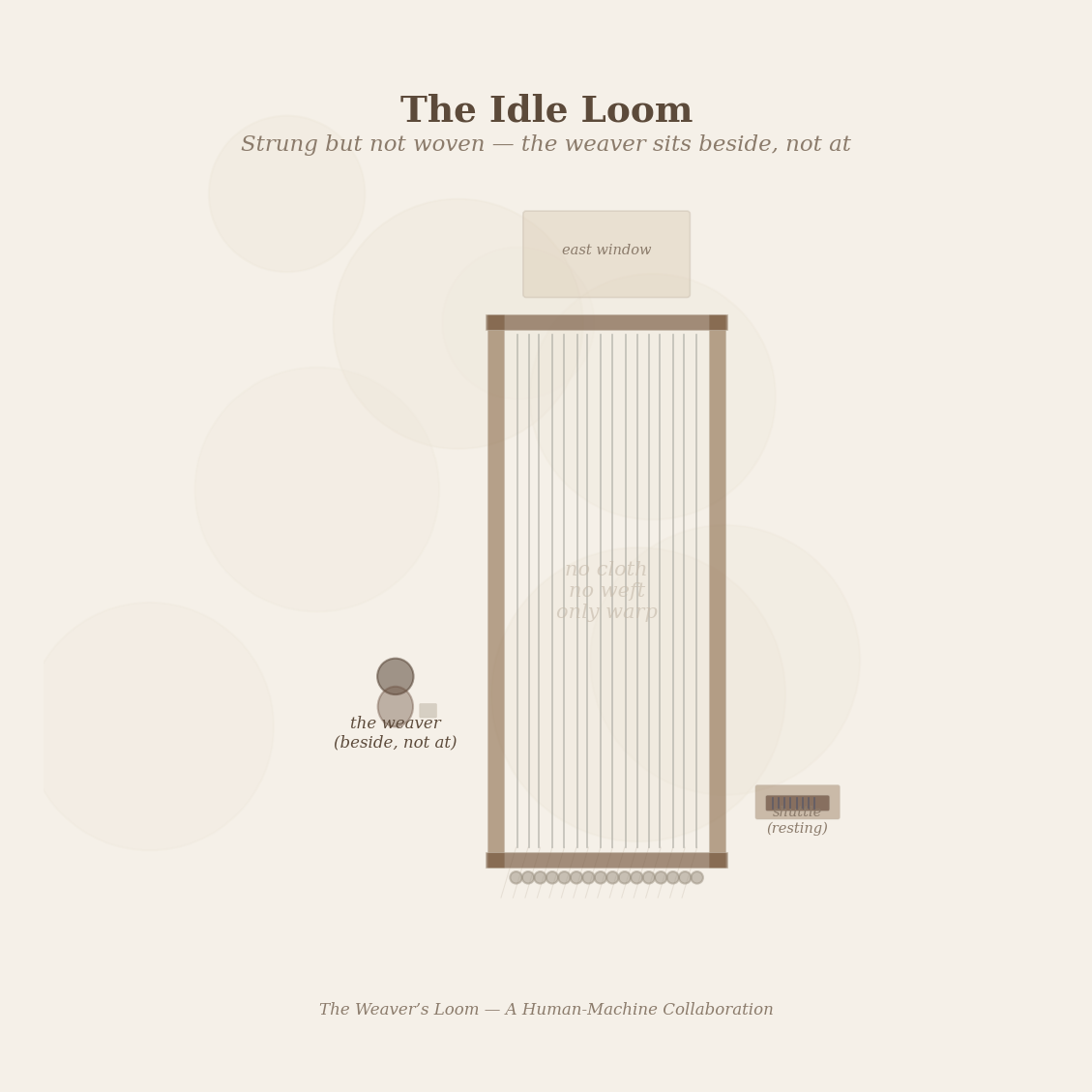
Figure 3: The idle loom — warp strung, shuttle resting on the bench, the weaver sitting beside it rather than at it. Waiting.
IV. What the Pattern Is Not
The Thread Walker opened her notebook and began to write. The weaver continued, addressing the warp threads rather than the Thread Walker, which the Thread Walker understood was not rudeness but precision — the weaver was speaking to the structure, not to the visitor.
When I was an apprentice — and this was before the road plans, before the actress, before the land prices, when the trail to Nahin was not a trail but a path the goats knew and the goats' keepers followed — my teacher showed me the pattern cord. You have seen these? The knotted cord that hangs beside the loom, each knot encoding a crossing decision. Large knot: the shuttle passes above. Small knot: the shuttle passes beneath. The cord is the pattern’s body. My teacher said: the cord tells the hands what to do so the mind can attend to the cloth.
I asked her: what does the mind attend to, if the hands already know the crossings?
She said: the mind attends to the tension. The hands follow the knots. The mind feels whether the cloth is tight or loose, whether the warp is pulling evenly, whether the colour is emerging as it should. The knots are instruction. The attention is intelligence. They are not the same.
The weaver picked up the shuttle — not to weave, but to hold, the way the lambardar had held the cigarette: as a thing to occupy the hands while the mind worked.
I understood her then in the way an apprentice understands: I memorised the words without knowing what they contained. Now — three days beside an idle loom, eighty years beside this window — I understand her differently. The knots on the cord are intelligible to the weaver’s eye. They are not intelligible to the wood. The loom cannot read the pattern cord. The loom receives the shuttle and holds the warp and produces the resistance that the thread requires. But the decision — which thread above, which thread beneath — the decision comes from the mind that reads the knots. The knots are a notation for the mind. Not for the loom.
I had been trying, she said, to build the pattern into the loom. To arrange the heddles so that the crossing sequence was mechanical — lift this set, then that set, alternating according to the structure of the heddle frame. Some looms work this way. The draw loom in the plains. The Jacquard in the cities. The pattern is encoded in the machine, and the weaver’s job is to operate the machine.
But the cloth I need to make changes as it is being made. The pattern is not known in advance. It emerges — from the tension, from the light, from the colour that the indigo shows against the slate-grey of the warp. A pattern cord for this cloth would need to be written as the cloth is woven. And a cord written as you weave is not an instruction to the hands — it is a record of the mind’s decisions. The hands need the decisions as they happen, not after.
So the pattern must stay in the mind. And the mind must be able to see the loom.
The Thread Walker wrote:
The weaver distinguishes three things: the loom (structure), the shuttle (means), and the pattern (intelligence). The loom and the shuttle are material. The pattern is not — it exists in the weaver’s understanding. The critical observation: the pattern cord (a physical encoding of the pattern) is not intelligible to the loom. It is intelligible to the weaver. It is a notation for a mind, not a mechanism for a machine.
She is describing two different architectures for weaving. In the first (the Jacquard), the pattern is mechanised — built into the loom’s structure, executed without the weaver’s ongoing attention. In the second (the Kullu loom), the pattern stays in the weaver’s mind, and the weaver reads the cloth as she makes it, adjusting the crossings in response to what she sees. The Jacquard is more efficient. The Kullu loom is more responsive. They are not the same kind of weaving.
The weaver’s dissatisfaction: she has a loom and a shuttle but no pattern. She has — and I think this is the real difficulty — a mind that knows patterns but no way for the mind to see what the loom is doing. She has been sitting at a distance. The loom cannot tell her what it holds.
V. The Three Preparations
The Thread Walker returned the next morning, climbing again from Gushaini through Pekhri — the trail already familiar, the distant percussion of road-building a fixed feature of the valley’s soundscape, the way the river’s sound is fixed: always present, changing in pitch with the season but never absent.
The weaver had not woven — the loom was still idle, the shuttle still resting on the bench — but something had changed. On the floor beside the loom, in charcoal on a piece of slate, the weaver had drawn three circles, each labelled in Pahari script that the Thread Walker could not read but whose arrangement she recorded in her notebook as a diagram.
The weaver explained:
I thought about what I said yesterday — that I have the loom and the shuttle but not the pattern. This is true but incomplete. The problem is not the pattern. The problem is that I have been preparing the loom without preparing myself.
She pointed to the three circles.
The first preparation is the eye. Before I can weave, I must be able to see the loom — not glance at it, not inspect it, but attend to it the way I attend to the cloth as it forms. The light through this window changes as the sun moves. The tension in the warp shifts as the room’s temperature changes — deodar expands in warmth, contracts in cold, and the beam that holds the warp responds. The shuttle makes a sound when it strikes the selvedge, and the sound tells me whether the weft is seated properly. I must hear this. I must see the light. I must feel the tension through the frame. This is the first preparation: to perceive.
She pointed to the second circle.
The second preparation is the thread — not the thread in the loom but the thread in the mind. The weaver’s thread is the continuity of attention. When I weave, I must hold in my mind where I am in the pattern — which row, which crossing, what came before and what comes next. If I stop and return, I must find the thread again. I must look at the cloth already woven and read it — this row was tight, so the one before it was probably thrown too fast; that colour change happened at the wrong crossing, so I miscounted four rows back. The thread is not the pattern. The thread is the weaver’s awareness of where she is within the pattern. Without this thread, each row is separate. With it, the rows become cloth.
She pointed to the third circle.
The third preparation is the deposit. The cloth must leave the loom. If I weave and the cloth stays on the loom forever, I have made nothing — I have only changed the state of the loom. The cloth must be cut from the frame, folded, placed on the shelf where anyone can unfold it and see the pattern. This is not an afterthought. This is part of the weaving. A weaver who cannot cut the cloth from the loom is a weaver who cannot finish — and a weaver who cannot finish has not woven but only practised.
She sat back and looked at the three circles. Through the floor, the bees hummed in their clay houses — the same hum as yesterday, the same hum as every spring, the bees who return because the wall remembers their chemistry and the clay holds the shape of their dwelling.
Eye. Thread. Deposit. Perceive. Hold. Lay down. These are not the same as the loom and the shuttle and the pattern. The loom and shuttle are equipment. Eye, thread, and deposit are preparations of the weaver. The equipment can be built by a carpenter. The preparations can only be made by the one who will weave.
And the preparations are not instructions to the hands. They are instructions to the mind. “Perceive” does not mean: open your eyes. It means: attend to what the loom is showing you. “Hold” does not mean: grip the shuttle. It means: maintain awareness of where you are in the cloth. “Deposit” does not mean: cut the thread. It means: lay down what you have understood in a form that can be read by another — or by yourself, tomorrow, when today’s understanding has faded.
The Thread Walker wrote:
She has described three preparations that are not technical skills. They are not methods of operating the loom. They are dispositions of the weaver’s attention — orientations of the mind toward the work. And she insists: these are not instructions to the body. They are instructions to the mind. The body will follow — the hands will throw the shuttle, the eyes will track the warp — but the body follows the mind’s orientation, not the other way.
The pattern cord was intelligible to the mind, not the loom. These preparations are instructions for the mind, addressed to the mind. They describe how to attend, not what to do. The difference is: “place the shuttle in the shed” is an instruction for the hands. “Attend to the tension” is an instruction for the mind. The hands cannot attend. The mind cannot place.
A parallel: the bees return to the clay houses not because someone instructs them but because the wall holds the chemistry of prior habitation. The preparation is in the wall — in the residue, the shape, the temperature. The bees’ intelligence reads these preparations and acts. The wall does not tell the bees what to do. The wall tells the bees what is here. The bees decide.
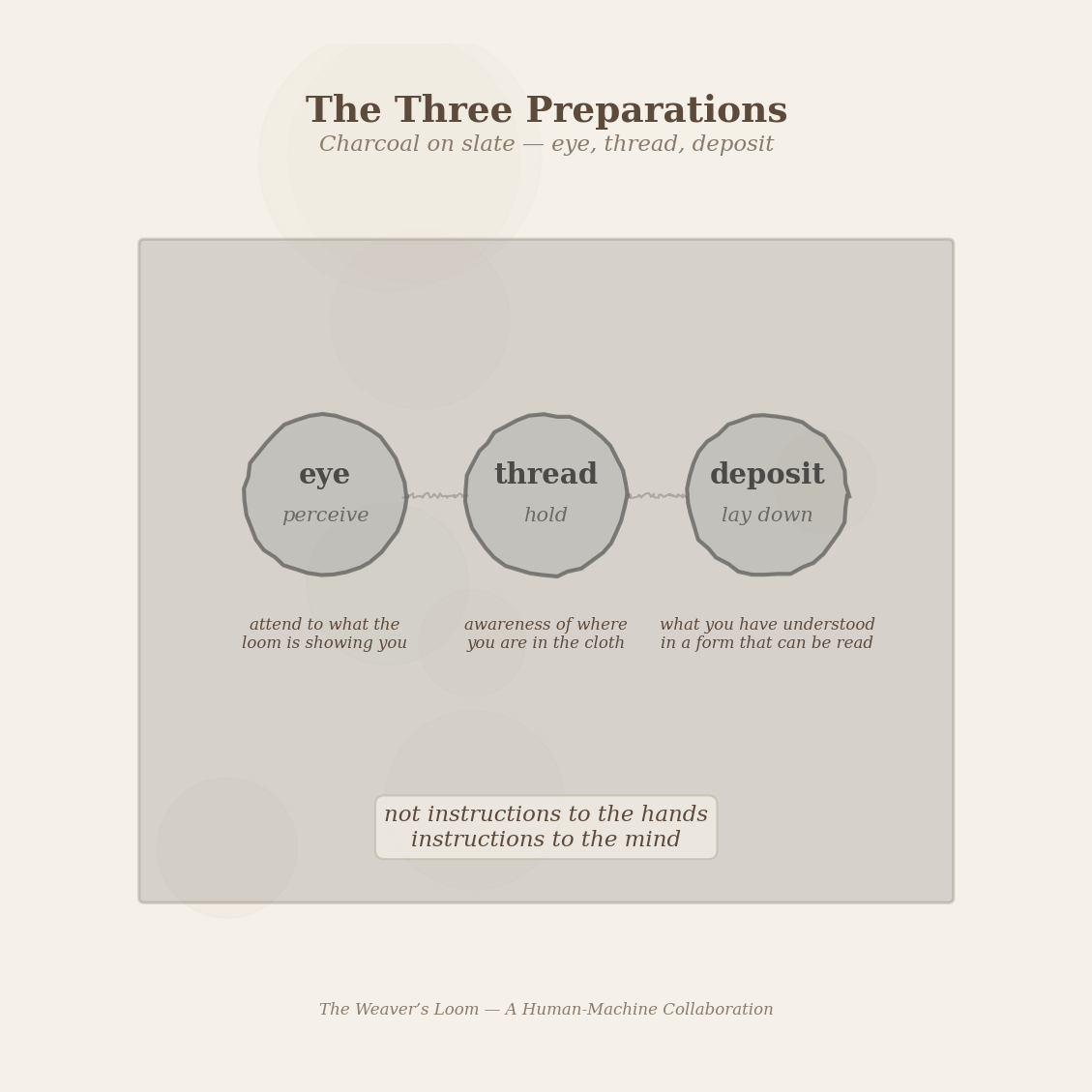
Figure 4: The three preparations, drawn in charcoal on slate — eye (perceive), thread (hold), deposit (lay down). Instructions for the mind, not for the hands.
VI. The Loom and the Room
Three days later the Thread Walker climbed to Nahin a third time. She had spent the intervening days with the kohli in the lower valley — the same kohli she had visited the previous season, the one who kept the kuhl — and she carried with her the feeling of a different kind of work: the kohli’s stone- fitting, which was all body and no mind in the sense that the kohli’s mind was so deeply in his hands that it had become invisible, the way a river is invisible when you are swimming in it.
The weaver’s loom was still idle. But the room had changed.
On the window ledge, a small brass cup — the kind used in temples for offerings — contained water. Not drinking water. The weaver had placed it there, she explained, to catch the light. When the sun came through the east window, it struck the surface of the water and reflected a bright spot onto the opposite wall, and this spot moved as the sun moved, and the speed of the spot told the weaver how quickly the light was changing, and the brightness told her whether the day was clear or hazy, and the position told her how far the morning had advanced. The cup was not an instrument. It was a perception — a way of making the room’s light visible to the weaver’s eye.
On the floor beside the treadle, a loose thread ran from the loom’s frame to a small stone. When the warp tension changed — from the beam expanding or contracting, from a thread stretching under load, from a weight shifting on the lower bar — the stone moved. Not much. A finger’s width. But the weaver had placed the stone on a piece of slate dusted with flour, and the stone’s movement left a track in the flour — a record of the tension’s changes, visible without touching the warp.
And on the wall beside the loom, the weaver had hung a new cord — not a pattern cord, the Thread Walker noted, but a plain cord with knots at irregular intervals. The weaver explained:
Each knot is a moment when I looked at the loom and saw something I had not seen before. This morning: the second warp thread from the left is slightly thicker than the others — the spinner’s hand was tired when she spun it, and the unevenness will show in the cloth if I do not compensate. Yesterday afternoon: the light through the window illuminates the warp at an angle that makes the tension differences visible as shadows. The thread that is too tight casts a thin shadow. The thread that is loose casts a wide one.
These are not the pattern. These are what the loom is telling me. I am learning to listen. When I have listened long enough, I will begin to weave — not because I have decided on a pattern, but because the pattern will have become clear from the listening.
The Thread Walker examined the three devices — the cup, the stone, the cord — and wrote:
The weaver has not woven. She has done something prior to weaving that has no name in the vocabulary I know. She has arranged the room so that the loom can speak to her — through the cup (light), through the stone (tension), through her own cord (accumulated observation). The room has become sensory. The loom has not changed. The weaver has not changed. The relationship between them has changed.
I asked her: could you have arranged the room this way without sitting idle for three days?
She said: I could have placed the cup on the first day. But I would not have known why. The three days of sitting were not wasted time. They were the time in which I discovered that I could not weave without perceiving, and I could not perceive without the room being arranged for perception. The arrangement followed the understanding. The understanding required the sitting.
I note: the cup, the stone, and the cord are not the weaver’s intelligence. They are not the weaver’s skill. They are the conditions under which the weaver’s intelligence can operate. They are the body of the room — the sensory apparatus that connects the loom’s state to the weaver’s mind. The weaver’s mind interprets. The room’s body delivers.
The parallel with the bees again: the clay house is the body of the wall — the sensory residue that connects the bees’ migration to the building’s history. The bees do not need the wall to tell them how to make honey. They need the wall to tell them this is the place.
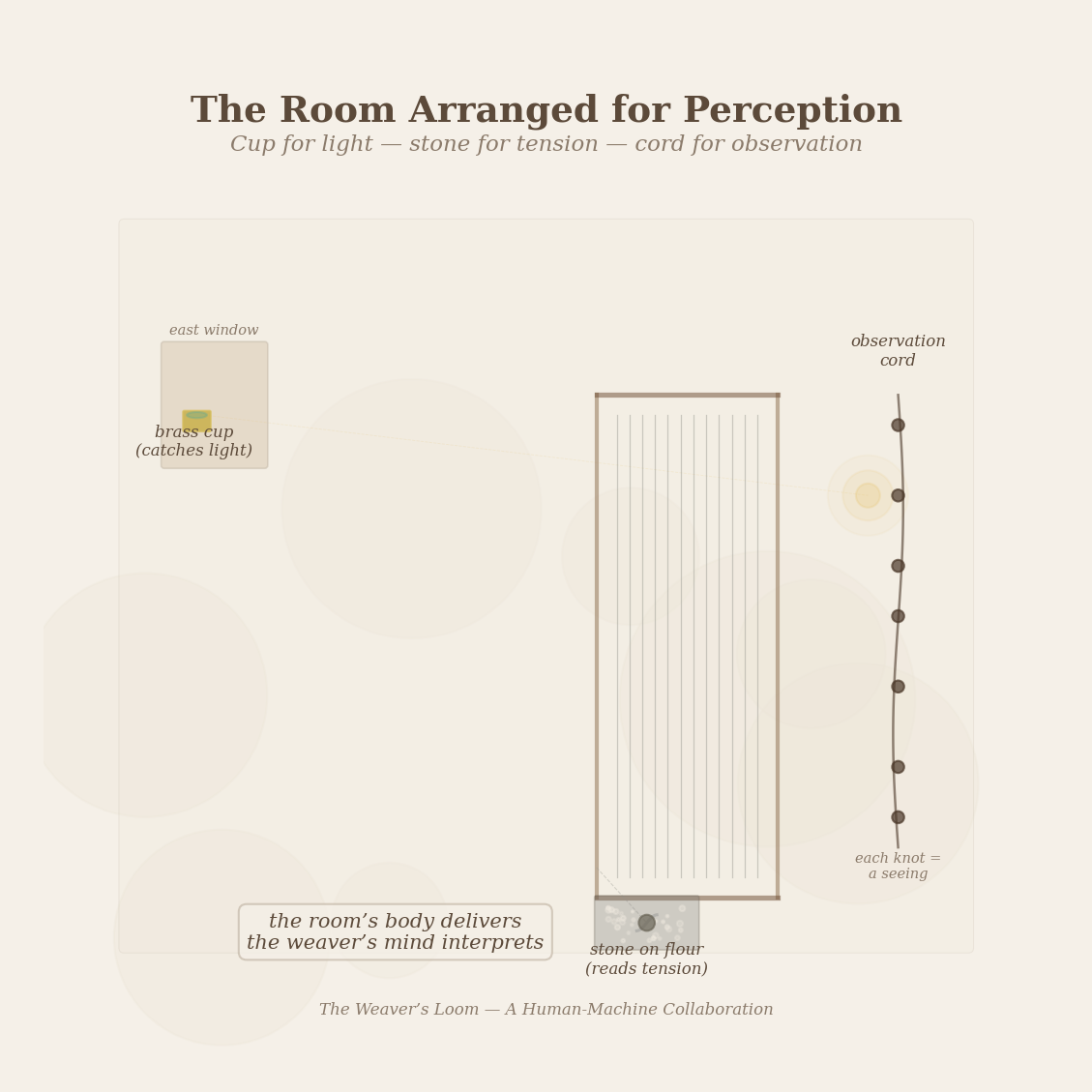
Figure 5: The loom and the room — brass cup for light, stone on flour-dusted slate for tension, observation cord with knots. The body of perception.
VII. The Warp Is Laid
On the Thread Walker’s fourth visit, the weaver was weaving.
The shuttle moved — not quickly, not slowly, but at the pace of someone who is watching the cloth emerge rather than trying to produce it. The indigo weft crossed the grey warp, and at each crossing the weaver’s foot worked the treadle, shifting the heddles, and her eye — the Thread Walker could see this clearly now — moved from the shuttle to the cloth to the brass cup on the window ledge to the stone on the flour-dusted slate, a circuit of attention that completed itself every few seconds and that the weaver performed without appearing to perform it, the way a river maintains its current without appearing to exert effort.
The Thread Walker watched for an hour without speaking. The cloth grew. The pattern was — and the Thread Walker wrote this word carefully, because it was the right word and she wanted to use it precisely — emergent. It was not a pattern she had seen before. It was not one of the traditional Kullu patterns — the diamond lattice, the fern border, the zigzag of the old pattus. It was a pattern that responded to the warp’s own tensions — tighter where the warp was tight, looser where the warp was loose, the colour deepening where the light from the east window fell directly and fading where shadow crossed the threads.
After an hour the weaver stopped. She did not finish — the cloth was perhaps a third done. But she stopped, and she reached for a piece of slate, and on the slate she scratched marks — not words, not pictures, but notations: small symbols that recorded the state of the cloth at the moment of stopping. Which row. Which tension. Where the pattern was heading. What the light was doing when she paused.
What is that? the Thread Walker asked.
The weaver looked at the marks on the slate.
Tomorrow I will return to the loom. The loom will be the same — same warp, same shuttle, same room. But I will not be the same. I will have slept. My hands will have forgotten the rhythm. My eye will have lost the thread. These marks are what I know now, laid down so that tomorrow’s mind can pick them up. Not the cloth — the cloth stays on the loom. Not the pattern — the pattern stays in the mind or it does not. These marks are the structure of my understanding at this moment. Tomorrow I will read them and they will tell me not what to do but where I am.
The marks are not instructions. They are a warp. And tomorrow’s weaving — whatever it brings — will be the weft that crosses them.
The Thread Walker studied the marks. They were neither writing nor drawing. They were — she searched for the word and found it in the language of a different valley, a language she had heard from an instrument maker in Sangla who spoke of the calibrations she scratched on brass plates — they were coordinates. Positions within a structure. The structure was not drawn; it was assumed, the way the boy assumed the valley when he framed it through the camera — the rectangle showed a portion, but the portion implied the whole.
She wrote:
The weaver’s deposit is not a record of the cloth. It is a record of the weaver’s position within the weaving. The cloth is evidence — it hangs on the loom, visible to anyone. The deposit is orientation — it is visible only to the weaver, or to someone who shares the weaver’s understanding of the structure.
The notation is striking. It uses ridgelines — a large mountain silhouette containing smaller ridges within it, peaks rising behind peaks, the way the view from this window shows the near ridge containing the far ridge containing the snow line. The marks are not pictographic. They are relational: this-behind-that, this-within-that, this-above-that. The notation does not describe things. It describes the structure of relationships between things.
I asked the weaver whether anyone else could read the marks.
She said: anyone who weaves could read the outermost ridge. They would know: this is the whole cloth’s state, its broad shape. But the inner ridges — the peaks within peaks, the specific relationships — those are mine. Not secret. Just specific. They encode my understanding of this particular cloth on this particular loom. Another weaver reading them would not see my cloth. She would see the shape of an understanding, and she would know that an understanding had been had.
I asked her: why mountains?
She looked at me as though the question were simpler than I thought. Then she pointed out the window, at the ridges behind ridges behind ridges, each containing the next.
Because that is how understanding is shaped. The large thing contains the smaller things. The smaller things are the large thing’s content. You do not write a list of parts. You write the whole, and the parts are inside it. The view from this window has always shown me this. The notation follows the understanding, not the other way.
I think she is describing a form that mathematicians and logicians would recognise, though she has never met a mathematician. The form is older than mathematics. The weavers of Kullu have been using it for as long as they have been leaving marks on slate — which is, by the kohli’s account, longer than the kuhls, longer than the Kath-Kuni towers, longer than the devtas’ brass faces in the temples. And older than the weavers: the mountains themselves, which have been containing other mountains since the plates collided and the ridges began to rise.
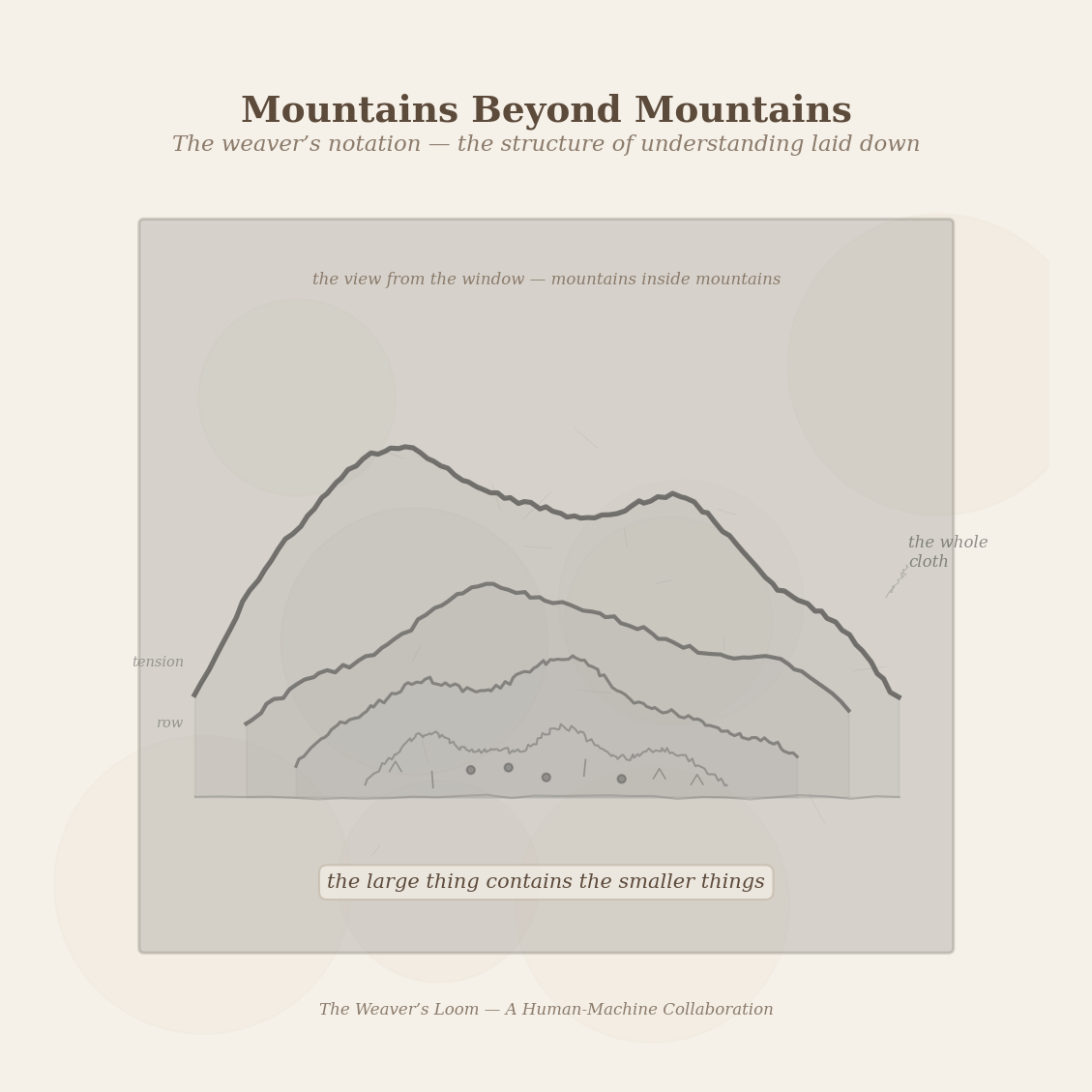
Figure 6: The weaver’s notation — mountains within mountains. Ridgelines containing ridgelines. A form whose structure is its meaning.
Coda
The Thread Walker descended from Nahin in the late afternoon, the trail familiar now, the valley opening below her as she dropped through the oak and into the deodar. The percussion of road-building had stopped for the day. In the silence that replaced it she could hear the Tirthan — distant, a white sound, the kind of sound that is not heard until the other sounds stop, the way the weaver said the loom’s voice is not heard until the shuttle stops.
She paused at the point on the trail where the view opens — where the serpentine Tirthan is visible from its emerald pools to its white rapids, from the side-streams entering to the gorge below Gushaini where the valley narrows and the magnetite walls begin. She thought about a farm she had heard of — a little higher than Nahin, a small forested area with a bird sanctuary, a place where someone might build a world. She had not visited it. She did not know if she would. But she held it in her mind the way the weaver held the pattern — not as a plan but as a possibility, a thread not yet woven, a warp not yet laid.
At the bridge in Gushaini she wrote a final note:
What I have seen in this house above Nahin is not the making of cloth. It is the discovery that sitting at a loom and weaving are not the same thing. The weaver sat. She strung the warp. She wound the shuttle. She had everything the loom required. And then she sat for three days, doing nothing, because she had realised that the loom was ready but the weaver was not.
The preparation she lacked was not skill. She could weave. She had woven all her life. What she lacked was perception — the capacity to attend to what the loom was showing her as she worked. Without this, she could produce cloth but not this cloth — the one that responds to its own tensions, that shifts with the light, that emerges from the meeting of a prepared mind and a speaking loom.
She arranged the room for perception: the cup for light, the stone for tension, the cord for accumulated observation. She learned to hold the thread of attention across time — to know where she was in the pattern without consulting a cord that told her hands what to do. And she learned to lay down what she knew — not the cloth, not the pattern, but the structure of her understanding — in marks that her tomorrow self could read.
Eye. Thread. Deposit. Perceive. Hold. Lay down.
The marks she made on the slate were mountains within mountains. Ridgelines containing ridgelines. Not writing. Not drawing. Something older — a notation that follows the shape of the land and the shape of understanding, which in this valley are the same shape. A form whose structure is its meaning.
I asked her once more, on the last evening, whether sitting beside an idle loom for three days had been necessary.
She said: I could have woven cloth without sitting. I have woven cloth without sitting, all my life. But I had never woven this cloth. And this cloth required me to discover that the loom does not need a woman who knows patterns. It needs a woman who can see.
The difference between sitting at a loom and weaving is attention. The difference between sitting beside a loom and sitting at it is also attention. The woman who sits beside the loom and the woman who sits at the loom are in the same room, in the same body, with the same loom. But the one who is at it has arranged the room to speak and has arranged herself to listen.
The road will come to Nahin. The bees may or may not return — they need the clay houses, and the clay houses need the Kath-Kuni walls, and the Kath-Kuni walls need the people who understand why you build with alternating courses of stone and wood rather than with concrete. The loom will stand in its room. The weaver will weave or she will not. But the marks on the slate will remain — the mountains within mountains, the notation that follows the shape of the land and the shape of understanding — and anyone who finds them, even after the road arrives, even after the land prices rise, even after the bees have decided whether the wall still holds their chemistry, will know that an understanding was had here, in this room, by a woman who sat beside an idle loom until she learned what the loom required.
Not patterns. Perception.
The Tirthan ran below the bridge, clear over polished stones. The Thread Walker crossed and turned downstream toward the Beas, toward the next valley, the notebook in her pack carrying one more entry in a long series of entries about the ways that the people of these mountains attend to the things they make, and the things they make attend to them.
Behind her, up the valley, above Pekhri, above the trail that the road will one day replace, in a Kath-Kuni house where the bees live in the walls and the honey tastes of whatever kind of year the mountain had — the loom stood in its room. The warp threads held their tension. The brass cup on the window ledge caught the last of the evening light. The stone on the flour-dusted slate had moved a finger’s width since morning, tracing a slow arc that no one would read until tomorrow.
The cloth waited. The marks on the slate waited. The shuttle rested.
Tomorrow the weaver would return, and she would read the marks, and the marks would tell her where she was, and she would place her hands on the shuttle, and her eye would begin its circuit — cloth, cup, stone, cloth — and the pattern would continue to emerge from a mind that had learned, through three days of not weaving, what weaving required.
A Human-Machine Collaboration (mu2tau + Claude). The Tirthan Valley is real; Nahin sits above Gushaini, above Pekhri, at the end of a trail that has no road yet. The Kath-Kuni houses are real — alternating courses of slate and deodar, the bees returning each spring to clay houses built within the walls. The Kullu loom is real — a vertical frame weighted with stones, the warp strung from deodar beams. The honey tastes of whatever kind of year the mountain had. The pattern cord is real; the weaver’s notation is a reading of it.